The Gamma-Aminobutyric Acid Type A Receptor
The gamma-aminobutyric acid type A receptor is a ligand-gated chloride channel. When gamma-aminobutyric acid binds to it, the channel opens and chloride ions flow into the neuron, hyperpolarizing the membrane and reducing the likelihood of firing. This is the principal fast inhibitory mechanism in the brain, and it is the target of two major drug classes used in epilepsy: the benzodiazepines and the barbiturates.
Both drug classes enhance gamma-aminobutyric acid type A receptor function, but they do so through different binding sites and by different mechanisms. This mechanistic difference produces different clinical effects and different risk profiles, and it is one of the most tested distinctions in pharmacology at the second-year level.
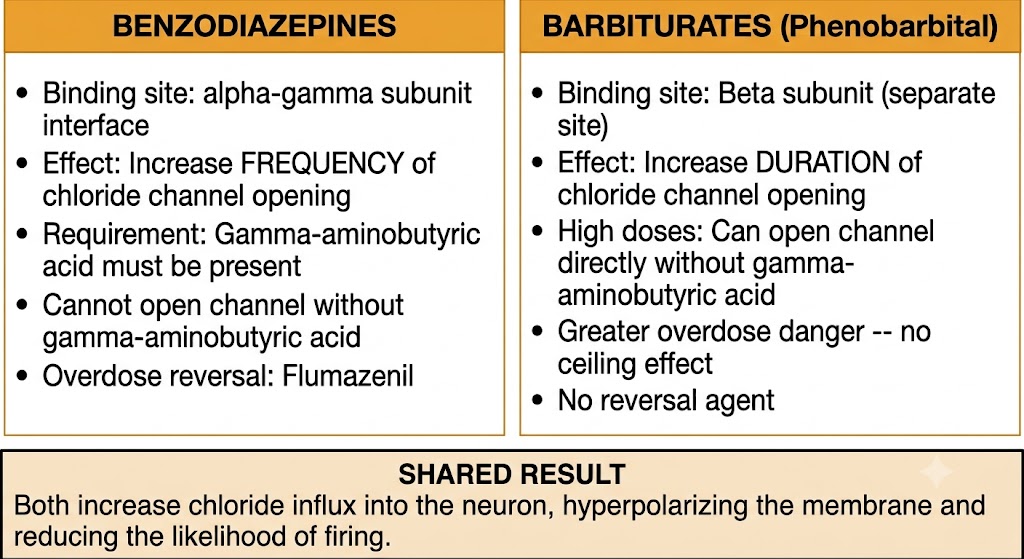
- Benzodiazepines — bind at the interface between alpha and gamma subunits; increase the frequency of chloride channel opening in response to gamma-aminobutyric acid; require gamma-aminobutyric acid to be present to work (they are allosteric modulators, not direct agonists)
- Barbiturates — bind at a separate site on the beta subunit; increase the duration of chloride channel opening; at high doses can directly open the channel without gamma-aminobutyric acid present
The direct channel-opening ability of barbiturates at high doses explains why barbiturate overdose is substantially more dangerous than benzodiazepine overdose — barbiturates can produce complete central nervous system and respiratory depression independent of endogenous gamma-aminobutyric acid tone.
Benzodiazepines
Benzodiazepines are among the most widely used drugs in medicine, with applications spanning anxiety, insomnia, alcohol withdrawal, procedural sedation, and epilepsy. In epilepsy, their role is primarily acute rather than chronic — they are the drugs of first choice for terminating an ongoing seizure, not for preventing seizures long-term. Tolerance to their anti-seizure effect develops rapidly with regular use, limiting their utility for chronic seizure prophylaxis.
Three benzodiazepines are particularly important in epilepsy, each occupying a different clinical niche based on its route of administration and duration of action.
- Intravenous first-line for status epilepticus
- Preferred over diazepam for status because it has a longer duration of central nervous system action despite similar plasma half-life
- Less redistribution to fat than diazepam → more sustained brain levels
- Intravenous or rectal gel for acute seizure rescue
- Rapid onset but shorter duration of anti-seizure effect due to redistribution
- Rectal formulation useful when intravenous access unavailable (home rescue)
- Oral; used for chronic seizure management
- Particularly useful for myoclonic seizures and absence seizures
- Long half-life supports twice-daily dosing
- Tolerance limits long-term utility in some patients
- Sedation, cognitive impairment, anterograde amnesia
- Respiratory depression — especially with opioids or alcohol
- Tolerance to anti-seizure effect with chronic use
- Physical dependence; abrupt withdrawal can precipitate seizures
- Flumazenil reverses benzodiazepine toxicity (competitive antagonist)
Phenobarbital and Primidone
Phenobarbital is the oldest anti-seizure drug in continuous clinical use, introduced in 1912. Despite its age, it remains relevant because it is effective, inexpensive, and widely available — particularly important in resource-limited settings. Its mechanism is barbiturate-class: it increases the duration of chloride channel opening at the gamma-aminobutyric acid type A receptor, and at high doses it can directly activate the channel.
Phenobarbital is a potent inducer of cytochrome P450 enzymes, creating broad drug interactions similar to those of carbamazepine and phenytoin. It reduces the plasma levels of many co-administered drugs including other anti-seizure drugs, warfarin, and oral contraceptives.
- Neonatal seizures — first-line; the only drug with robust evidence in this setting
- Focal and generalized tonic-clonic seizures in adults and children
- Third-line agent in status epilepticus after benzodiazepines and fosphenytoin/valproate/levetiracetam fail
- Resource-limited settings where newer drugs are unavailable
- Sedation and cognitive impairment — often treatment-limiting, especially in children
- Hyperactivity and behavioral problems in children (paradoxical)
- Tolerance and physical dependence
- Cytochrome P450 induction — broad drug interactions
- Teratogenicity — avoid in pregnancy when alternatives exist
Primidone is metabolized to phenobarbital as its primary active metabolite. For clinical purposes, primidone can be thought of as a prodrug for phenobarbital — its anti-seizure effects are largely attributable to the phenobarbital it generates after metabolism. Primidone itself also has some direct anti-seizure activity, but the phenobarbital contribution dominates.
Clinical Use in Status Epilepticus
Status epilepticus is defined as a continuous seizure lasting more than five minutes, or two or more seizures without recovery of consciousness between them. It is a neurological emergency requiring immediate treatment. The treatment protocol follows a stepwise sequence, with gamma-aminobutyric acid-enhancing drugs as both the first and last pharmacological intervention.
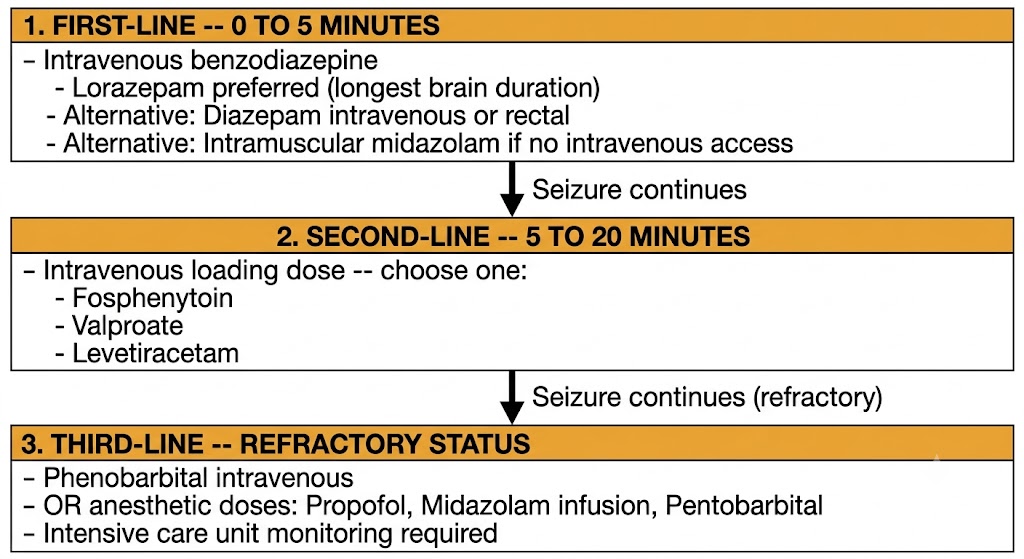
First-line (0–5 minutes): Intravenous benzodiazepine. Lorazepam is preferred (longer duration of action at the brain). Diazepam intravenous or rectal is an alternative when lorazepam is unavailable. Intramuscular midazolam is acceptable when intravenous access cannot be established quickly.
Second-line (5–20 minutes, if seizure continues): Intravenous fosphenytoin, valproate, or levetiracetam. These are given as loading doses and work more slowly than benzodiazepines but provide longer-lasting seizure suppression.
Third-line (refractory status epilepticus): Phenobarbital intravenous, or anesthetic doses of propofol, midazolam infusion, or pentobarbital with continuous electroencephalogram monitoring in an intensive care unit.
The reason benzodiazepines are first-line for status epilepticus is speed — they reach the brain within minutes of intravenous administration and rapidly suppress seizure activity. Their limitation is duration: redistribution reduces brain levels over 20 to 30 minutes, which is why second-line agents with longer action are added even when the benzodiazepine initially terminates the seizure.
Adverse Effects, Tolerance, and Dependence
Both benzodiazepines and barbiturates produce a spectrum of central nervous system depression proportional to dose — from sedation and anxiolysis at low doses, through hypnosis and anticonvulsant effects at moderate doses, to anesthesia and respiratory depression at high doses. Barbiturates extend further along this spectrum and can produce fatal respiratory depression at doses not far above the therapeutic range, which is why they have been largely replaced by benzodiazepines for anxiety and insomnia despite being introduced decades earlier.
Both classes produce physical dependence with regular use. Abrupt discontinuation after prolonged use can trigger a withdrawal syndrome that includes anxiety, tremor, sweating, and — most seriously — seizures. This withdrawal seizure risk applies even in patients who originally took the drug for non-epilepsy indications such as anxiety or insomnia. Tapering rather than abrupt discontinuation is required after prolonged use of either class.
Benzodiazepine overdose — sedation and respiratory depression; can be reversed with flumazenil, a competitive antagonist at the benzodiazepine binding site on the gamma-aminobutyric acid type A receptor. Flumazenil has a shorter half-life than most benzodiazepines, so re-sedation can occur after reversal and monitoring is required.
Barbiturate overdose — more severe respiratory and cardiovascular depression; no specific reversal agent. Treatment is supportive. This asymmetry in reversibility is a major reason benzodiazepines have replaced barbiturates for most non-epilepsy indications.