Ethosuximide and Absence Seizures
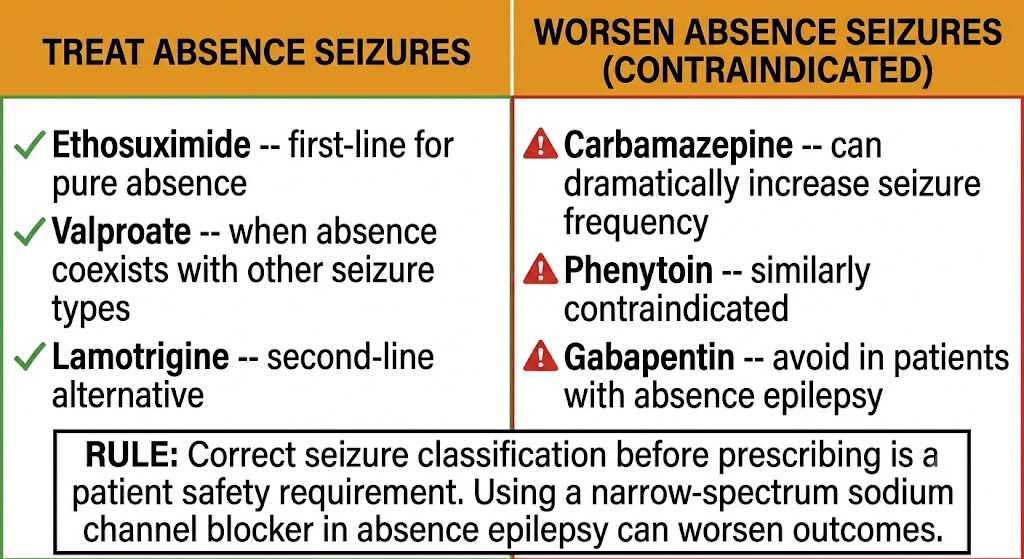
Ethosuximide occupies a singular clinical niche: it is the drug of first choice for childhood absence epilepsy when no other seizure type is present. Its mechanism is unusually selective — it blocks T-type voltage-gated calcium channels in thalamic relay neurons, interrupting the rhythmic thalamocortical oscillation that generates the three-per-second spike-and-wave discharge characteristic of absence seizures.
This thalamic calcium channel specificity explains both ethosuximide's strength and its limitation. The drug suppresses absence seizures with an efficacy comparable to valproate but without valproate's toxicity. However, because it has no activity at sodium channels and no effect on gamma-aminobutyric acid type A receptors, it provides no protection against tonic-clonic or myoclonic seizures. When a patient with childhood absence epilepsy also has generalized tonic-clonic seizures — a common combination — ethosuximide alone is insufficient and valproate is preferred.
Several commonly used anti-seizure drugs are contraindicated in absence epilepsy because they can increase absence seizure frequency. The mechanism is suppression of cortical excitability in a way that paradoxically facilitates the thalamocortical rhythm underlying absence. The three most important are:
- Carbamazepine — contraindicated in absence epilepsy; can dramatically worsen seizure frequency
- Phenytoin — similarly contraindicated; same mechanism of worsening
- Gabapentin — can worsen absence seizures; avoid in patients with known or suspected absence epilepsy
Prescribing any of these to a patient with unrecognized absence epilepsy — for example, treating what appears to be anxiety or neuropathic pain with gabapentin in a child with undiagnosed absence epilepsy — can substantially increase seizure burden.
Levetiracetam
Levetiracetam has become one of the most widely prescribed anti-seizure drugs because it combines broad-spectrum efficacy, a favorable drug interaction profile, and simple pharmacokinetics. Its mechanism is unique among anti-seizure drugs: it binds synaptic vesicle protein 2A, a protein involved in regulating neurotransmitter release from presynaptic vesicles. This is not a sodium channel, calcium channel, gamma-aminobutyric acid receptor, or glutamate receptor mechanism — it is a completely separate molecular target.
The practical consequence of this mechanism is that levetiracetam does not interact with cytochrome P450 enzymes. It is not a cytochrome P450 inducer or inhibitor, and it is not itself metabolized by cytochrome P450. This gives it a clean drug interaction profile compared to the older agents — an important advantage in patients taking multiple medications.
- Broad spectrum — focal, generalized tonic-clonic, myoclonic, absence
- First-line or adjunctive for many seizure types
- Preferred in pregnancy over older agents (lower teratogenic risk)
- Renal elimination — no hepatic metabolism; dose adjustment needed in renal impairment
- No cytochrome P450 interactions
The most distinctive adverse effects of levetiracetam are psychiatric and behavioral rather than sedating or cognitive:
- Irritability and agitation — the most common behavioral complaint
- Aggression — can be severe enough to require drug discontinuation
- Depression and mood changes
- Psychosis — rare but reported
These psychiatric effects, not sedation, are levetiracetam's primary clinical liability and the main reason patients discontinue it.
Topiramate
Topiramate is a broad-spectrum anti-seizure drug with an unusually diverse mechanistic profile. It blocks sodium channels, enhances gamma-aminobutyric acid type A receptor activity, inhibits glutamate at alpha-amino-3-hydroxy-5-methyl-4-isoxazolepropionic acid receptors, and inhibits carbonic anhydrase. This last mechanism is responsible for two of its most clinically significant adverse effects.
- Sodium channel blockade — contributes to focal and tonic-clonic seizure suppression
- Gamma-aminobutyric acid type A enhancement — enhances inhibitory neurotransmission
- Glutamate inhibition — blocks alpha-amino-3-hydroxy-5-methyl-4-isoxazolepropionic acid receptors, reducing excitatory transmission
- Carbonic anhydrase inhibition — produces metabolic acidosis and promotes kidney stone formation
- Focal seizures (adjunctive and monotherapy)
- Generalized tonic-clonic seizures
- Lennox-Gastaut syndrome
- Migraine prophylaxis
- Used in combination with phentermine for obesity
- Cognitive impairment — word-finding difficulty, slowed thinking; the "Dopamax" nickname reflects how commonly this occurs
- Weight loss — often used therapeutically
- Kidney stones — from carbonic anhydrase inhibition; adequate hydration required
- Metabolic acidosis — monitor bicarbonate levels
- Teratogenicity — cleft palate and lip; avoid in pregnancy
- Acute angle-closure glaucoma — rare but requires prompt discontinuation
Gabapentin and Pregabalin
Gabapentin and pregabalin are structurally related to gamma-aminobutyric acid, and their names imply a gamma-aminobutyric acid mechanism. This is misleading. Neither drug acts at gamma-aminobutyric acid receptors. Instead, both bind to the alpha-2-delta subunit of voltage-gated calcium channels, reducing calcium influx at presynaptic terminals and decreasing neurotransmitter release. The name is a historical artifact, not a mechanistic description — and the gap between name and mechanism is one of the highest-yield distinctions tested at the second-year level.
Gabapentin and pregabalin are not gamma-aminobutyric acid receptor agonists. They do not bind to gamma-aminobutyric acid type A or gamma-aminobutyric acid type B receptors. They do not increase gamma-aminobutyric acid levels. Their mechanism is alpha-2-delta subunit binding on voltage-gated calcium channels. A question asking which drug "acts at gamma-aminobutyric acid receptors" should never have gabapentin or pregabalin as the correct answer.
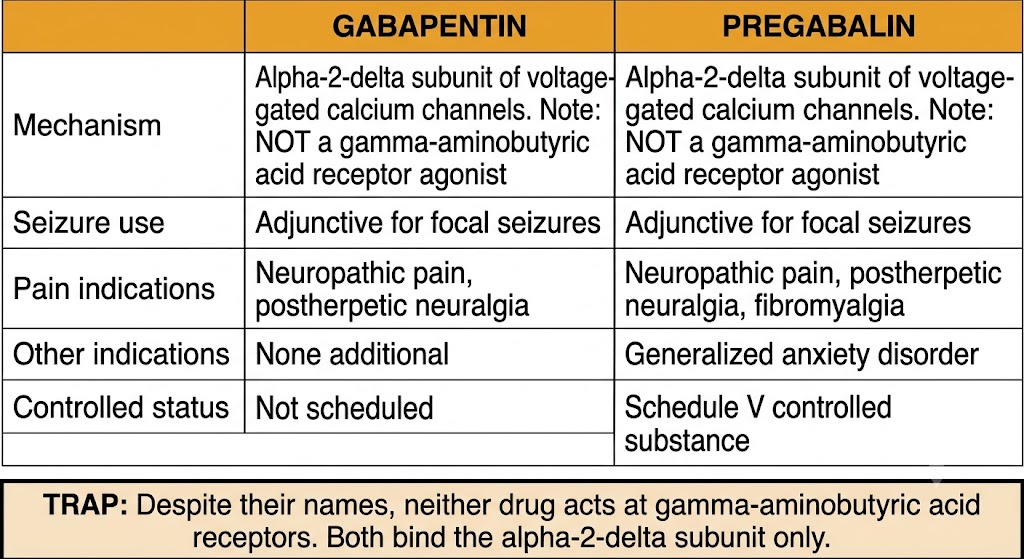
- Adjunctive for focal seizures
- Neuropathic pain — diabetic neuropathy, postherpetic neuralgia
- Not scheduled (no federal controlled substance scheduling)
- Non-linear absorption — higher doses absorbed less efficiently
- Minimal drug interactions
- Worsens absence seizures — contraindicated in absence epilepsy
- Same mechanism as gabapentin — higher potency
- Focal seizures (adjunctive)
- Neuropathic pain, postherpetic neuralgia, fibromyalgia
- Generalized anxiety disorder
- Schedule V controlled substance — abuse potential recognized
- More linear absorption than gabapentin
Comparative Summary
The five drugs in this module cover a wide range of mechanisms and clinical niches. The single most important distinguishing fact for each is worth stating plainly before moving to the next chapter.
- Ethosuximide — T-type calcium channel blocker; first-line for pure childhood absence epilepsy; no efficacy against tonic-clonic or myoclonic seizures
- Levetiracetam — synaptic vesicle protein 2A modulator; no cytochrome P450 interactions; primary adverse effects are behavioral (irritability, aggression), not sedation
- Topiramate — multiple mechanisms including carbonic anhydrase inhibition; cognitive impairment ("Dopamax") is the primary dose-limiting adverse effect; kidney stones and teratogenicity are additional concerns
- Gabapentin — alpha-2-delta subunit ligand, not a gamma-aminobutyric acid agonist; worsens absence seizures; used for neuropathic pain and focal seizures
- Pregabalin — same mechanism as gabapentin at higher potency; Schedule V controlled substance; additionally approved for fibromyalgia and generalized anxiety disorder