Status Epilepticus — Drug Selection Rationale
Status epilepticus is defined as a continuous seizure lasting more than five minutes, or two or more seizures without recovery of consciousness between them. The sequential treatment protocol covered in Module 4 follows a logic that is worth understanding at the pharmacological level, not just memorizing as a list.
Benzodiazepines are first-line because they are the fastest-acting agents available — intravenous lorazepam reaches effective brain concentrations within minutes. Their limitation is redistribution: as drug moves from the brain into fat and muscle, brain levels fall over 20 to 30 minutes. This redistribution explains why a second agent is always given even when the benzodiazepine terminates the initial seizure — without a longer-acting drug on board, seizures frequently recur.
The second-line agents — fosphenytoin, valproate, and levetiracetam — work more slowly but provide durable seizure suppression over hours. Fosphenytoin blocks sodium channels; valproate works through multiple mechanisms; levetiracetam modulates synaptic vesicle protein 2A. All three are given as intravenous loading doses. The choice among them depends on patient factors: valproate is avoided in pregnancy and in patients with liver disease; fosphenytoin is avoided in patients with cardiac arrhythmias; levetiracetam has the fewest contraindications but the least established evidence base in status epilepticus.
- Focal onset seizures — carbamazepine, lamotrigine, levetiracetam, oxcarbazepine, lacosamide; any of these is appropriate first-line
- Generalized tonic-clonic — valproate, lamotrigine, levetiracetam, topiramate; broad-spectrum agents preferred
- Absence — ethosuximide (pure absence) or valproate (mixed); avoid carbamazepine, phenytoin, gabapentin
- Myoclonic — valproate first-line; levetiracetam alternative; avoid sodium channel blockers
- Juvenile myoclonic epilepsy — valproate first-line (covers all three seizure types); levetiracetam or lamotrigine if valproate not appropriate
Epilepsy in Pregnancy
Managing epilepsy in pregnancy requires balancing two competing risks: the risk of fetal harm from the anti-seizure drug, and the risk of fetal harm from uncontrolled maternal seizures. Generalized tonic-clonic seizures during pregnancy cause maternal hypoxia, acidosis, and physical trauma that independently harm the fetus. Neither risk can be ignored, and stopping medication in pregnancy is not automatically the safer choice.
The goal is effective seizure control at the lowest effective dose of the drug with the lowest teratogenic risk that controls the patient's seizures. This almost always means continuing therapy rather than stopping, while optimizing drug choice and dose.
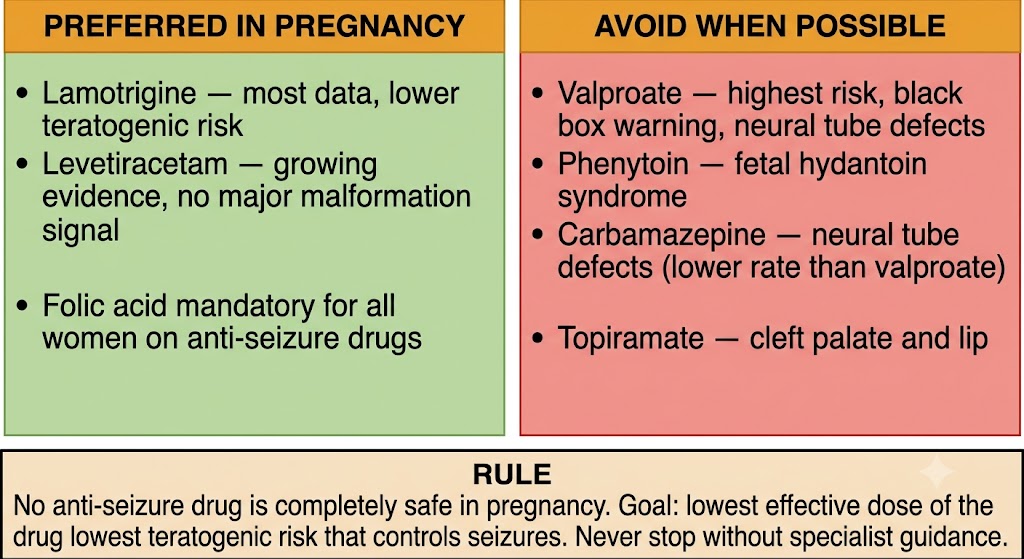
- Lamotrigine — lower teratogenic risk than older agents; most data supporting use in pregnancy; levels rise during pregnancy, requiring monitoring and dose adjustment
- Levetiracetam — growing evidence base; no major malformation signal in registry data; preferred when lamotrigine is not suitable
- Valproate — highest teratogenic risk; neural tube defects and neurodevelopmental impairment; black box warning; avoid as first-line in women of childbearing potential
- Phenytoin — fetal hydantoin syndrome; avoid when alternatives exist
- Carbamazepine — neural tube defects; lower risk than valproate but still significant
- Topiramate — cleft palate and lip; avoid
All women with epilepsy who are pregnant or planning pregnancy should receive folic acid supplementation. Anti-seizure drugs, particularly valproate and carbamazepine, interfere with folate metabolism and increase the risk of neural tube defects. High-dose folic acid (4 to 5 mg daily, compared to the standard 0.4 mg) is recommended for women taking valproate or carbamazepine. Supplementation reduces but does not eliminate the teratogenic risk. It should begin before conception when pregnancy is planned.
Epilepsy in the Elderly
Epilepsy in the elderly presents different pharmacological challenges than epilepsy in younger adults. Older patients typically have reduced renal function, lower albumin (affecting protein-bound drug levels), reduced hepatic metabolic capacity, and a higher likelihood of being on multiple medications for other conditions. These factors together make the older anti-seizure drugs — phenytoin, carbamazepine, and phenobarbital — harder to use safely in this population.
Phenytoin is particularly problematic in elderly patients. Its zero-order kinetics make dosing unpredictable at baseline, and hypoalbuminemia in elderly patients means more free (active) drug at any given total plasma level, increasing toxicity risk. Carbamazepine's cytochrome P450 induction creates broad drug interactions with the cardiovascular, anticoagulant, and other medications elderly patients commonly take.
- Lamotrigine — well-tolerated, fewer drug interactions than older agents, effective for focal seizures which predominate in the elderly
- Levetiracetam — no cytochrome P450 interactions; dose reduction needed with renal impairment
- Gabapentin — minimal interactions; useful for comorbid neuropathic pain; dose reduction with renal impairment
- Phenytoin — unpredictable kinetics worsen with hypoalbuminemia; fall risk from ataxia; broad interactions
- Carbamazepine — hyponatremia risk increases with age; broad cytochrome P450 interactions; cardiac effects
- Phenobarbital — sedation and cognitive impairment poorly tolerated; fall risk
- Benzodiazepines — fall risk; cognitive impairment; paradoxical agitation
Neonatal and Pediatric Seizures
Neonatal seizures are a distinct clinical entity from epilepsy in older children and adults. They are often caused by acute brain injury — hypoxic-ischemic encephalopathy, metabolic disturbances, infection, or structural abnormalities — rather than by a chronic epilepsy syndrome. Phenobarbital remains the drug of first choice for neonatal seizures, despite its sedation burden, because it has the strongest evidence base in this population and is widely available. Levetiracetam is increasingly used as an alternative or adjunct, but phenobarbital remains the standard first-line agent in most centers.
- Childhood absence epilepsy — ethosuximide first-line (pure absence); valproate if tonic-clonic seizures also present; avoid carbamazepine and phenytoin
- Juvenile myoclonic epilepsy — valproate first-line; levetiracetam or lamotrigine if valproate not appropriate (particularly in adolescent females given teratogenicity)
- Lennox-Gastaut syndrome — multiple drug-resistant seizure types; valproate, lamotrigine, topiramate, clobazam; often requires polypharmacy
- Focal epilepsy in children — carbamazepine, oxcarbazepine, lamotrigine, levetiracetam; same principles as adults
Behavioral adverse effects of anti-seizure drugs are particularly important to monitor in children. Levetiracetam's irritability and aggression can be especially disruptive in school-age children. Phenobarbital causes sedation and, paradoxically, hyperactivity in a substantial proportion of children, often leading to discontinuation. Topiramate's cognitive effects can impair learning and academic performance.
Drug Selection Summary Across Populations
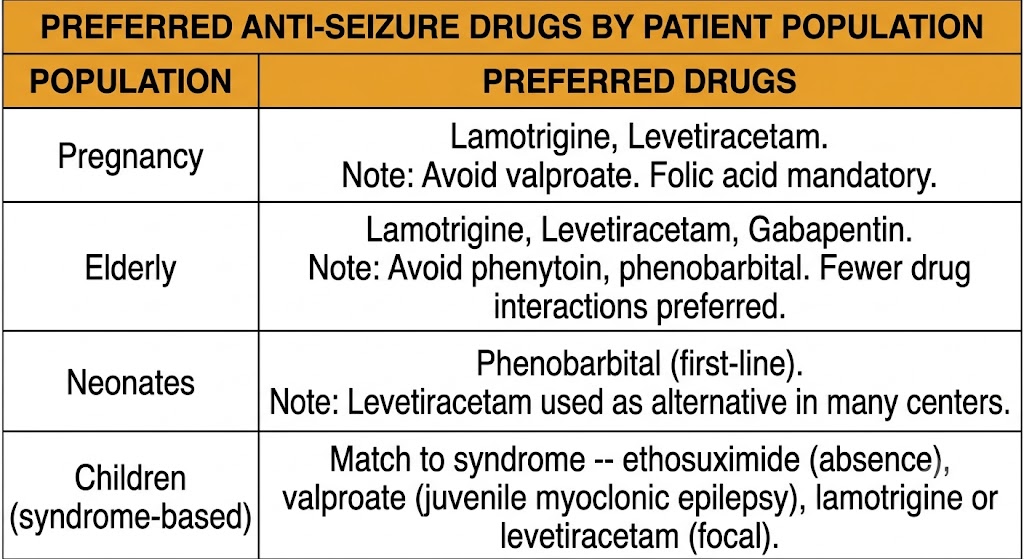
Drug selection in epilepsy is governed by three overlapping considerations: the seizure type (which determines which drugs are pharmacologically appropriate), the epilepsy syndrome (which may point to a preferred first-line agent), and the patient's individual characteristics (pregnancy, age, comorbidities, and other medications). The following principles apply across all populations.
- Match drug to seizure type first — using a narrow-spectrum drug in generalized epilepsy (or one that worsens absence in an absence patient) is a fundamental error
- Women of childbearing potential — avoid valproate as first-line; prefer lamotrigine or levetiracetam; counsel about teratogenic risk of all anti-seizure drugs; prescribe folic acid
- Elderly patients — prefer agents with fewer drug interactions and more predictable kinetics; lamotrigine and levetiracetam are generally better tolerated than phenytoin, carbamazepine, or phenobarbital
- Neonates — phenobarbital remains first-line despite sedation burden
- Drug interactions matter at every age — phenytoin, carbamazepine, and phenobarbital are all cytochrome P450 inducers; valproate is an inhibitor; levetiracetam and lamotrigine have the cleanest profiles