Protease inhibitors (PIs) block the HIV-1 aspartyl protease, the enzyme that cleaves the Gag and Gag-Pol polyproteins into mature structural and enzymatic proteins after virion budding. Without protease activity, newly budded virions are morphologically immature and non-infectious. PIs require pharmacokinetic boosting to reach therapeutic plasma concentrations.
PIs are peptidomimetic compounds that bind the protease active site and block substrate cleavage. Because protease acts after virion budding, PIs cause release of non-infectious immature particles — a mechanistic distinction from RT and integrase inhibitors that block earlier steps.
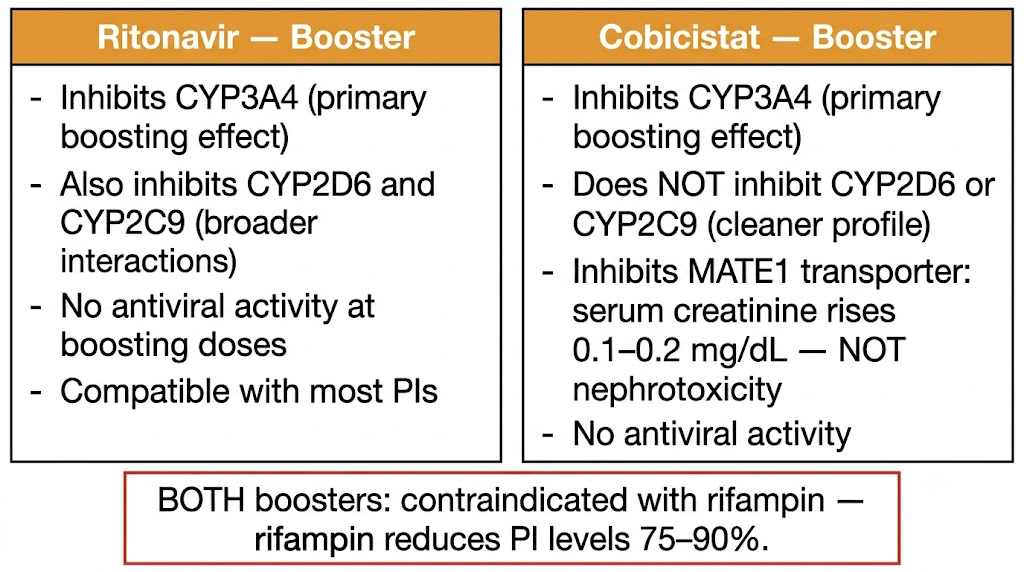
All clinically used PIs are extensively metabolized by cytochrome P450 3A4 (CYP3A4) and are substrates of P-glycoprotein (P-gp). Without pharmacokinetic enhancement, oral bioavailability is low and variable. Pharmacokinetic boosting uses the potent CYP3A4 and P-gp inhibitory activity of low-dose ritonavir (100–200 mg) or cobicistat (150 mg) to dramatically raise co-administered PI plasma concentrations, extending half-lives and enabling once- or twice-daily dosing. Ritonavir at boosting doses provides no meaningful antiviral activity itself. Cobicistat was developed specifically as a booster without intrinsic antiviral activity. However, cobicistat inhibits renal tubular secretion of creatinine, producing a predictable serum creatinine rise of approximately 0.1–0.2 mg/dL that does not reflect true nephrotoxicity — this must not be misinterpreted as renal impairment.
Both inhibit CYP3A4 to boost PI concentrations. Ritonavir additionally inhibits CYP2D6 and CYP2C9 — a broader interaction profile. Cobicistat inhibits MATE1, causing a serum creatinine artifact of 0.1–0.2 mg/dL with no true glomerular filtration rate (GFR) change; use cystatin C-based eGFR when true renal function is needed. Neither booster should be combined with the other, and both are incompatible with rifampin.
Darunavir (DRV) is the preferred PI in current guidelines. Boosted with ritonavir (800/100 mg once daily in treatment-naive patients) or cobicistat (800/150 mg once daily), darunavir has an exceptionally high genetic resistance barrier: at least three major PI resistance mutations must accumulate simultaneously for clinical failure. It binds the protease active site through an extensive hydrogen bond network with the protease backbone that is disrupted only by multiple simultaneous active-site mutations. Atazanavir (ATV) was the first once-daily PI and is distinguished by inhibition of uridine diphosphate glucuronosyltransferase 1A1 (UGT1A1), causing unconjugated hyperbilirubinemia and scleral icterus in up to 10% of patients — benign and reversible but a common reason for regimen switching. Atazanavir also causes nephrolithiasis from atazanavir crystal deposition in approximately 1–3% of long-term users.
| PI Agent | Resistance Barrier | Distinctive Toxicity | Key Interaction |
|---|---|---|---|
| Darunavir/r or /c | Very high | Rash (sulfonamide moiety); GI | Rifampin contraindicated; reduce statins |
| Atazanavir/r or /c | Moderate | Unconjugated hyperbilirubinemia; nephrolithiasis | PPIs: unboosted ATV contraindicated |
| Lopinavir/ritonavir | Moderate | GI intolerance; dyslipidemia; QTc prolongation | Rifampin contraindicated |
The toxicity profile of PIs extends beyond individual agent effects. As a class, boosted PIs are associated with dyslipidemia, insulin resistance, and a drug interaction burden — mediated through booster-driven CYP3A4 inhibition — that is the most extensive of any antiretroviral drug class. The statin interaction is a classic high-stakes example that every prescriber must know.
PI-associated dyslipidemia is most pronounced with lopinavir/ritonavir (LPV/r), which can raise triglycerides 2–5-fold and low-density lipoprotein (LDL) cholesterol by 20–40%. Darunavir-based regimens produce substantially less dyslipidemia. The mechanism involves inhibition of hepatic lipid metabolism and upregulation of lipogenic pathways. Statin management in patients on boosted PI regimens requires careful attention: simvastatin and lovastatin are absolutely contraindicated because CYP3A4 inhibition by the booster raises their plasma concentrations up to 50-fold, producing catastrophic myopathy and rhabdomyolysis risk. Atorvastatin may be used cautiously at the lowest effective dose. Rosuvastatin and pravastatin are the preferred statins with boosted PIs — rosuvastatin is not CYP3A4-metabolized, and pravastatin is the safest choice with lopinavir/ritonavir.
Simvastatin and lovastatin are absolutely contraindicated with boosted PI regimens. CYP3A4 inhibition raises simvastatin concentrations up to 50-fold — catastrophic myopathy and rhabdomyolysis risk. Use rosuvastatin or pravastatin. Atorvastatin may be used at the lowest effective dose with monitoring.
The drug interaction landscape of boosted PIs is the most complex in antiretroviral pharmacology. Boosted PIs raise concentrations of any CYP3A4 substrate co-administered. Key interactions include: immunosuppressants (cyclosporine, tacrolimus, sirolimus concentrations increase dramatically — critical in transplant patients); rifabutin (dose must be reduced from 300 mg to 150 mg every other day); direct oral anticoagulants (DOACs) such as rivaroxaban and apixaban are contraindicated due to combined CYP3A4 and P-gp inhibition; voriconazole is paradoxically reduced rather than raised by ritonavir-boosted PIs; and combined oral contraceptives require additional or alternative contraception. Rifampin is contraindicated with all boosted PIs — it reduces PI area under the concentration-time curve (AUC) by 75–90%, entirely negating the pharmacokinetic boosting strategy.
PI resistance mutations cluster in the protease active site and flanking regions. Major mutations directly impair inhibitor binding; minor mutations restore viral fitness. Darunavir resistance requires at least three major PI resistance mutations to accumulate simultaneously for clinical failure. Cross-resistance among PIs is extensive; once five or more major mutations accumulate, susceptibility to all available PIs is substantially reduced and the class should be abandoned in favor of other drug classes.
Integrase strand transfer inhibitors (INSTIs) are the cornerstone of current preferred first-line antiretroviral therapy (ART). They block the strand transfer step of HIV integration, have minimal off-target toxicity, and — for second-generation agents dolutegravir and bictegravir — present a resistance barrier so high that virologic failure with resistance selection is rare even with suboptimal adherence.
HIV integrase performs two sequential reactions: 3′-processing (removing two nucleotides from each 3′ end of viral DNA in the cytoplasm) and strand transfer (inserting the processed viral DNA into host chromosomal DNA in the nucleus). INSTIs chelate two magnesium ions in the integrase active site, specifically blocking the strand transfer step.
Raltegravir (RAL) was the first approved INSTI. It is dosed twice daily (short plasma half-life) and eliminated primarily by UGT1A1-mediated glucuronidation without significant cytochrome P450 (CYP) involvement. Its low genetic resistance barrier — a single mutation at any of three pathways confers significant resistance — limits its use when higher-barrier agents are available. It retains importance in pregnancy (most safety data of any INSTI) and in patients with severe hepatic impairment (where dolutegravir data are limited). Elvitegravir (EVG) requires cobicistat boosting and is available only in fixed-dose combinations (Stribild: EVG/cobicistat/TDF/FTC; Genvoya: EVG/cobicistat/TAF/FTC), inheriting cobicistat's full interaction burden including the creatinine artifact.
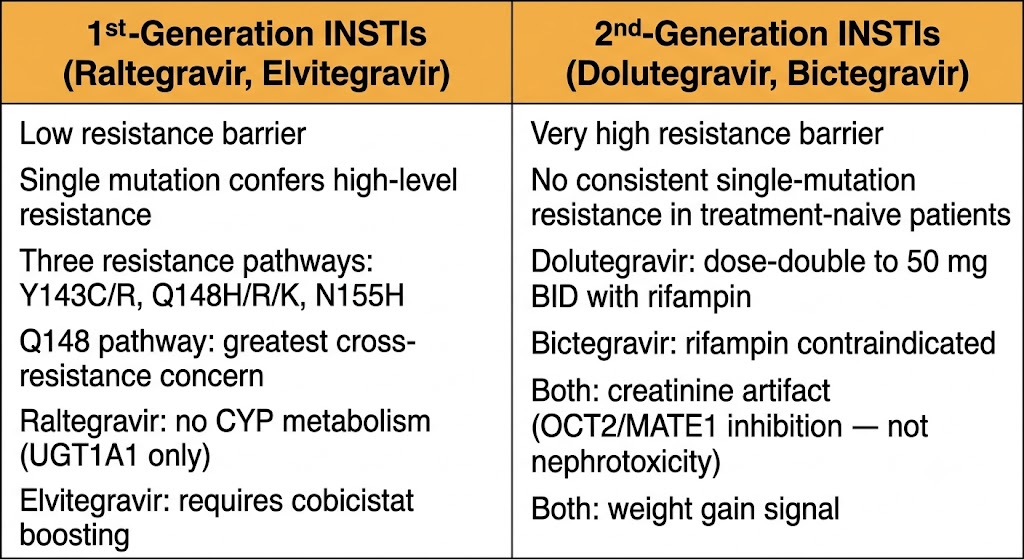
Dolutegravir (DTG) is a second-generation INSTI with a substantially higher genetic resistance barrier than raltegravir or elvitegravir. Clinically meaningful resistance to dolutegravir in treatment-naive patients is extraordinarily rare. Dolutegravir is metabolized primarily by UGT1A1 with minor CYP3A4 contribution; it inhibits renal tubular secretion of creatinine, producing the same creatinine artifact as cobicistat. Bictegravir (BIC), available only as Biktarvy (BIC/TAF/FTC), has a resistance profile equivalent to dolutegravir with no clinically relevant treatment-emergent resistance in phase 3 trials.
An early signal from the Tsepamo study in Botswana (2018) suggested increased neural tube defect (NTD) risk with periconceptional dolutegravir (~0.9% vs ~0.1% background). Subsequent larger analyses show NTD rates with dolutegravir of approximately 0.19%, no longer statistically significantly different from background. Current guidelines accept dolutegravir throughout pregnancy including at conception, but this should be discussed with patients of childbearing potential when selecting a regimen.
Weight gain associated with INSTI-based regimens has emerged as a clinically significant concern. Pooled analyses from switch trials show patients switching to INSTI-based regimens gain an average of 2–4 kg over 48–96 weeks, with greater weight gain seen when INSTIs are combined with TAF rather than TDF. The mechanism likely involves a combination of immune reconstitution effects (return-to-health phenomenon), direct metabolic effects of integrase inhibition, and elimination of TDF-mediated appetite suppression. Women and persons of African ancestry appear to experience greater INSTI-associated weight gain in current data.
Despite the high resistance barriers of second-generation INSTIs, two interaction categories require careful management in all patients: polyvalent cation chelation (the most commonly missed INSTI interaction) and rifamycin co-administration. Pregnancy and hepatic impairment also require agent-specific consideration within the class.
INSTI resistance pathways differ by generation. Raltegravir and elvitegravir have three independent resistance pathways, each requiring only a single primary mutation for significant resistance. One of these pathways, when combined with accessory mutations, can also reduce dolutegravir susceptibility — the main clinical concern when a second-generation INSTI is planned after first-generation failure. For dolutegravir and bictegravir, no consistent resistance pathway has emerged in treatment-naive patients.
The most clinically important drug interaction for all INSTIs is chelation with polyvalent metal cations. The diketo acid pharmacophore that chelates Mg2+ in the integrase active site also chelates dietary and supplemental divalent and trivalent cations (Ca2+, Mg2+, Al3+, Fe2+/3+, Zn2+) in the gastrointestinal (GI) tract, forming insoluble complexes that dramatically reduce INSTI absorption. Antacids containing magnesium or aluminum, calcium supplements, and iron supplements must be separated from INSTI dosing. For dolutegravir and raltegravir, cation-containing products must be separated by at least 2 hours before or 6 hours after the INSTI dose. Bictegravir may be taken with calcium- or iron-containing supplements if taken with food. This interaction is frequently missed in clinical practice because patients on ART — especially those with TDF-related bone loss — are commonly prescribed calcium and vitamin D supplementation.
Calcium, magnesium, iron, and aluminum supplements and antacids dramatically reduce INSTI absorption through GI chelation. Timing: dolutegravir and raltegravir must be separated from these products by 2 hours before or 6 hours after dosing. Bictegravir may be taken with calcium or iron if taken with food. Failure to counsel on supplement timing is a common cause of subtherapeutic INSTI levels in otherwise-adherent patients.
Rifampin induces UGT1A1 and CYP3A4, reducing dolutegravir AUC by approximately 54% and bictegravir AUC by approximately 75%. For dolutegravir, the approved strategy is dose doubling from 50 mg once daily to 50 mg twice daily, which restores adequate plasma concentrations. Bictegravir is contraindicated with rifampin because dose doubling in the fixed-dose combination context has not been validated and the interaction magnitude is greater. Rifabutin has substantially less inducing activity and can generally be used with standard INSTI doses. In pregnancy, dolutegravir is now recommended throughout by current guidelines. Raltegravir remains an important INSTI alternative in pregnancy with extensive safety data. Long-acting cabotegravir-rilpivirine is not recommended in pregnancy due to absent safety data and the prolonged pharmacokinetic tail that would persist if adverse effects required discontinuation.
Entry inhibitors encompass mechanistically diverse agents that block HIV infection before reverse transcription occurs. They target the sequential steps of HIV attachment and entry: CD4 binding, co-receptor engagement, and membrane fusion. Clinical use remains limited to specific populations due to the requirement for tropism testing (maraviroc), injectable delivery (enfuvirtide), and specialized indications for newer attachment inhibitors.
HIV-1 uses one of two co-receptors for membrane fusion: CCR5 (C-C chemokine receptor type 5) is used by R5-tropic virus, which predominates in early and established infection; CXCR4 (C-X-C chemokine receptor type 4) is used by X4-tropic virus, which emerges in approximately 50% of patients with advanced disease. Maraviroc (MVC) is a CCR5 antagonist that blocks the conformational change in CCR5 required for gp41-mediated fusion. Because it targets a host receptor rather than a viral protein, resistance requires viral tropism shift from R5 to X4 rather than mutation at the drug-binding site. Maraviroc has no activity against X4-tropic or dual-tropic virus; a validated co-receptor tropism assay must confirm exclusively R5 tropism before prescribing. Maraviroc is metabolized by CYP3A4 and its dose must be adjusted based on co-administered ARVs: 150 mg twice daily with potent CYP3A4 inhibitors (boosted PIs), 300 mg twice daily standard, or 600 mg twice daily with potent CYP3A4 inducers.
Maraviroc must never be prescribed without prior confirmation of exclusively CCR5 tropism by a validated assay. Any detectable CXCR4-using virus predicts virologic failure with maraviroc. Tropism can shift over time; repeat testing before initiating maraviroc after any period of viremia or treatment interruption is strongly recommended.
Enfuvirtide (T-20) is a synthetic peptide fusion inhibitor that blocks gp41-mediated membrane fusion. It must be administered by subcutaneous injection twice daily, limiting its use to salvage regimens where oral options are exhausted. Injection site reactions occur in virtually all patients receiving enfuvirtide. Ibalizumab is a humanized monoclonal antibody that blocks HIV entry without impairing CD4-mediated immune function; it is given intravenously every 2 weeks for MDR HIV. Fostemsavir is an oral attachment inhibitor (prodrug of temsavir) that binds gp120 directly, blocking CD4 receptor engagement; it is approved for heavily treatment-experienced adults with MDR HIV failing their current regimen.
The evolution of preferred first-line ART reflects three decades of pharmacological learning: from complex multi-pill schedules with significant toxicity toward single-tablet regimens with high tolerability and resistance barriers so high that treatment failure with resistance selection is now rare. Long-acting injectable regimens now offer monthly or bimonthly administration as a departure from the daily oral pill paradigm.
Current Department of Health and Human Services (DHHS) guidelines identify two preferred initial regimens for treatment-naive adults. Bictegravir/TAF/FTC (Biktarvy) is a single-tablet once-daily regimen combining the highest-barrier INSTI available with the preferred tenofovir prodrug formulation; it has no food requirements and no significant CYP interactions. Dolutegravir plus TAF/FTC (or TDF/FTC) is the alternative preferred regimen. Both achieve virologic suppression below 50 copies/mL in approximately 90% of treatment-naive adults by week 48, with no resistance observed at virologic failure in registrational studies. The dominance of INSTIs over PIs and NNRTIs in first-line therapy is justified on multiple pharmacological grounds: second-generation INSTIs have a resistance barrier so high that treatment-naive patients cannot develop resistance during failure, INSTI-based regimens suppress HIV faster than efavirenz-based therapy, and tolerability is superior to both PI and NNRTI comparators in head-to-head trials.
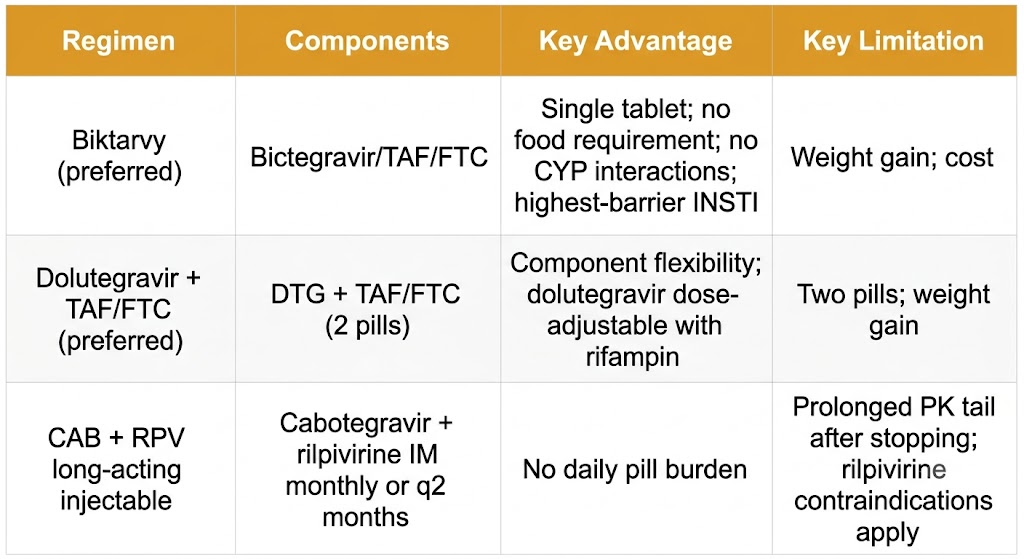
Cabotegravir plus rilpivirine (CAB+RPV) long-acting injectable ART represents the most significant pharmacological innovation in HIV treatment delivery since the first fixed-dose combination. Cabotegravir is a second-generation INSTI closely related to dolutegravir, formulated as a nanosuspension for intramuscular injection. The approved regimen uses an oral lead-in for 4 weeks to assess tolerability, followed by monthly (600 mg cabotegravir + 900 mg rilpivirine) or every-2-month (600 mg + 1,200 mg) intramuscular injections. Phase 3 trials demonstrated non-inferiority to daily oral ART in virologically suppressed adults. After injection, both drugs are absorbed slowly from the depot (T-max approximately 7 days for cabotegravir), providing sustained concentrations throughout the dosing interval. Contraindications mirror those of oral rilpivirine: pre-existing NNRTI or INSTI resistance mutations, rifamycins, viral load above 100,000 copies/mL, CD4 below 200 cells/µL, and pregnancy.
Both cabotegravir and rilpivirine have prolonged pharmacokinetic tails after injection discontinuation (cabotegravir detectable up to 12 months; rilpivirine up to 4 years in some individuals). If injections are stopped abruptly, a functional monotherapy or dual-therapy window exists as drug levels fall below protective concentrations. Patients who wish to discontinue injectable therapy must transition to oral ART promptly — DHHS recommends starting oral ART the day after the last injection.
Lenacapavir (LEN) is a capsid inhibitor with a novel mechanism distinct from all other antiretroviral classes. It is formulated for subcutaneous injection every 6 months — the longest dosing interval of any approved antiretroviral — and is approved in combination with an optimized background regimen for heavily treatment-experienced adults with MDR HIV. Lenacapavir is both a CYP3A4 substrate and a moderate CYP3A4 inhibitor, requiring careful drug interaction assessment. Ongoing trials are evaluating lenacapavir as part of long-acting first-line regimens.
| Author(s) | Title / Source | Focus |
|---|---|---|
| Kohl NE et al. | Active human immunodeficiency virus protease is required for viral infectivity. Proc Natl Acad Sci USA. 1988 | PI mechanism — protease required for infectivity |
| Zeldin RK, Petruschke RA | Pharmacological and therapeutic properties of ritonavir-boosted protease inhibitor therapy in HIV-infected patients. J Antimicrob Chemother. 2004 | Pharmacokinetic boosting with ritonavir |
| De Meyer S et al. | Resistance profile of darunavir: combined 24-week results from the POWER trials. AIDS Res Hum Retroviruses. 2008 | Darunavir resistance mutations |
| Dooley KE, Flexner C, Andrade AS | Drug interactions involving combination antiretroviral therapy and other anti-infective agents. J Infect Dis. 2008 | ARV drug interactions — broad review |
| Summa V et al. | Discovery of raltegravir, a potent, selective orally bioavailable HIV-integrase inhibitor. J Med Chem. 2008 | INSTI mechanism and raltegravir pharmacology |
| Walmsley SL et al. | Dolutegravir plus abacavir-lamivudine for the treatment of HIV-1 infection. N Engl J Med. 2013 | Dolutegravir efficacy (SINGLE trial) |
| Sax PE et al. | Coformulated bictegravir, emtricitabine, and tenofovir alafenamide vs dolutegravir with emtricitabine and tenofovir alafenamide. Lancet. 2017 | Bictegravir phase 3 trial |
| Gulick RM et al. | Maraviroc for previously treated patients with R5 HIV-1 infection. N Engl J Med. 2008 | Maraviroc efficacy and tropism requirement |
| Orkin C et al. | Long-acting cabotegravir and rilpivirine after oral induction for HIV-1 infection. N Engl J Med. 2020 | CAB+RPV long-acting injectable ART (ATLAS trial) |
| Margolis DA et al. | Long-acting intramuscular cabotegravir and rilpivirine in adults with HIV-1 infection (LATTE-2). Lancet. 2017 | CAB+RPV phase 2b long-acting data |
| Segal-Maurer S et al. | Capsid inhibition with lenacapavir in multidrug-resistant HIV-1 infection. N Engl J Med. 2022 | Lenacapavir mechanism and efficacy |