Antiretroviral (ARV) drug interactions arise from predictable pharmacokinetic mechanisms: inhibition or induction of cytochrome P450 (CYP) enzymes, modulation of uridine diphosphate glucuronosyltransferase 1A1 (UGT1A1), and alteration of drug transporter activity. Understanding the mechanistic basis allows clinicians to anticipate and manage interactions without memorizing every individual combination.
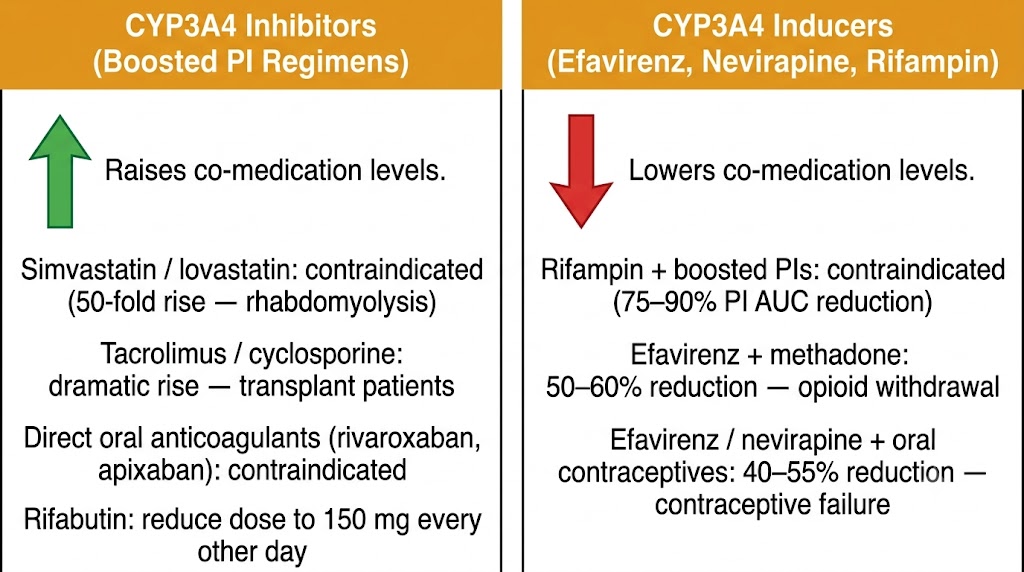
CYP3A4 metabolizes the majority of currently approved ARVs and a vast proportion of all drugs used in clinical medicine. CYP3A4 inhibition by ritonavir and cobicistat is the basis of pharmacokinetic boosting, but the same mechanism raises plasma concentrations of any co-administered CYP3A4 substrate — producing interactions spanning statins, immunosuppressants, benzodiazepines, opioids, direct oral anticoagulants (DOACs), and antifungals. CYP3A4 induction by efavirenz, nevirapine, and rifampin decreases concentrations of CYP3A4 substrates, potentially reducing co-administered drug efficacy to subtherapeutic levels. Rifampin is the strongest clinically available CYP3A4 inducer and reduces the area under the concentration-time curve (AUC) of most protease inhibitors (PIs) by 75–90%, entirely negating the pharmacokinetic boosting strategy. The magnitude of CYP3A4 interactions scales with the fraction of the victim drug metabolized by CYP3A4 — drugs with high CYP3A4 dependence are most sensitive to interaction.
UGT1A1 is the primary elimination pathway for raltegravir (RAL) and contributes substantially to dolutegravir (DTG) and bictegravir (BIC) clearance. Atazanavir inhibits UGT1A1 — producing its characteristic unconjugated hyperbilirubinemia and also raising raltegravir concentrations. Rifampin strongly induces UGT1A1, reducing raltegravir AUC by approximately 40% and dolutegravir AUC by approximately 54% — the basis for doubling the dolutegravir dose to 50 mg twice daily when rifampin is co-administered.
Drug transporters mediate several clinically important ARV interactions distinct from CYP metabolism. P-glycoprotein (P-gp), an efflux transporter expressed in the intestinal epithelium, blood-brain barrier, and renal tubule, limits absorption and central nervous system (CNS) penetration of many ARVs and is inhibited by ritonavir and cobicistat. Cobicistat and dolutegravir inhibit renal tubular secretion of creatinine, producing a predictable serum creatinine rise that reflects transporter blockade rather than nephrotoxicity.
For any new drug added to an ARV regimen, ask: (1) Is it a CYP3A4, UGT1A1, or P-gp substrate, inhibitor, or inducer? (2) Does the ARV regimen contain a booster (ritonavir or cobicistat)? If yes, assume all CYP3A4-sensitive drugs will be affected. (3) Is the ARV an inducer (efavirenz, nevirapine)? If yes, assume all CYP3A4 and UGT1A1 substrates will be reduced. Use the University of Liverpool HIV Drug Interactions Checker for all complex regimen decisions.
Certain drug classes generate ARV interactions of sufficient clinical magnitude that subtherapeutic ARV concentrations, treatment failure, or serious co-medication toxicity result without appropriate management. These span the most commonly prescribed drug classes in populations where HIV is prevalent.
Rifamycin co-treatment for tuberculosis (TB) represents the highest-stakes ARV interaction scenario. Rifampin is the most potent CYP3A4 and UGT1A1 inducer in clinical use. Rifampin reduces PI AUC by 75–90% regardless of pharmacokinetic boosting — all PI-based regimens are contraindicated with rifampin. Among non-nucleoside reverse transcriptase inhibitors (NNRTIs), efavirenz is the only acceptable option with rifampin, maintaining adequate concentrations despite approximately 26% AUC reduction. Among INSTIs, dolutegravir 50 mg twice daily is the preferred strategy with rifampin, restoring adequate trough concentrations via dose doubling. Rifabutin is a weaker CYP3A4 inducer than rifampin and can be used with PI-based regimens (at reduced dose of 150 mg every other day), INSTIs at standard doses, and NNRTIs without dose adjustment — making it the preferred rifamycin in resource-rich settings where ARV flexibility is available.
Acid-suppressing agents interact with ARVs whose absorption depends on gastric acidity. Rilpivirine absorption decreases by approximately 76% with concurrent proton pump inhibitor (PPI) use — PPIs raise gastric pH throughout the day regardless of timing, making the combination absolutely contraindicated. Histamine-2 (H2) receptor antagonists may be used with rilpivirine if administered at least 12 hours before or 4 hours after. Unboosted atazanavir similarly requires gastric acidity and cannot be co-administered with PPIs; boosted atazanavir tolerates PPIs at reduced doses when administered at least 12 hours before. PPI-dependent patients should use dolutegravir- or bictegravir-based regimens, which have no acid-dependent absorption.
Efavirenz reduces methadone plasma concentrations by 50–60% through CYP3A4 and CYP2B6 induction, precipitating opioid withdrawal within days to weeks of initiation. Contact the methadone clinic before starting efavirenz, warn the patient about withdrawal symptoms, and arrange dose escalation in advance. Dolutegravir-based regimens are strongly preferred in patients on methadone maintenance therapy — they have no clinically significant interaction with methadone.
Anticonvulsants that are potent CYP3A4 and UGT1A1 inducers — carbamazepine, phenytoin, phenobarbital, and oxcarbazepine — reduce plasma concentrations of essentially all ARVs to a clinically significant degree. The preferred approach is to use non-inducing anticonvulsants where clinically appropriate: levetiracetam, lamotrigine (with caution in boosted PI regimens), lacosamide, and pregabalin have minimal CYP interactions and are preferred in patients on ARV therapy. When inducing anticonvulsants cannot be avoided, dolutegravir 50 mg twice daily is the preferred INSTI strategy, following the same principle as rifampin co-treatment. Hormonal contraceptives are affected by ARV interactions through CYP3A4-mediated changes in estrogen and progestin metabolism. Efavirenz and nevirapine reduce ethinyl estradiol concentrations by 40–55%, potentially compromising combined oral contraceptive pill (COCP) efficacy; alternative or additional contraceptive methods are recommended. Intrauterine devices (IUDs) — both copper and levonorgestrel-releasing — are unaffected by ARV interactions and are the safest options in women on ARVs with significant hormonal interactions.
Antiretroviral toxicity has evolved substantially: the most severe toxicities of early regimens — lactic acidosis, severe lipoatrophy, life-threatening hypersensitivity — are now rare with modern agents. Current toxicity concerns center on renal and bone effects of tenofovir-containing regimens, metabolic consequences of integrase inhibitors and boosted PIs, hepatotoxicity in viral hepatitis co-infection, and immune reconstitution inflammatory syndrome (IRIS) in advanced immunodeficiency.
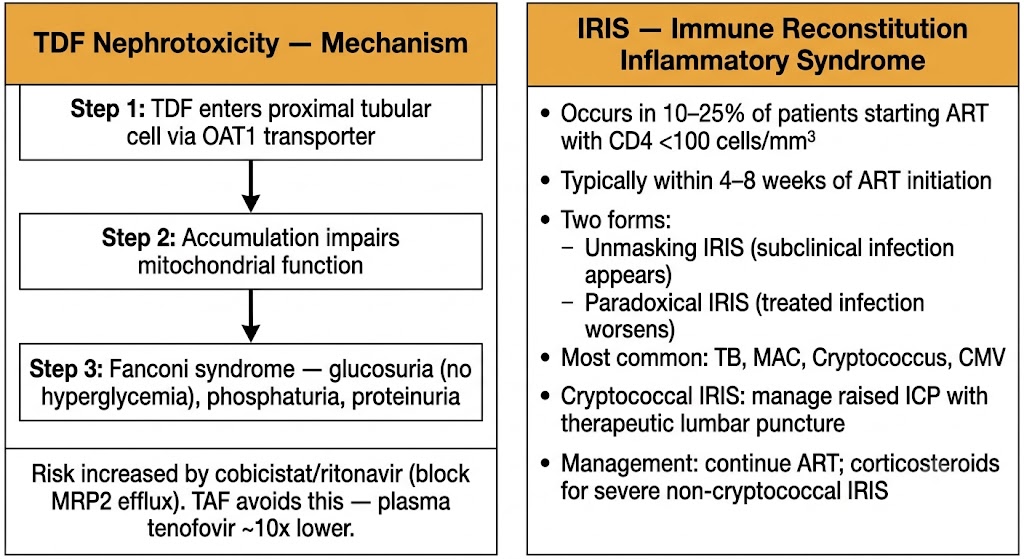
Tenofovir disoproxil fumarate (TDF) nephrotoxicity manifests across a spectrum from subclinical proximal tubular dysfunction to overt Fanconi syndrome. TDF is concentrated in proximal tubular cells, where it impairs mitochondrial function. The full Fanconi picture includes normoglycemic glucosuria, phosphaturia with hypophosphatemia, aminoaciduria, and tubular proteinuria. Risk factors include baseline renal impairment, older age, low body weight, and co-administration with boosted PIs or cobicistat — which increase proximal tubular TDF concentrations. Tenofovir alafenamide (TAF), which delivers tenofovir to lymphocytes at approximately 90% lower plasma tenofovir concentrations, substantially reduces proximal tubular exposure and is associated with significantly less nephrotoxicity and bone mineral density (BMD) loss than TDF. Bone mineral density loss occurs with any ARV regimen initiation, but TDF is consistently associated with greater BMD loss than TAF or abacavir-containing regimens.
Hepatotoxicity from ARV agents occurs through several distinct mechanisms. Nevirapine-associated hepatotoxicity is the most severe and occurs through an immune-mediated hypersensitivity mechanism concentrated in patients with higher cluster of differentiation 4 (CD4) counts at ARV initiation — women with CD4 above 250 cells/mm³ and men with CD4 above 400 cells/mm³ are at highest risk. Atazanavir causes unconjugated hyperbilirubinemia through UGT1A1 inhibition — this is benign and not true hepatotoxicity. In patients with underlying hepatitis B virus (HBV) or hepatitis C virus (HCV) co-infection, any ARV-associated hepatotoxicity risk is amplified; hepatic monitoring every 3–6 months is appropriate in the first 12 weeks of treatment. Abacavir use has been associated with increased myocardial infarction risk in large observational studies (relative risk approximately 1.7–1.9-fold vs non-users), most pronounced in patients with pre-existing high cardiovascular risk; current guidelines recommend avoiding abacavir in patients with high 10-year cardiovascular risk when alternative backbones are available.
IRIS occurs in 10–25% of patients initiating ART with advanced immunodeficiency (CD4 below 100 cells/mm³), typically within 4–8 weeks. Two forms: unmasking IRIS (previously subclinical infection becomes apparent) and paradoxical IRIS (known treated infection worsens despite effective antimicrobial therapy). Most common precipitants: Mycobacterium tuberculosis, Mycobacterium avium complex (MAC), Cryptococcus neoformans, and cytomegalovirus (CMV). Cryptococcal IRIS carries the highest mortality risk — lumbar puncture and intracranial pressure (ICP) management are essential. Management: continue ART and antimicrobials; corticosteroids for severe non-cryptococcal IRIS; therapeutic lumbar puncture for cryptococcal IRIS-associated raised ICP.
The pharmacological management of HIV in pregnancy serves two simultaneous goals: maintaining viral suppression to preserve the pregnant person's health, and reducing plasma HIV RNA viral load to prevent mother-to-child transmission (MTCT). These goals are aligned — durable viral suppression below the limit of detection is the single most effective intervention for MTCT prevention, achieving transmission rates below 1% in resource-rich settings.
All persons with HIV who are pregnant or planning pregnancy should initiate or continue ART regardless of CD4 count or viral load. Among INSTIs, dolutegravir is now recommended throughout pregnancy including at conception by current Department of Health and Human Services (DHHS) and World Health Organization (WHO) guidelines, following reassessment of the neural tube defect signal. Raltegravir retains an important role as an INSTI alternative in pregnancy with the most extensive historical safety data. Among nucleoside reverse transcriptase inhibitor (NRTI) backbones, TDF plus emtricitabine (FTC) or lamivudine (3TC) is the preferred backbone, supported by the largest body of safety and efficacy data and providing dual HBV activity. Zidovudine (ZDV) retains a specific role in MTCT prevention: intrapartum intravenous (IV) ZDV is administered to HIV-positive persons in labor with viral load above 1,000 copies/mL or unknown viral load to reduce transmission risk at delivery, regardless of the oral ARV regimen being maintained.
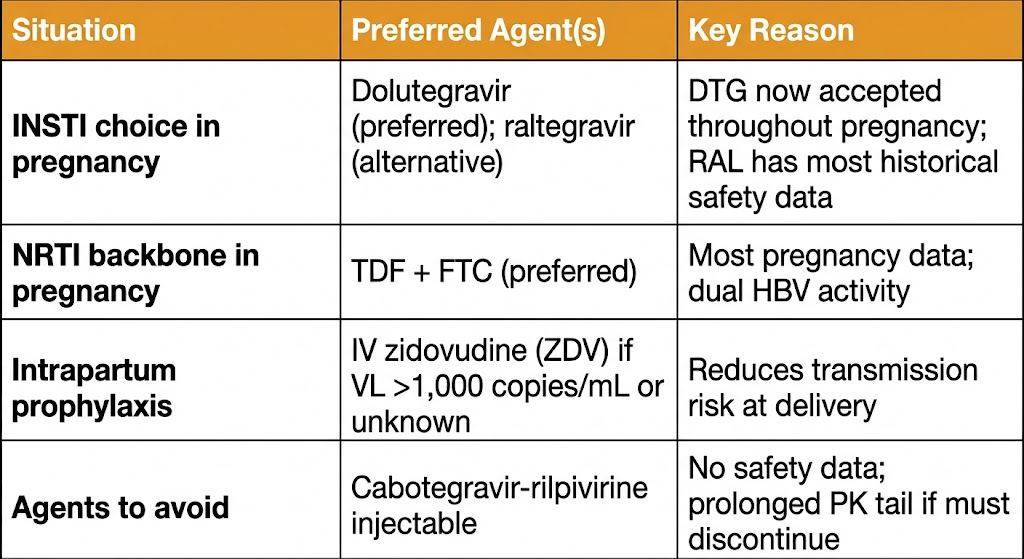
Several ARV agents are specifically restricted in pregnancy. Efavirenz's historical Food and Drug Administration (FDA) Pregnancy Category D classification has been substantially revised — current DHHS guidelines accept it throughout pregnancy when no preferred alternative exists, though it remains a non-preferred agent. Atazanavir carries a risk of severe neonatal hyperbilirubinemia and kernicterus from UGT1A1 inhibition crossing the placenta; neonatal bilirubin monitoring is required if atazanavir is used near term. Cabotegravir-rilpivirine long-acting injectable ART is not recommended in pregnancy — safety data are absent and the prolonged pharmacokinetic tail makes rapid discontinuation impossible if adverse effects emerge. For persons with viral load below 50 copies/mL at 36 weeks' gestation, intrapartum ZDV infusion is not required and cesarean section is not recommended on HIV grounds. For those with viral load above 1,000 copies/mL or unknown viral load at delivery, intrapartum IV ZDV plus elective cesarean section at 38 weeks is recommended. Neonatal prophylaxis with ZDV syrup for 4–6 weeks is standard for all infants born to HIV-positive mothers.
Renal and hepatic impairment alter ARV pharmacokinetics through reduced drug clearance, altered protein binding, and changes in first-pass metabolism. Most modern ARVs require little or no dose adjustment across the renal impairment spectrum, but important exceptions exist — particularly for fixed-dose combinations whose individual components have differing renal thresholds.
Among NRTIs, TDF, FTC, 3TC, and ZDV are renally eliminated and require dose adjustment at reduced estimated glomerular filtration rate (eGFR). TDF should not be initiated when eGFR is below 60 mL/min/1.73m²; TAF may be used down to eGFR of 15 mL/min/1.73m² and is preferred over TDF in chronic kidney disease (CKD). Abacavir is hepatically metabolized and requires no renal dose adjustment at any eGFR level. Fixed-dose combinations impose specific eGFR thresholds based on their least-renally-tolerant component: Biktarvy (BIC/TAF/FTC) is not recommended below eGFR 15 mL/min/1.73m²; Genvoya (elvitegravir/cobicistat/TAF/FTC) is not recommended below eGFR 30 mL/min/1.73m² due to the cobicistat component. INSTIs generally require no renal dose adjustment because their primary elimination is hepatic — dolutegravir, raltegravir, and bictegravir can all be used without dose modification at any eGFR level including dialysis. The cobicistat-associated serum creatinine rise — a transporter-mediated artifact — must not be misinterpreted as worsening renal function; cystatin C-based eGFR provides a more accurate reflection of true GFR in cobicistat-treated patients.
Hepatic impairment most significantly affects agents with high hepatic extraction. Among PIs, darunavir and lopinavir are contraindicated in severe hepatic impairment (Child-Pugh C) due to substantially elevated and unpredictable drug exposures. Among INSTIs, raltegravir pharmacokinetics are not substantially altered by hepatic impairment and it is the preferred INSTI in Child-Pugh C disease. Dolutegravir AUC increases approximately 1.5-fold in moderate hepatic impairment (Child-Pugh B) but remains acceptable; it is not recommended in Child-Pugh C. Abacavir is contraindicated in moderate to severe hepatic impairment due to its dependence on hepatic metabolism for elimination. HBV co-infection in HIV-positive patients requires ARV selection that includes TDF or TAF to simultaneously suppress both viruses; discontinuation of HBV-active ARVs without maintaining HBV suppression risks catastrophic hepatic decompensation from HBV flare.
The aging of the HIV-positive population has created a new clinical challenge: managing HIV as a chronic condition in persons with accumulating comorbidities, polypharmacy, and age-related pharmacokinetic changes. HIV/tuberculosis (HIV/TB) co-treatment remains the most pharmacologically complex scenario in infectious disease practice, requiring simultaneous management of the rifampin-ARV interaction, IRIS risk, and overlapping hepatotoxicity.
Older persons living with HIV experience accelerated aging phenotypes including earlier onset of cardiovascular disease, osteoporosis, neurocognitive impairment, and frailty compared with age-matched HIV-negative individuals. The polypharmacy burden is substantial — a median of 8–12 concurrent medications is common in patients above age 60, dramatically increasing the probability of clinically relevant drug interactions. Pharmacokinetic changes of aging relevant to ARV management include reduced renal function (necessitating lower eGFR thresholds for TDF use and more careful monitoring of renally-cleared agents), reduced hepatic blood flow and CYP enzyme activity (modestly increasing exposure to hepatically-metabolized ARVs), and reduced albumin concentrations (affecting protein binding of highly-bound agents such as PIs).
The HIV/TB co-treatment synthesis requires simultaneous management of the rifampin-ARV interaction, IRIS risk, overlapping hepatotoxicity, and optimization of both treatment durations. The preferred approach in resource-rich settings: (1) initiate TB treatment with standard four-drug therapy; (2) initiate ART within 2 weeks for patients with CD4 below 50 cells/mm³ (to minimize mortality risk from delayed treatment) and within 8–12 weeks for those with CD4 above 50 cells/mm³ (allowing TB treatment to establish some control before immune reconstitution); (3) use dolutegravir 50 mg twice daily with rifampin, or switch to rifabutin 150 mg three times weekly to allow standard-dose dolutegravir and more flexible ARV choices. Hepatotoxicity monitoring every 2–4 weeks during the intensive phase of TB treatment plus ARV initiation is essential. Paradoxical TB-IRIS occurs in 15–20% of HIV/TB co-treated patients and is managed with non-steroidal anti-inflammatory drugs (NSAIDs) for mild cases and corticosteroids for severe presentations.
Cardiovascular risk management in HIV-positive patients integrates standard risk factor modification with HIV-specific considerations. The 10-year cardiovascular risk in HIV-positive patients is approximately 1.5–2-fold higher than in HIV-negative individuals of the same age and sex after adjustment for traditional risk factors, attributable to chronic immune activation and effects of certain ARVs on lipid metabolism and endothelial function. Statin therapy requires attention to drug interactions: rosuvastatin and pravastatin are the safest choices with boosted PI-containing regimens; atorvastatin may be used at reduced doses; simvastatin and lovastatin are contraindicated. Smoking cessation is the highest-impact modifiable cardiovascular risk factor in HIV-positive patients and should be addressed at every clinical encounter.
| Author(s) | Title / Source | Focus |
|---|---|---|
| Flexner C | HIV-protease inhibitors. N Engl J Med. 1998 | PI pharmacology and interactions |
| Dooley KE, Flexner C, Andrade AS | Drug interactions involving combination antiretroviral therapy and other anti-infective agents. J Infect Dis. 2008 | ARV drug interaction mechanisms |
| Tseng A et al. | Role of the pharmacist in caring for patients with HIV/AIDS: clinical practice guidelines. Can J Hosp Pharm. 2012 | ARV interaction management — clinical guidelines |
| Gupta SK et al. | Guidelines for the management of chronic kidney disease in HIV-infected patients. Clin Infect Dis. 2005 | Renal dosing in HIV |
| Nunez M | Hepatotoxicity of antiretrovirals: incidence, mechanisms and management. J Hepatol. 2006 | ARV hepatotoxicity |
| Zash R, Makhema J, Shapiro RL | Neural-tube defects with dolutegravir treatment from the time of conception. N Engl J Med. 2018 | Dolutegravir neural tube defect signal |
| Townsend CL et al. | Low rates of mother-to-child transmission of HIV following effective pregnancy interventions in the United Kingdom and Ireland, 2000–2006. AIDS. 2008 | MTCT prevention with ART |
| Gupta SK, Post FA, Arribas JR et al. | Renal safety of tenofovir alafenamide vs. tenofovir disoproxil fumarate: a pooled analysis of 26 clinical trials. AIDS. 2019 | TAF vs TDF renal safety |
| Soriano V et al. | Care of HIV patients with chronic hepatitis B: updated recommendations from the HIV-Hepatitis B Virus International Panel. AIDS. 2008 | HIV/HBV co-infection management |
| Guaraldi G et al. | Premature age-related comorbidities among HIV-infected persons compared with the general population. Clin Infect Dis. 2011 | Aging and HIV comorbidities |
| Havlir DV et al. | Timing of antiretroviral therapy for HIV-1 infection and tuberculosis. N Engl J Med. 2011 | HIV/TB co-treatment timing |