CHAPTER 36  ·  ANTIVIRAL PHARMACOLOGY
1. HBV Virology & Serology · 2. HBV Pharmacology · 3. HCV Virology & DAA Framework · 4. HCV DAA Regimens · 5. HCV Special Populations · 6. Co-infection & Monitoring ↑ Top
Module Contents
Section 1
HBV Virology, Serology, and Treatment Goals
Viral lifecycle, serological markers, cccDNA as the barrier to cure, and treatment indications

Hepatitis B virus (HBV) is a partially double-stranded DNA virus of the Hepadnaviridae family that maintains a stable nuclear reservoir of covalently closed circular DNA (cccDNA) that persists despite antiviral therapy. This intranuclear reservoir is the fundamental pharmacological barrier to HBV cure and explains why antiviral therapy suppresses but does not eradicate infection in most patients.

Current antiviral therapy targets the HBV reverse transcriptase step; no approved agent directly degrades cccDNA, which is why therapy is indefinite in most patients.

Serological markers provide both a roadmap of infection phase and endpoints for treatment monitoring. Hepatitis B surface antigen (HBsAg) is present in all phases of active infection; its loss with or without development of hepatitis B surface antibody (anti-HBs) represents functional cure — the highest achievable therapeutic endpoint, occurring spontaneously in fewer than 1% of chronically infected adults per year and rarely in response to antiviral therapy. Hepatitis B e antigen (HBeAg) presence indicates high-level viral replication and high infectivity; seroconversion to anti-HBe marks a transition to lower-replication phases in many patients. HBV DNA quantification by polymerase chain reaction (PCR) is the primary measure of viral replication and treatment response, with treatment targets of undetectable or below the lower limit of quantification (generally below 10–20 international units per milliliter [IU/mL]). Hepatitis B core antibody (anti-HBc) IgM indicates acute infection; anti-HBc IgG persists lifelong and marks past or current HBV exposure.

HBV Reactivation — The Hidden Risk of Immunosuppression

HBV reactivation occurs when immunosuppression allows amplification of the cccDNA reservoir, producing a sudden surge in HBV DNA, hepatitis, and occasionally acute liver failure. Risk is highest with anti-CD20 therapy (rituximab), systemic corticosteroids, and cytotoxic chemotherapy. All patients receiving immunosuppression should be screened for HBsAg and anti-HBc before initiation. HBsAg-positive patients require prophylactic antiviral therapy (tenofovir or entecavir) starting one to two weeks before immunosuppression, continuing for at least six to twelve months after completion. Anti-HBc-positive/HBsAg-negative patients require monitoring or prophylaxis depending on immunosuppression intensity.
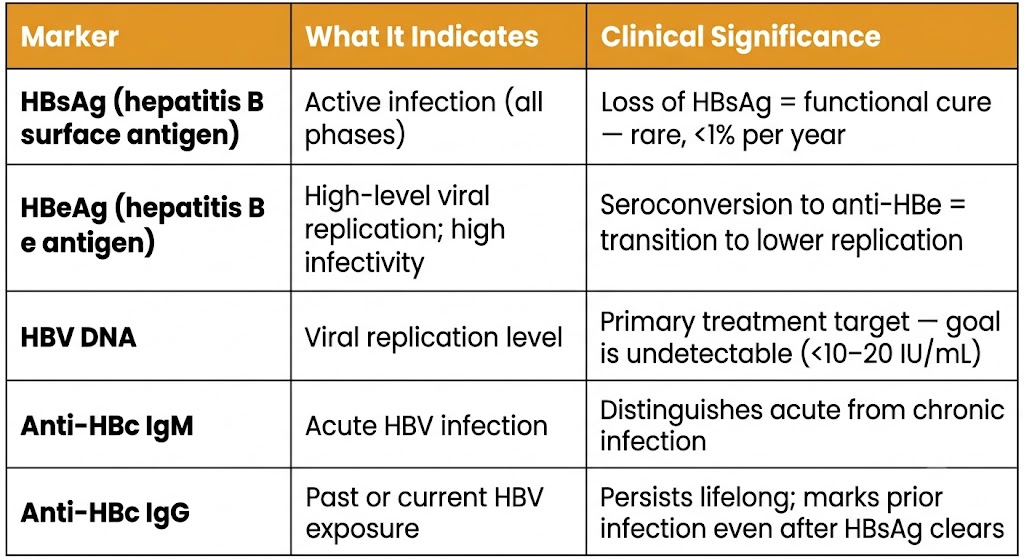
HBV serological markers table

HBV infection phases determine treatment eligibility. The immune-tolerant phase features high HBV DNA, HBeAg positivity, normal alanine aminotransferase (ALT), and minimal hepatic inflammation — antiviral therapy is generally not indicated because immune-mediated hepatocyte injury is absent and treatment response is poor. The immune-active phase features elevated ALT, active hepatic inflammation, and variable HBV DNA — treatment is indicated. HBeAg-negative chronic hepatitis B, which predominates in Mediterranean and Asian regions due to precore mutant strains, represents a distinct treatment-requiring phase with low-to-intermediate HBV DNA and fluctuating ALT. Most guidelines recommend treatment for all patients with compensated or decompensated cirrhosis regardless of HBV DNA level, and for patients with HBV DNA above 2,000 IU/mL and ALT above the upper limit of normal.
Section 2
HBV Pharmacology and Resistance
Nucleos(t)ide analogues, peginterferon, resistance mutation profiles, and treatment selection

The pharmacological treatment of chronic HBV has been transformed by high-barrier nucleos(t)ide analogues (NAs) with potent HBV reverse transcriptase inhibitory activity and minimal resistance selection. Tenofovir disoproxil fumarate (TDF) and tenofovir alafenamide (TAF) are the preferred first-line agents for most patients; entecavir is an alternative with an equally high resistance barrier.

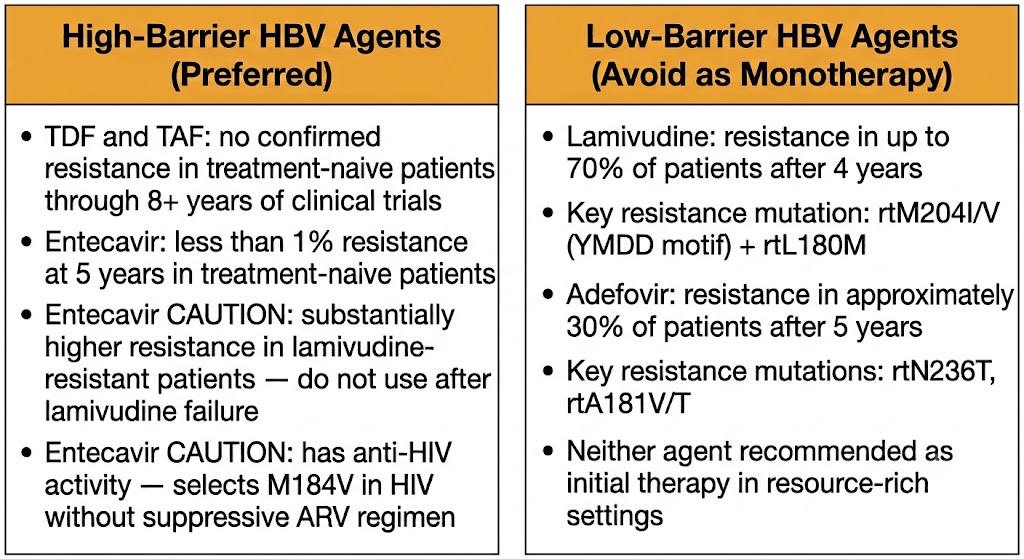
TDF and TAF are acyclic phosphonate nucleotide analogues that inhibit HBV reverse transcriptase, acting as chain terminators after incorporation into nascent HBV DNA strands. TDF has been the standard of care for HBV for over a decade and the only nucleos(t)ide analogue with demonstrated efficacy in decompensated cirrhosis; it achieves undetectable HBV DNA in approximately 70–80% of treatment-naive HBeAg-positive and 90% of HBeAg-negative patients by week 48. TAF, using the same phosphonamidate prodrug chemistry as in HIV treatment, produces equivalent HBV suppression at one-quarter the dose of TDF with significantly better renal and bone safety parameters — a meaningful advantage given the long-term nature of HBV therapy. Neither TDF nor TAF has yielded any confirmed resistance mutations in treatment-naive patients through 8 years of follow-up in clinical trials, establishing the highest resistance barrier of any anti-HBV agent.

Entecavir (ETV) is a guanosine nucleoside analogue that inhibits HBV reverse transcription with a high resistance barrier — fewer than 1% of treatment-naive patients develop entecavir resistance through 5 years. However, a critical caveat applies: entecavir resistance is substantially higher in patients with pre-existing lamivudine resistance mutations where only one or two additional mutations are needed for high-level entecavir resistance. Entecavir should therefore not be used in patients with known lamivudine or telbivudine resistance. An additional pharmacological hazard: entecavir has sufficient anti-HIV activity to select for the M184V resistance mutation in HIV when used without a fully suppressive antiretroviral (ARV) regimen. HIV-positive patients receiving entecavir must also be on a fully suppressive ARV regimen.

HBV antiviral resistance barriers — high versus low barrier agents

Lamivudine (3TC) and adefovir dipivoxil select resistance mutations in up to 70% and 30% of patients respectively after several years of monotherapy and have been largely superseded by tenofovir and entecavir in resource-rich settings. Peginterferon alfa-2a is the only immune-based therapy approved for chronic HBV and the only agent capable of inducing durable off-treatment responses including HBeAg seroconversion and, rarely, HBsAg loss. Administered as 180 micrograms subcutaneously weekly for 48 weeks, it achieves HBeAg seroconversion in approximately 27–32% of HBeAg-positive patients. Peginterferon is contraindicated in decompensated cirrhosis and psychiatric disorders; adverse effects include flu-like symptoms, cytopenias, neuropsychiatric effects, and thyroid dysfunction requiring monitoring. Predictors of favorable response include HBV genotype A or B, high baseline ALT, and low baseline HBV DNA.

Agent Resistance Barrier Key Resistance Mutations Preferred Use
TDFVery highNone confirmed in 8-year trialsFirst-line; decompensated cirrhosis; HIV/HBV co-infection
TAFVery highNone confirmedFirst-line; preferred if CKD or osteoporosis risk
EntecavirVery high (naive)Rare in naive patients; higher risk on lamivudine-resistant backgroundFirst-line; avoid if lamivudine-resistant; avoid without suppressive ARV in HIV
LamivudineLowCommon after 1–4 years of monotherapy (up to 70%)Not recommended first-line; HIV backbone use only
Peginterferon alfa-2aN/A (immune-based)N/AFinite therapy goal; HBeAg-positive; genotype A/B preferred
Section 3
HCV Virology and Direct-Acting Antiviral Framework
Viral targets, drug classes, genotype classification, and the pharmacological basis of cure

Hepatitis C virus (HCV) is a positive-sense single-stranded RNA virus of the Flaviviridae family. Unlike HBV, HCV does not integrate into the host genome and lacks a nuclear cccDNA reservoir, making pharmacological cure achievable with finite antiviral therapy. Current direct-acting antiviral (DAA) regimens achieve sustained virological response at 12 weeks post-treatment (SVR12) — operationally equivalent to cure — in more than 95% of treatment-naive patients across all genotypes.

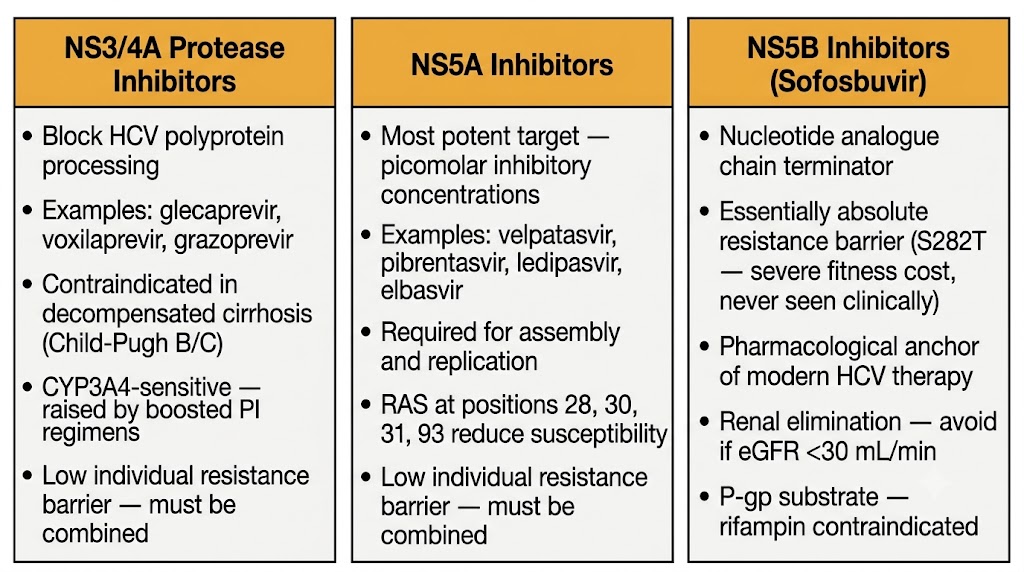
The HCV genome encodes a large polyprotein cleaved into structural proteins and non-structural proteins. Three non-structural proteins are the targets of all approved DAAs. NS3/4A is a serine protease that cleaves the HCV polyprotein; its inhibition blocks polyprotein processing and halts viral replication. NS5A is a multifunctional phosphoprotein essential for viral RNA replication and virion assembly; its inhibition makes it the most potent target in the HCV drug armamentarium. NS5B is the RNA-dependent RNA polymerase (RdRp) responsible for copying the HCV genome; it is targeted by nucleotide analogues (which act as obligate chain terminators after incorporation) and non-nucleoside inhibitors. HCV exists in seven major genotypes (GT1 through GT7) with multiple subtypes. The advent of pangenotypic DAA regimens — those active against all genotypes — has substantially simplified treatment by obviating genotype testing before therapy in most clinical settings.

The pharmacological basis of HCV cure with finite therapy rests on four properties of current DAA regimens: extremely high antiviral potency (reducing HCV RNA by 4–6 log10 within days of initiation), combinational targeting of three non-overlapping mechanisms (preventing resistance emergence through single mutations), high resistance barrier for newer agents (particularly sofosbuvir, for which resistance requires multiple simultaneous mutations), and the absence of a persistent nuclear reservoir unlike HBV cccDNA. SVR12 is considered durable and equivalent to cure because HCV RNA levels do not rebound after sustained suppression in the absence of reinfection. Large prospective cohort studies demonstrate fewer than 1% of patients with SVR12 experience viral relapse.

SVR12 Is Cure

Undetectable HCV RNA 12 weeks after completing therapy (SVR12) represents durable eradication of HCV infection in the vast majority of patients. SVR12 is associated with regression of hepatic fibrosis, reduced risk of hepatocellular carcinoma (HCC) — though not elimination of risk in patients with advanced cirrhosis — and in compensated cirrhosis a significant reduction in liver-related mortality. Patients with advanced fibrosis or cirrhosis who achieve SVR12 require continued HCC surveillance by ultrasound every 6 months indefinitely, as residual risk persists despite cure.

Section 4
HCV Direct-Acting Antiviral Regimens
Pangenotypic and genotype-specific regimens, drug interactions, and treatment duration

The current landscape of HCV therapy is defined by three pangenotypic regimens — sofosbuvir/velpatasvir, glecaprevir/pibrentasvir, and sofosbuvir/velpatasvir/voxilaprevir — alongside retained genotype-specific regimens for specific clinical indications. Treatment selection is driven by genotype, presence of cirrhosis, prior treatment history, renal function, and the DAA interaction profile of concurrent medications.

Sofosbuvir (SOF) is a uridine nucleotide analogue prodrug that acts as a chain terminator at the NS5B active site. Sofosbuvir has an essentially absolute genetic resistance barrier — resistance has never been documented to emerge during clinical treatment. Sofosbuvir is a P-glycoprotein (P-gp) substrate; inducers of these transporters (rifampin, carbamazepine, St. John's Wort) reduce sofosbuvir plasma concentrations substantially and are contraindicated. Sofosbuvir is renally eliminated and is not recommended in patients with estimated glomerular filtration rate (eGFR) below 30 mL/min/1.73m² due to metabolite accumulation.

Sofosbuvir/velpatasvir (SOF/VEL, Epclusa) is a pangenotypic fixed-dose combination pairing sofosbuvir with velpatasvir, a second-generation NS5A inhibitor with activity across all genotypes including genotype 3 (GT3). It is administered as one tablet daily for 12 weeks, achieving SVR12 rates above 95% across all genotypes. Adding voxilaprevir — a pangenotypic NS3/4A protease inhibitor — to SOF/VEL produces sofosbuvir/velpatasvir/voxilaprevir (SOF/VEL/VOX, Vosevi), used for 8 weeks in treatment-naive patients without cirrhosis and for 12 weeks in treatment-experienced patients with prior NS5A inhibitor exposure. Proton pump inhibitors (PPIs) reduce velpatasvir absorption and should not exceed omeprazole-equivalent 20 mg when taken simultaneously with SOF/VEL.

Glecaprevir/pibrentasvir (GLE/PIB, Mavyret) is a fixed-dose combination of a pangenotypic NS3/4A protease inhibitor (glecaprevir) and a pangenotypic NS5A inhibitor (pibrentasvir). Its defining pharmacological advantage is abbreviated treatment duration: 8 weeks in treatment-naive patients without cirrhosis regardless of genotype. It is also the preferred regimen in severe renal impairment including dialysis, because neither component is renally eliminated — both are primarily biliary-excreted — avoiding the accumulation concerns of sofosbuvir in this population. Glecaprevir inhibits hepatic uptake transporters, raising statin plasma concentrations — rosuvastatin is contraindicated with glecaprevir/pibrentasvir, and other statins require dose limitation. Atazanavir substantially raises glecaprevir plasma concentrations and is contraindicated; efavirenz reduces both glecaprevir and pibrentasvir levels and is also contraindicated.

HCV direct-acting antiviral drug class targets — NS3/4A, NS5A, NS5B
Regimen Targets Genotypes Duration Key Notes
SOF/VEL (Epclusa)NS5B + NS5APangenotypic12 wksPPIs: simultaneous, max omeprazole 20 mg; avoid rifampin
GLE/PIB (Mavyret)NS3/4A + NS5APangenotypic8 wks (naive, no cirrhosis)Preferred in dialysis; rosuvastatin contraindicated; avoid ATV, EFV
SOF/VEL/VOX (Vosevi)NS5B + NS5A + NS3/4APangenotypic8 wks (naive) / 12 wks (NS5A-experienced)Re-treatment after NS5A inhibitor failure
LDV/SOF (Harvoni)NS5A + NS5BGT1, GT4–68–12 wksPPI max omeprazole 20 mg simultaneously; avoid rifampin
EBR/GZR (Zepatier)NS5A + NS3/4AGT1, GT412–16 wksGT1a: NS5A resistance testing required before prescribing; safe in dialysis
Section 5
HCV Special Populations and Resistance
Cirrhosis, renal impairment, HIV/HCV co-infection, and resistance-associated substitutions

DAA therapy achieves high SVR12 rates across most patient populations, but cirrhosis, advanced renal impairment, HIV co-infection, prior DAA experience, and baseline resistance-associated substitutions (RASs) require tailored regimen selection and in some cases extended treatment duration.

Compensated cirrhosis (Child-Pugh A) does not substantially reduce SVR12 rates with pangenotypic regimens, but does influence treatment duration. Glecaprevir/pibrentasvir for 12 weeks (rather than 8 weeks) is used in treatment-naive patients with compensated cirrhosis; sofosbuvir/velpatasvir for 12 weeks is similarly used. Genotype 3 (GT3)-infected patients with cirrhosis are the most challenging scenario in contemporary HCV practice — SVR12 rates with sofosbuvir/velpatasvir are approximately 88–91%, below the greater-than-95% threshold achieved in other populations; sofosbuvir/velpatasvir/voxilaprevir for 12 weeks is the preferred approach in NS5A-naive GT3 cirrhotic patients. Decompensated cirrhosis (Child-Pugh B or C) is a contraindication to NS3/4A protease inhibitor-containing regimens because protease inhibitor concentrations increase dramatically in hepatic impairment, increasing toxicity. Sofosbuvir/velpatasvir with or without ribavirin for 12–24 weeks is the preferred approach in decompensated cirrhosis.

Severe renal impairment (eGFR below 30 mL/min/1.73m²) requires careful DAA selection because sofosbuvir accumulation is not well characterized at low eGFR levels. The preferred regimen in this setting is glecaprevir/pibrentasvir, which has no renal elimination pathway and is approved at standard doses including in patients on hemodialysis, achieving SVR12 rates above 98%. HIV/HCV co-infection was historically associated with accelerated hepatic fibrosis progression and lower interferon response rates. With DAA therapy, SVR12 rates in HIV/HCV co-infected patients are equivalent to those in HCV monoinfected patients across all approved regimens, provided HIV is virologically suppressed and the ARV regimen is compatible with the chosen DAA. NS3/4A protease inhibitors (glecaprevir, voxilaprevir, grazoprevir) are sensitive CYP3A4 substrates; ritonavir- and cobicistat-boosted ARV regimens raise NS3/4A inhibitor concentrations substantially — atazanavir/ritonavir raises glecaprevir exposure approximately 6-fold and is contraindicated; sofosbuvir/velpatasvir has a favorable interaction profile with most INSTIs and NNRTIs.

NS5A resistance-associated substitutions (RASs) can reduce SVR12 rates with specific regimens when present at baseline. Baseline NS5A RAS testing is recommended before elbasvir/grazoprevir in genotype 1a-infected patients (where NS5A resistance-associated substitutions predict reduced efficacy and mandate 16-week treatment with ribavirin), before sofosbuvir/velpatasvir/voxilaprevir in genotype 1a treatment-experienced patients, and before re-treatment after prior DAA failure involving NS5A inhibitors. For modern pangenotypic regimens such as sofosbuvir/velpatasvir and glecaprevir/pibrentasvir, baseline RAS testing is not routinely required because SVR12 rates exceed 95% even in the presence of known baseline RASs for most patient populations — sofosbuvir's exceptional resistance barrier anchors these combinations against NS5A or NS3 RAS-mediated failures.

Section 6
Co-infection, Monitoring, and Clinical Decision Framework
HBV/HCV co-infection, HBV reactivation during HCV DAA therapy, monitoring parameters, and treatment sequencing

HBV/HCV co-infection, HBV reactivation during HCV DAA therapy, and the long-term management obligations that persist after SVR12 represent the synthesis of hepatitis B and C pharmacology as it applies in clinical practice.

In HBV/HCV co-infected patients, HCV typically dominates virologically, suppressing HBV replication through interferon-mediated mechanisms. Paradoxically, as HCV is eliminated by DAA therapy, the interferon-stimulated gene signaling that suppressed HBV replication dissipates, allowing HBV reactivation in patients not receiving HBV-active therapy. HBV reactivation during DAA therapy occurs in 1–2% of HBsAg-positive patients, with rare cases of acute liver failure documented. All patients initiating HCV DAA therapy must be screened for HBsAg and anti-HBc before starting treatment. HBsAg-positive patients should receive concomitant HBV-active antiviral therapy (TDF or TAF) throughout HCV DAA therapy and for several months after completion. Anti-HBc-positive, HBsAg-negative patients require monitoring of HBV DNA during and after HCV therapy.

Monitoring during HCV DAA therapy is streamlined given the favorable safety profiles of modern regimens. HCV RNA should be measured at baseline, at the end of treatment, and at 12 weeks after completing treatment to establish SVR12. Routine ALT and complete blood count (CBC) monitoring during treatment is not mandatory for most patients but is appropriate in cirrhotic patients and those on ribavirin. After SVR12, patients with advanced fibrosis or cirrhosis require HCC surveillance by liver ultrasound every 6 months indefinitely — even after cure — because the risk of HCC is reduced but not eliminated by viral eradication in established cirrhosis. Treatment sequencing in HIV/HBV/HCV triply infected patients requires that HBV be covered throughout: the preferred ARV backbone (TDF/FTC or TAF/FTC) suppresses HBV simultaneously. The most dangerous scenario is achieving HCV cure and then switching to an HBV-inactive ARV regimen, which can precipitate catastrophic HBV reactivation in co-infected patients.

HBV Reactivation During HCV DAA Therapy — Screen Before You Treat

HBV reactivation during HCV DAA treatment can produce acute liver failure in HBsAg-positive patients not receiving HBV-active therapy. All patients initiating HCV DAA therapy must have HBsAg and anti-HBc checked before treatment. HBsAg-positive patients must start TDF or TAF simultaneously with or before HCV DAA initiation and continue for at least 12 weeks after completing HCV treatment. Do not treat HCV in an HBsAg-positive patient without a clear HBV management plan in place.

Visual Summary  ·  Module 4 of 8
Hepatitis B and C Pharmacology
HBV serology, antiviral agents, HCV DAA regimens, and clinical decision rules
Suggested References
Author(s) Title / Source Focus
Seeger C, Mason WS Molecular biology of hepatitis B virus infection. Virology. 2015 HBV lifecycle and cccDNA biology
Terrault NA, Lok ASF, McMahon BJ et al. Update on prevention, diagnosis, and treatment of chronic hepatitis B: AASLD 2018 hepatitis B guidance. Hepatology. 2018 HBV treatment guidelines
Marcellin P et al. Regression of cirrhosis during treatment with tenofovir disoproxil fumarate for chronic hepatitis B. Lancet. 2013 TDF efficacy and cirrhosis regression in HBV
Perrillo RP et al. AGA Institute technical review on prevention and treatment of hepatitis B virus reactivation during immunosuppressive drug therapy. Gastroenterology. 2015 HBV reactivation during immunosuppression
Lohmann V et al. Replication of subgenomic hepatitis C virus RNAs in a hepatoma cell line. Science. 1999 HCV replication biology
Feld JJ, Jacobson IM, Hezode C et al. Sofosbuvir and velpatasvir for HCV genotype 1, 2, 4, 5, and 6 infection. N Engl J Med. 2015 SOF/VEL pangenotypic efficacy (ASTRAL trials)
Asselah T et al. Efficacy of glecaprevir/pibrentasvir in patients with hepatitis C virus genotype 1–6 without cirrhosis. Clin Gastroenterol Hepatol. 2018 GLE/PIB pangenotypic efficacy
Foster GR et al. Sofosbuvir and velpatasvir for HCV genotype 2 and 3 infection. N Engl J Med. 2015 SOF/VEL for GT2 and GT3
Rockstroh JK et al. Efficacy and safety of grazoprevir and elbasvir in patients with HCV and HIV co-infection. Lancet HIV. 2015 EBR/GZR in HIV/HCV co-infection
Bersoff-Matcha SJ et al. Hepatitis B virus reactivation associated with direct-acting antiviral therapy for chronic HCV. Ann Intern Med. 2017 HBV reactivation during HCV DAA therapy
Ioannou GN, Feld JJ What are the benefits of a sustained virologic response to direct-acting antiviral therapy for HCV infection? Gastroenterology. 2019 Long-term benefits of SVR12
Back to top