A fundamental principle that unifies antiviral resistance across all virus families is the quasispecies concept: replicating virus populations do not exist as a single genotype but as dynamic clouds of closely related but genetically distinct variants. This mutational diversity is the raw material from which drug-resistant mutants are selected, and it exists before antiviral therapy is initiated.
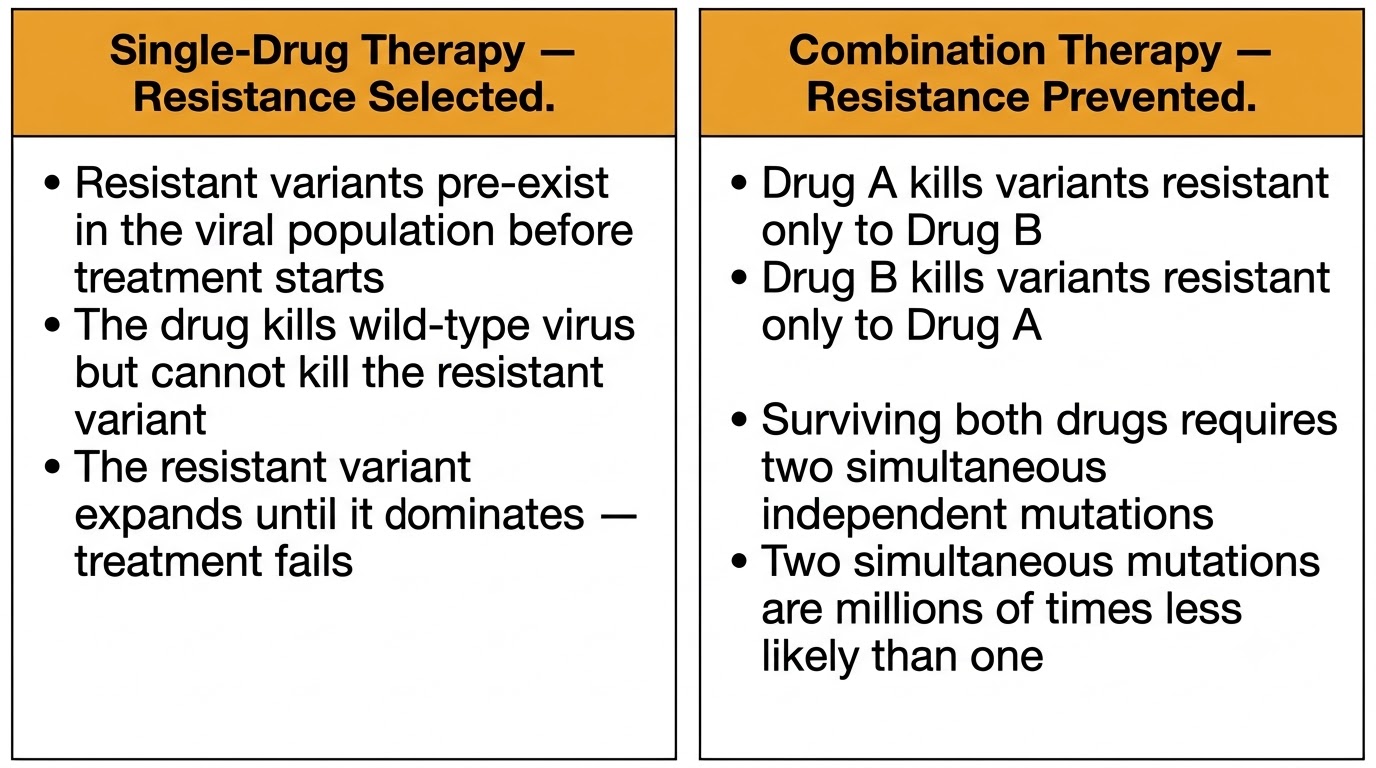
RNA viruses — including HIV, hepatitis C virus (HCV), and influenza — replicate using RNA-dependent RNA polymerases (RdRp) that lack the proofreading exonuclease activity present in cellular DNA polymerases. The resulting high mutation rate means that, for a genome of several thousand nucleotides, every possible single-nucleotide substitution is generated at some frequency in every infected individual during every day of active replication. In HIV, with a viral replication rate producing approximately 10 billion virions per day, the entire sequence space of all possible single-point mutations is populated many times daily within a single infected person. The clinical implication is that drug-resistant variants are not induced by antiviral therapy — they pre-exist as minority variants at frequencies that may be undetectable by standard resistance tests but are present in the quasispecies. Antiviral therapy creates a selection pressure that eliminates wild-type virus (which cannot replicate in the presence of drug) while allowing pre-existing resistant variants to replicate and expand to dominance.
DNA viruses replicate with higher fidelity than RNA viruses, but even herpesviruses and poxviruses generate sufficient mutational diversity during acute infection to produce drug-resistant variants. The herpesvirus thymidine kinase (TK) gene has a higher intrinsic mutation rate than other viral genes because TK is dispensable for viral replication in cell culture (though important for efficient replication in neurons), allowing TK-null and TK-partial mutants to accumulate with less fitness cost than mutations in essential structural genes. The polyomavirus BK and JC viruses, as small DNA viruses relying largely on host cell replication machinery, generate less diversity but can still develop resistance variants under selection pressure — though clinical resistance to cidofovir in polyomavirus disease has not been characterized as systematically as HIV or herpesvirus resistance.
Resistance is selected, not induced. High viral replication rates ensure that resistant variants pre-exist before treatment. The faster a virus replicates and the higher its mutation rate, the more diverse the quasispecies and the more rapidly resistance can be selected. Single-drug therapy selects for resistance efficiently; combination therapy with multiple mechanistically non-overlapping agents creates a mutational requirement for simultaneous multiple independent mutations — which occurs at rates many orders of magnitude lower than single mutations. This is the pharmacological rationale for combination antiretroviral therapy (ART), combination HCV direct-acting antiviral (DAA) therapy, and the principle of combination in other viral infections.
Not all resistance mutations are clinically equivalent. The degree to which a resistance mutation impairs viral replication in the absence of drug selection — its fitness cost — determines whether resistant strains are clinically relevant only during active drug selection or whether they can spread in the human population without drug pressure. Fitness cost is the single most important determinant of whether resistance remains a patient-level problem or becomes a public health crisis.
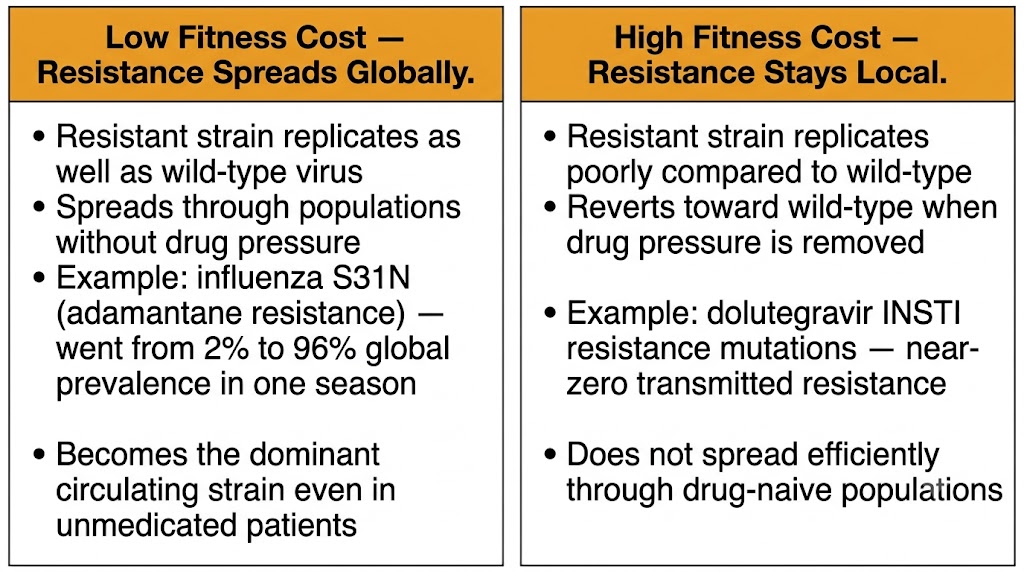
Replicative fitness is measured by comparing the growth kinetics of a resistant variant to wild-type virus under identical conditions in the absence of drug. A high-fitness-cost mutation substantially impairs viral replication — the resistant variant replicates more slowly, produces fewer progeny, and competes poorly against wild-type virus when drug pressure is removed. A low-fitness-cost mutation has minimal impact on viral replication capacity, allowing the resistant strain to circulate and transmit in drug-naive populations as efficiently as wild-type virus. The clinical consequences differ radically: high-fitness-cost resistant variants may emerge during treatment but revert toward wild-type in the absence of ongoing drug pressure; low-fitness-cost variants can spread through communities and become dominant circulating strains.
The influenza M2 adamantane resistance mutation serine-to-asparagine at position 31 (S31N) provides the paradigmatic example of a low-fitness-cost resistance mutation spreading globally. S31N has negligible fitness cost — the virus with S31N replicates as efficiently as wild-type virus. In 2005–2006, S31N swept through circulating influenza A H3N2 strains from under 2% to over 96% global prevalence within a single influenza season, primarily through natural transmission without drug selection pressure in most of those individuals. This epidemiological fact — that a resistant strain spread in unmedicated patients — established that fitness cost determines transmission potential, not drug use alone. The 2009 pandemic H1N1 strain was also introduced with S31N pre-existing.
In contrast, the HIV thymidine analogue mutations (TAMs) are associated with progressive accumulation and meaningful but incomplete fitness costs, reflected in the gradual accumulation required for high-level resistance. HIV integrase strand transfer inhibitor (INSTI) resistance mutations that substantially reduce dolutegravir susceptibility carry significant fitness cost, limiting their transmission in drug-naive populations and contributing to the exceptional resistance barrier of second-generation INSTIs. Compensatory mutations that partially restore fitness to resistant variants complicate this picture: many resistance mutations select accompanying compensatory mutations in other regions of the same gene or in partner proteins that stabilize the resistant enzyme conformation — allowing the virus to maintain adequate replicative fitness while retaining drug resistance.
Resistance testing translates the molecular biology of viral resistance mutations into clinically actionable guidance for drug selection. Two fundamentally different approaches — genotypic and phenotypic testing — each provide information that the other cannot, and their complementary roles are most apparent in complex multi-drug-resistant virus situations.
Genotypic resistance testing sequences the relevant viral gene regions and identifies mutations at codons known to be associated with drug resistance. For HIV, standard genotypic testing sequences the reverse transcriptase (RT) and protease (PR) genes from plasma HIV RNA; extended testing covers additional drug targets as clinically indicated. Sanger sequencing, the historical standard, detects mutations present in more than approximately 20% of the viral population. Next-generation sequencing (NGS) — also called deep sequencing or ultradeep sequencing — can detect minority variants at frequencies as low as 1–5%, though the clinical significance of low-frequency minority variants varies by drug class: for some drugs with low genetic resistance barriers (like rilpivirine), the detection of minority resistance variants at even low frequency predicts treatment failure; for high-barrier drugs like dolutegravir, minority variants rarely predict failure in treatment-naive patients. Genotypic results are interpreted against maintained databases of resistance mutations and their associated phenotypic effects, using algorithms such as those from the Stanford HIV Drug Resistance Database (Stanford HIVdb), Rega, and ANRS (French National Agency for Research on AIDS).
Phenotypic resistance testing directly measures the concentration of drug required to inhibit viral replication by 50% (IC50) or 90% (IC90) in cell culture, comparing the resistant virus to a reference wild-type strain. The ratio of the resistant virus IC50 to the wild-type IC50 is the fold-change in susceptibility — the clinically reported result. Phenotypic testing is more directly informative about the magnitude of resistance and is essential for novel resistance mutation combinations whose phenotypic consequences cannot be predicted from genotypic data alone. Its limitations include high cost, long turnaround time (2–3 weeks), and the requirement for viral culture, which may not be technically feasible for all viruses. Virtual phenotype — a computational approach that predicts the phenotypic result from genotypic data by matching the genotype to a large database of paired genotype-phenotype observations — provides a middle ground with shorter turnaround and lower cost than true phenotypic testing.
Genotypic resistance testing is indicated at HIV diagnosis (to detect transmitted resistance), at virologic failure (viral load above 200 copies/mL on ART), and when switching regimens for tolerability reasons in patients with prior treatment failure. Testing should be performed while the patient is on the failing regimen or within 4 weeks of stopping, because wild-type virus rapidly outcompetes resistant variants in the absence of drug pressure — resistance mutations may become undetectable within weeks of treatment interruption, creating a false impression of susceptibility that is pharmacologically misleading.
HIV antiviral resistance has been studied more extensively than resistance to any other pathogen, producing a detailed understanding of how mutation patterns, drug class characteristics, and adherence behavior interact to determine virologic outcomes. These accumulated lessons directly inform the pharmacological principles of current first-line regimen design.
Resistance mutations cluster within the genes encoding the drug target. Nucleoside reverse transcriptase inhibitor (NRTI) resistance mutations occur in the RT gene and fall into two mechanistic categories: discrimination mutations (M184V/I, K65R) that reduce incorporation of the drug-nucleotide analog relative to the natural substrate, and excision mutations (thymidine analogue mutations [TAMs]) that enable RT to remove the incorporated chain-terminating nucleotide analog from the growing DNA chain. The M184V mutation deserves particular attention: it confers high-level lamivudine (3TC) and emtricitabine (FTC) resistance but simultaneously increases susceptibility to AZT (zidovudine) and tenofovir by impairing TAM-mediated excision and reducing the ability of RT to incorporate nucleotide analogs efficiently. This partial sensitivity-restoring effect of M184V to other NRTIs has led to a strategy of maintaining 3TC or FTC even in the presence of M184V resistance, exploiting this partial restoration of susceptibility.
Non-nucleoside reverse transcriptase inhibitor (NNRTI) resistance mutations occur at or near the hydrophobic NNRTI binding pocket in the RT gene. The genetic resistance barrier of efavirenz and nevirapine is low — single mutations (K103N for efavirenz and nevirapine) can confer high-level resistance. Rilpivirine has a higher barrier than efavirenz for some resistance pathways but critically requires pre-treatment viral load below 100,000 copies/mL and CD4 above 200 cells/mm³ for first-line use, because higher viral replication rates generate a more diverse quasispecies that is more likely to harbor rilpivirine-resistant minority variants. Doravirine has a distinct resistance mutation profile with minimal overlap with efavirenz mutations at K103N, enabling use after efavirenz failure in some circumstances. The clinical imperative from NNRTI pharmacology is that any subtherapeutic drug exposure — whether from missed doses, malabsorption, or drug interactions — can select NNRTI resistance mutations because the barrier to resistance is a single mutation, while maintaining efficacious drug concentrations is straightforward with standard dosing.
Transmitted drug resistance — the acquisition of HIV carrying pre-existing resistance mutations from a treatment-experienced source partner — occurs in approximately 10–17% of newly diagnosed individuals in resource-rich settings, with prevalence varying by drug class and geographic location. NNRTI transmitted resistance predominates because NNRTI-resistant viruses carry fitness-competent mutations (particularly K103N, which has low fitness cost) that persist in the quasispecies without drug pressure. INSTI and PI transmitted resistance remains lower than NNRTI transmitted resistance globally because the relevant resistance mutations carry higher fitness costs. The pragmatic implication is that baseline genotypic resistance testing at diagnosis is essential: prescribing a regimen containing efavirenz or rilpivirine without baseline testing risks starting a patient on a regimen they may have pre-existing resistance to, driving treatment failure from day one.
The resistance profiles of HBV, HCV, and herpesvirus antivirals illustrate how the mechanism of drug action, the replication strategy of the virus, and the structure of the drug-binding site jointly determine the genetic barrier to resistance and the pattern of cross-resistance among agents.
HBV resistance to nucleos(t)ide analogues (NAs) is well characterized for agents in widespread use. Lamivudine (3TC) selects resistance mutations in the HBV reverse transcriptase within 12–24 months of monotherapy in most patients, substantially reducing susceptibility to lamivudine and telbivudine but with only modest effects on tenofovir susceptibility. TDF and TAF resistance surveillance through 8 or more years of phase 3 clinical trials has found no confirmed resistance mutations in treatment-naive patients. HBV covalently closed circular DNA (cccDNA) persistence in the nucleus means that any NA resistance developed during therapy may remain archived in cccDNA even after resistance mutations become undetectable in plasma — a consideration when sequencing future therapy in patients with prior NA treatment failure.
HCV resistance-associated substitutions (RASs) are clinically most relevant for NS5A inhibitors, which have the lowest individual genetic resistance barrier of the three DAA classes used in combination therapy. NS5A inhibitors achieve exceptionally low inhibitory concentrations — their exceptional potency paradoxically makes them more vulnerable to resistance because even small reductions in binding affinity from single mutations can shift effective concentrations above achievable plasma levels. NS5A RASs are pre-existing in approximately 10–15% of genotype 1a-infected patients and reduce susceptibility to first-generation NS5A inhibitors (ledipasvir, elbasvir) substantially. Second-generation NS5A inhibitors velpatasvir and pibrentasvir maintain activity against most NS5A RASs, explaining why sofosbuvir/velpatasvir and glecaprevir/pibrentasvir achieve high SVR12 rates even in patients with pre-existing NS5A RASs. NS5B sofosbuvir resistance requires a specific substitution that imposes severe fitness cost and has never been documented to emerge during clinical treatment — the most striking real-world demonstration of how fitness cost can render a resistance pathway clinically irrelevant despite the mutation's existence in cell culture.
Herpesvirus resistance mechanisms are mechanistically instructive because they illustrate the relationship between drug activation pathway and resistance cross-pattern. Acyclovir, penciclovir, and related agents all require viral thymidine kinase (TK) for initial phosphorylation — TK-deficient mutations therefore confer simultaneous resistance to all TK-dependent agents. Because foscarnet and cidofovir do not require TK for activity, TK-deficient acyclovir-resistant HSV retains complete susceptibility to both agents. If the resistance mutation is instead in the viral DNA polymerase, the cross-resistance pattern reflects the structural overlap of the various agents' binding sites: some DNA polymerase mutations reduce acyclovir susceptibility while partially reducing foscarnet susceptibility (since both interact with the same enzyme), while cidofovir may retain activity even against some polymerase-mediated acyclovir-resistant strains. This mechanistic mapping of resistance cross-patterns provides the blueprint for sequential drug selection in acyclovir-resistant herpesvirus disease.
The pharmacological principles of antiviral resistance — quasispecies pre-existence, fitness cost, cross-resistance patterns, and the relationship between replication rate and resistance selection speed — apply directly to pandemic preparedness planning. The COVID-19 pandemic provided the most recent and largest-scale test of these principles and revealed both the successes and the gaps in global antiviral preparedness.
Pandemic preparedness from an antiviral resistance perspective requires three pre-pandemic investments: resistance surveillance infrastructure, stockpiling of mechanistically diverse agents, and validated resistance assays ready for deployment before outbreak onset. Resistance surveillance for influenza A provides the model: a WHO-coordinated global influenza surveillance network monitors neuraminidase inhibitor resistance globally on a continuous basis, reporting resistance prevalence in real time and providing the epidemiological basis for treatment guideline updates within days of a new emergence. This infrastructure allowed the 2008–2009 oseltamivir-resistant H1N1 epidemic to be detected, characterized, and addressed with guideline updates within weeks. The analogous system does not yet exist for most other respiratory viruses, creating a surveillance gap that pandemic COVID-19 exposed when SARS-CoV-2 variants of concern (Omicron and its sublineages) were associated with reduced susceptibility to several initially deployed monoclonal antibody therapies.
The COVID-19 experience with antiviral resistance illustrates both the successes and limitations of accelerated antiviral development. Nirmatrelvir targets the highly conserved SARS-CoV-2 main protease (Mpro), a target that has accumulated only modest resistance data in clinical use to date — consistent with the conservation pressure on this essential protease. Remdesivir targets the viral RdRp with relatively high genetic resistance barrier. However, sotrovimab — a broadly neutralizing monoclonal antibody — lost activity against Omicron BA.2 and subsequent subvariants through mutations in the spike protein epitope it targets, rendering a licensed therapy clinically ineffective within months of its widespread deployment. This rapid obsolescence of monoclonal antibodies against shifting viral surface antigens — without pre-existing resistance surveillance tools — demonstrates that therapeutic antibodies require more robust variant monitoring than small molecule antivirals, whose targets (polymerases, proteases, integrases) evolve under stronger fitness constraints than viral surface proteins that face dual selection pressure from immune responses and receptor binding.
The overarching resistance principle for pandemic preparedness is combination coverage across mechanistically non-overlapping agents. Just as HIV treatment became durable only when three mechanistically diverse agents were combined, effective pandemic antiviral strategies require stockpiling and maintaining access to drugs targeting multiple steps in viral replication. A pathogen that develops resistance to a protease inhibitor should face a second agent targeting the polymerase; resistance to the polymerase inhibitor should encounter a third agent targeting a distinct step such as cell entry or capsid function. The practical barriers — cost of maintaining diverse stockpiles, difficulty predicting which pathogen classes will generate the next pandemic, and the challenge of maintaining regulatory approvals for stockpiled drugs — are substantial, but the pharmacological principle is clear: mechanistic diversity is the most durable defense against resistance-mediated therapeutic failure at pandemic scale.
Every antiviral regimen decision in this chapter can be traced back to resistance principles: combination ART to prevent HIV resistance selection; high-barrier INSTIs to maintain efficacy despite imperfect adherence; two- or three-drug DAA combinations for HCV to overcome individual-agent RASs; foscarnet as the rescue agent when TK-dependent acyclovir resistance emerges in herpesvirus disease; adamantane obsolescence from low-fitness-cost S31N spread in influenza; and the ongoing surveillance imperative that must precede any widespread antiviral deployment.
| Author(s) | Title / Source | Focus |
|---|---|---|
| Domingo E, Holland JJ | RNA virus mutations and fitness for survival. Annu Rev Microbiol. 1997 | Viral quasispecies and mutation rate theory |
| Coffin JM | HIV population dynamics in vivo: implications for genetic variation, pathogenesis, and therapy. Science. 1995 | HIV quasispecies and resistance pre-existence |
| Kuritzkes DR | HIV-1 antiretroviral drug resistance. J Infect Dis. 2011 | HIV resistance mechanisms — comprehensive review |
| Rhee SY et al. | Human immunodeficiency virus reverse transcriptase and protease sequence database. Nucleic Acids Res. 2003 | Stanford HIV Drug Resistance Database foundation |
| Hammer SM et al. | Antiretroviral treatment of adult HIV infection: 2008 recommendations of the International AIDS Society-USA Panel. JAMA. 2008 | HIV resistance — clinical management principles |
| Lok AS et al. | Antiviral drug-resistant HBV: standardization of nomenclature and assays and recommendations for management. Hepatology. 2007 | HBV resistance standardization |
| Pawlotsky JM | Hepatitis C virus resistance to direct-acting antiviral drugs in interferon-free regimens. Gastroenterology. 2016 | HCV DAA resistance mechanisms |
| Chou S | Approach to drug-resistant cytomegalovirus in transplant recipients. Curr Opin Infect Dis. 2015 | Herpesvirus resistance cross-patterns |
| Hurt AC | The epidemiology and spread of drug resistant human influenza viruses. Curr Opin Virol. 2014 | Influenza resistance surveillance and fitness cost |
| Gupta RK et al. | HIV-1 drug resistance before initiation or re-initiation of first-line antiretroviral therapy in low-income and middle-income countries. Lancet Infect Dis. 2018 | Transmitted drug resistance — global prevalence |
| Owen DR et al. | An oral SARS-CoV-2 Mpro inhibitor clinical candidate for the treatment of COVID-19. Science. 2021 | Nirmatrelvir design and Mpro resistance considerations |