CHAPTER 27  ·  GASTROINTESTINAL PHARMACOLOGY
Section 1

Gastric Acid Secretion: The Parietal Cell and the Proton Pump

Three convergent receptor pathways, the histamine H2 receptor as the dominant signal, and the hydrogen-potassium ATPase as the final common effector

Understanding why acid-suppressive drugs work requires knowing how gastric acid secretion is regulated. Three stimulatory inputs converge on one target: the hydrogen-potassium ATPase proton pump. Each acid-suppressive drug class interrupts this pathway at a different point.

Three Receptor Inputs to the Parietal Cell

Gastric parietal cells receive stimulatory signals from three receptor types. Histamine released from enterochromaffin-like cells in the gastric mucosa binds histamine H2 receptors, which are coupled to Gs proteins and raise intracellular cyclic adenosine monophosphate, activating protein kinase A. Gastrin released from antral G cells binds cholecystokinin B receptors on both parietal cells and enterochromaffin-like cells, the latter pathway amplifying histamine release and creating a paracrine loop. Acetylcholine from vagal fibers binds muscarinic M3 receptors, raising intracellular calcium through a Gq-coupled pathway.

Histamine is quantitatively the most important of the three inputs. This explains why histamine H2 receptor antagonists suppress acid secretion effectively even without blocking gastrin or muscarinic receptors directly. Histamine amplifies the response to the other two stimuli, so blocking the H2 receptor partially blunts all three inputs.

The Proton Pump

The hydrogen-potassium ATPase is located on tubulovesicle membranes within the resting parietal cell. Stimulation causes these vesicles to fuse with the apical canalicular membrane, greatly expanding the secretory surface and inserting active pumps into contact with the gastric lumen. Each pump cycle exchanges one intracellular hydrogen ion for one luminal potassium ion, consuming one molecule of adenosine triphosphate. The result is a luminal pH approaching 1.0.

Because the pump must be actively secreting to be accessible in the canalicular space, proton pump inhibitors can only inactivate pumps that are turned on at the time of drug exposure. This is why proton pump inhibitors must be taken before a meal and why full efficacy requires several days of dosing to reach steady state.

Why Histamine Dominates Parietal Cell Activation

Gastrin acts partly by stimulating enterochromaffin-like cells to release histamine, not only by directly activating parietal cell cholecystokinin B receptors. Acetylcholine also promotes histamine release from enterochromaffin-like cells in addition to its direct muscarinic M3 receptor effect. The net result is that histamine mediates a large portion of the response to all three stimuli. Histamine H2 receptor antagonists therefore blunt responses to gastrin and vagal stimulation, not only to histamine itself.


Section 2

Proton Pump Inhibitors

Prodrug activation in the acidic canaliculus, irreversible hydrogen-potassium ATPase inactivation, CYP2C19 pharmacogenomics, and the adverse effect profile with long-term use

Proton pump inhibitors are the most potent acid-suppressive drugs available and the first-line pharmacological treatment for most acid-related disorders. Their mechanism of irreversible enzyme inhibition explains both their therapeutic superiority over histamine H2 receptor antagonists and their distinctive dosing requirements.
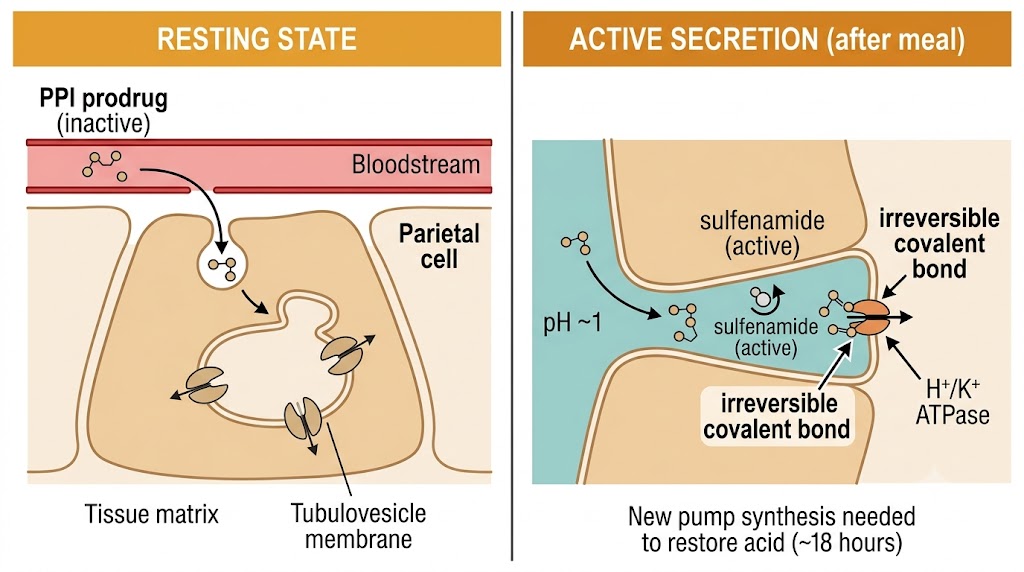
Diagram showing proton pump inhibitor prodrug activation in the gastric secretory canaliculus and covalent binding to the hydrogen-potassium ATPase
Proton pump inhibitors require acid activation in the secretory canaliculus to form the reactive sulfenamide that irreversibly inhibits the hydrogen-potassium ATPase pump.
Mechanism and Dosing Requirements

All proton pump inhibitors are substituted benzimidazole prodrugs. They are absorbed in the small intestine, reach the parietal cell via the bloodstream, and concentrate in the acidic secretory canaliculus. At the low pH of the canaliculus, each prodrug undergoes acid-catalyzed conversion to a reactive sulfenamide that forms a covalent disulfide bond with a cysteine residue on the luminal surface of the hydrogen-potassium ATPase, permanently inactivating that pump molecule. The only way to restore acid secretion is to synthesize new pump protein, which takes approximately 18 hours.

This mechanism explains two non-negotiable dosing rules. First, proton pump inhibitors must be taken 30 to 60 minutes before the first meal of the day, because food stimulates parietal cells to translocate resting pumps to the canalicular membrane, maximizing the number of active pumps available for inactivation. A proton pump inhibitor taken with or after a meal encounters far fewer active pumps and produces substantially less acid suppression. Second, full efficacy requires 3 to 5 days of once-daily dosing to reach steady state, because on day 1 many pumps remain in the resting tubulovesicular pool and are not yet accessible.

Available Agents

The available proton pump inhibitors are omeprazole, esomeprazole (the S-enantiomer of omeprazole), lansoprazole, pantoprazole, and rabeprazole. All share the same mechanism and produce equivalent acid suppression at standard doses in the majority of patients. The pharmacokinetic differences between agents are primarily relevant for drug interactions and for patients with CYP2C19 polymorphisms.

CYP2C19 Pharmacogenomics

All proton pump inhibitors are metabolized primarily by the cytochrome P450 2C19 enzyme. This enzyme is genetically polymorphic. Patients who are ultrarapid metabolizers clear proton pump inhibitors so quickly that standard doses may produce inadequate acid suppression, which can cause treatment failure especially in Helicobacter pylori eradication regimens. Patients who are poor metabolizers accumulate two to five times higher drug levels than normal metabolizers and achieve substantially greater acid suppression at standard doses.

Among available agents, rabeprazole is least affected by CYP2C19 polymorphism because it is metabolized predominantly by non-enzymatic pathways. Pantoprazole has minimal inhibitory effect on CYP2C19 and is preferred when a proton pump inhibitor is needed in a patient taking clopidogrel, because omeprazole and esomeprazole inhibit CYP2C19 and reduce clopidogrel activation to its active metabolite.

Adverse Effects with Long-Term Use

Short-term proton pump inhibitor use is well tolerated. Long-term use carries several risks that are clinically important. Hypomagnesemia occurs because gastric acid is required for normal magnesium absorption through intestinal channels; chronic acid suppression impairs magnesium uptake and can cause severe hypomagnesemia with tetany, seizures, or cardiac arrhythmias. Oral magnesium supplementation does not correct this because the absorptive defect persists; discontinuing the proton pump inhibitor is required.

The risk of Clostridioides difficile colitis is increased because gastric acid normally destroys ingested organisms; acid suppression allows greater survival and colonic colonization. Calcium absorption is also impaired because calcium carbonate requires acid for dissolution; calcium citrate is preferred for supplementation in patients on proton pump inhibitors. Rebound acid hypersecretion occurs on abrupt discontinuation after prolonged use because chronic hypergastrinemia drives proliferation of enterochromaffin-like cells; gradual tapering is preferable to abrupt stopping.

Proton Pump Inhibitor: Timing Is Non-Negotiable

A proton pump inhibitor taken at the wrong time is substantially less effective. The drug must reach the parietal cell while the cell is actively secreting, which requires food stimulation. Correct timing: 30 to 60 minutes before the first meal. A proton pump inhibitor taken at bedtime or with breakfast without a 30-minute lead time will encounter far fewer active pumps. For twice-daily regimens, the second dose goes 30 to 60 minutes before the evening meal, not at bedtime. Correct timing is the single most common correctable source of proton pump inhibitor treatment failure.

Section 3

Histamine H2 Receptor Antagonists

Competitive reversible blockade at the parietal cell H2 receptor, famotidine versus cimetidine, tolerance with continuous use, and the current clinical role

Histamine H2 receptor antagonists were the dominant acid-suppressive drugs before proton pump inhibitors were introduced. Their clinical role has narrowed considerably, but they remain useful for specific indications including nocturnal acid breakthrough and short-term symptom relief.

Mechanism and Efficacy

Histamine H2 receptor antagonists competitively and reversibly block histamine H2 receptors on parietal cells, reducing cyclic adenosine monophosphate generation and decreasing acid output. Because the block is competitive, acid secretion recovers as histamine concentrations exceed the concentration the administered dose can displace. This makes H2 receptor antagonists less effective than proton pump inhibitors, which suppress 90 to 95 percent of pump capacity versus the 60 to 70 percent suppression achieved by H2 receptor antagonists. H2 receptor antagonists are particularly effective for nocturnal acid secretion, which is more histamine-driven and less dependent on meal stimulation than daytime postprandial secretion.

Famotidine vs. Cimetidine

Four H2 receptor antagonists reached clinical use: cimetidine, ranitidine, famotidine, and nizatidine. Ranitidine was globally withdrawn in 2020 because it degrades to N-nitrosodimethylamine, a probable carcinogen, during storage. Cimetidine is rarely used today because it is a broad inhibitor of cytochrome P450 enzymes including CYP1A2, CYP2C9, CYP2D6, and CYP3A4, raising plasma concentrations of warfarin, theophylline, phenytoin, and many other drugs to potentially toxic levels. Cimetidine also blocks androgen receptors at higher doses, causing gynecomastia and impotence.

Famotidine is the preferred agent. It has negligible cytochrome P450 inhibition, no anti-androgenic effects, and a predictable renal excretion profile requiring dose reduction in renal impairment. There is no clinical situation in which cimetidine is preferred over famotidine.

Tolerance and Current Clinical Role

Tolerance develops with continuous H2 receptor antagonist use. After one to two weeks of regular dosing, acid suppression is substantially less than with the first dose, because sustained hypergastrinemia drives upregulation of H2 receptors on parietal cells and proliferation of enterochromaffin-like cells. This limits their utility for long-term maintenance.

Current appropriate uses include: short-term or on-demand symptom relief for mild heartburn, supplementing proton pump inhibitors for nocturnal acid breakthrough in patients who wake with reflux symptoms despite daytime proton pump inhibitor therapy, stress ulcer prophylaxis in critically ill patients, and use in patients who cannot tolerate proton pump inhibitors.

Drug Interaction Alert
Cimetidine: Avoid Due to Cytochrome P450 Inhibition
  • Inhibits CYP1A2, CYP2C9, CYP2D6, CYP3A4 — broad inhibitor
  • Raises warfarin levels: bleeding risk
  • Raises theophylline levels: toxicity risk (seizures, arrhythmias)
  • Raises phenytoin levels: ataxia, nystagmus
  • Blocks androgen receptors: gynecomastia, impotence at high doses
  • Famotidine has none of these interactions — always preferred

Section 4

Helicobacter pylori Eradication

First-line and salvage regimens, clarithromycin resistance, the role of CYP2C19 in treatment success, diagnostic testing with the urea breath test and stool antigen test, and why 14-day therapy outperforms 7-day therapy

Helicobacter pylori infection is the principal cause of peptic ulcer disease worldwide and carries a small but real lifetime risk of gastric cancer in colonized individuals. Eradication heals ulcers and prevents recurrence. Choosing the right regimen requires knowing local resistance patterns and the patient's prior antibiotic history.

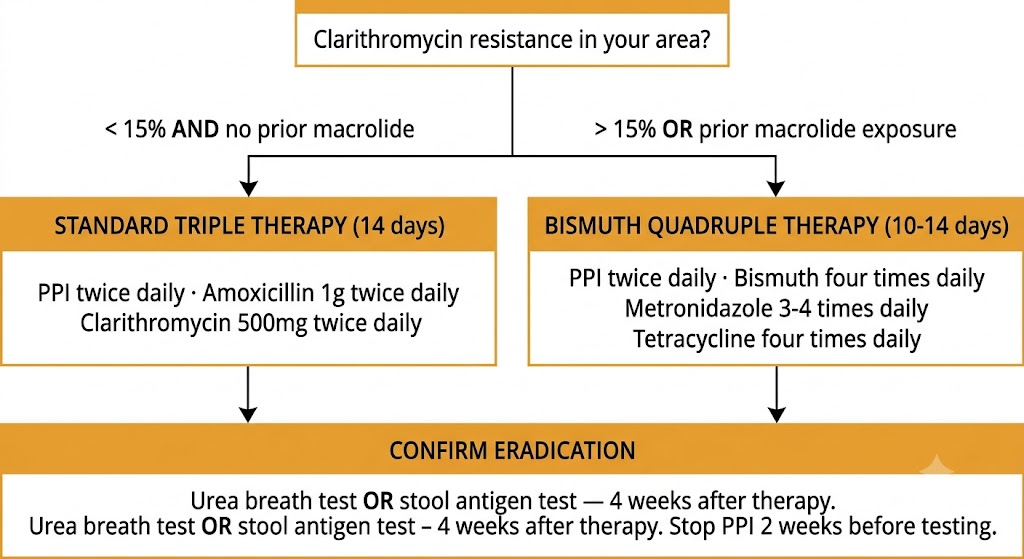
Decision tree for selecting Helicobacter pylori eradication regimen based on local clarithromycin resistance rate
Regimen selection for Helicobacter pylori eradication depends on local clarithromycin resistance rates and prior macrolide exposure. Both regimens run for 14 days.
Indications and Regimen Selection

All patients with confirmed Helicobacter pylori infection should be treated regardless of whether they are symptomatic. Standard triple therapy combines a proton pump inhibitor twice daily with amoxicillin 1 gram twice daily and clarithromycin 500 milligrams twice daily for 14 days. However, clarithromycin resistance now exceeds 15 percent in many regions of the United States and Europe, which renders triple therapy inadequate in those settings.

Bismuth quadruple therapy is the preferred first-line regimen in areas with high clarithromycin resistance or when the patient has had prior macrolide antibiotic exposure. This regimen combines a proton pump inhibitor twice daily with bismuth subcitrate or subsalicylate four times daily, metronidazole three to four times daily, and tetracycline four times daily for 10 to 14 days, achieving eradication rates above 90 percent regardless of clarithromycin resistance.

Why Proton Pump Inhibitor Potency Matters for Eradication

Antibiotics are far less active against Helicobacter pylori at low gastric pH. Eradication success depends on maintaining intragastric pH above 6 for a large proportion of the 24-hour period, which concentrates antibiotics in the gastric mucus and enhances bactericidal activity. CYP2C19 ultrarapid metabolizers clear proton pump inhibitors quickly, resulting in less sustained acid suppression and lower eradication rates at standard doses. For these patients, doubling the proton pump inhibitor dose or selecting rabeprazole, which is less sensitive to CYP2C19 activity, improves outcomes.

Diagnostic Testing

The urea breath test is the preferred non-invasive diagnostic test and the standard for confirming eradication after treatment. The patient ingests labeled urea; Helicobacter pylori urease hydrolyzes it to labeled carbon dioxide detected in exhaled breath. Sensitivity and specificity both exceed 95 percent. The stool antigen test using monoclonal antibody detection is an equally accurate alternative.

Both tests require a washout period before testing to avoid false negatives: proton pump inhibitors must be stopped at least 2 weeks before testing, and antibiotics or bismuth must be stopped at least 4 weeks before testing. Failure to observe these washout periods is the most common cause of false-negative results in clinical practice. Serologic antibody testing cannot confirm eradication because antibody titers remain elevated for months to years after successful treatment and cannot distinguish active from past infection.

First-Line Regimens
Helicobacter pylori Eradication
  • Triple therapy (low resistance areas): proton pump inhibitor + amoxicillin + clarithromycin, 14 days
  • Bismuth quadruple therapy (preferred when clarithromycin resistance >15%): proton pump inhibitor + bismuth + metronidazole + tetracycline, 10–14 days
  • 14-day duration outperforms 7-day by 5–10 percentage points
  • Confirm eradication with urea breath test 4 weeks after completing therapy
Testing Pitfalls
Avoid False Negatives
  • Proton pump inhibitors: stop 2 weeks before urea breath test or stool antigen test
  • Antibiotics or bismuth: stop 4 weeks before testing
  • Serology: cannot confirm eradication — antibodies persist for months to years
  • Order urea breath test or stool antigen test, not serology, for post-treatment confirmation

Section 5

Cytoprotective Agents: Antacids, Sucralfate, and Misoprostol

Acid neutralization versus mucosal protection, sucralfate at the ulcer crater, misoprostol as a prostaglandin analog for nonsteroidal anti-inflammatory drug gastroprotection, and the absolute contraindication in pregnancy

Cytoprotective agents protect the gastric mucosa through mechanisms distinct from acid suppression. Antacids neutralize acid transiently. Sucralfate forms a physical barrier over ulcer craters. Misoprostol replaces the prostaglandins that nonsteroidal anti-inflammatory drugs deplete, restoring mucosal defense. Each has a defined clinical role and important limitations.

Antacids

Antacids are aluminum, magnesium, or calcium salts that neutralize luminal hydrochloric acid directly, raising intragastric pH and transiently inactivating pepsin. Aluminum hydroxide is constipating; magnesium hydroxide is laxative; combination preparations balance these effects. Duration of action is only 1 to 2 hours when taken on an empty stomach. Antacids are appropriate for on-demand relief of mild intermittent heartburn but have no role in ulcer healing or long-term acid management.

Clinically important interactions: antacids chelate fluoroquinolones, tetracyclines, iron salts, and bisphosphonates, forming non-absorbable complexes that markedly reduce absorption of these drugs. These medications should be taken at least 2 hours before or 4 to 6 hours after antacids.

Sucralfate

Sucralfate is an aluminum salt of sucrose octasulfate that polymerizes at acidic pH into a viscous paste. It selectively adheres to proteins at the base of ulcer craters and areas of mucosal damage, forming a physical barrier that protects the ulcer from acid, pepsin, and bile for up to 6 hours per dose. It also stimulates prostaglandin synthesis and mucus secretion. Sucralfate does not neutralize acid.

Because sucralfate contains aluminum, it should be avoided in patients with severe renal impairment who cannot excrete the absorbed aluminum load. Like antacids, sucralfate binds numerous drugs in the intestinal lumen including fluoroquinolones, phenytoin, warfarin, digoxin, and thyroid hormone; a 2-hour separation from these agents is required. Sucralfate is used for stress ulcer prophylaxis in ventilated intensive care unit patients and may carry a lower risk of ventilator-associated pneumonia than proton pump inhibitors because it does not raise intragastric pH.

Misoprostol

Misoprostol is a synthetic prostaglandin E1 analog that acts on prostaglandin E receptors on parietal cells and gastric mucosal cells to stimulate mucus and bicarbonate secretion, enhance mucosal blood flow, and mildly inhibit acid secretion. Its primary pharmacological rationale is to replace the prostaglandins that nonsteroidal anti-inflammatory drugs suppress by inhibiting cyclooxygenase-1. Because nonsteroidal anti-inflammatory drug-induced gastric mucosal injury is largely a consequence of systemic prostaglandin depletion rather than topical acid damage, enteric-coated nonsteroidal anti-inflammatory drug formulations do not prevent ulcers, but misoprostol does. At 200 micrograms four times daily it reduces the incidence of nonsteroidal anti-inflammatory drug-induced gastric and duodenal ulcers by approximately 40 percent. Dose-dependent diarrhea and abdominal cramping limit its tolerability and adherence.

Misoprostol: Absolute Contraindication in Pregnancy

Misoprostol stimulates uterine contractions through prostaglandin E receptors on myometrium. Even at the gastroprotective dose of 200 micrograms four times daily it can cause first-trimester miscarriage or preterm labor. Misoprostol is FDA Pregnancy Category X. It is deliberately used in obstetrics for cervical ripening and labor induction and in combination with mifepristone for medical termination of pregnancy — which is precisely why inadvertent exposure in pregnancy is dangerous. Before prescribing misoprostol for nonsteroidal anti-inflammatory drug gastroprotection, confirm absence of pregnancy and ensure reliable contraception. In women of childbearing potential requiring nonsteroidal anti-inflammatory drug gastroprotection, a proton pump inhibitor is uniformly preferred.


Suggested References
Author / Organization Title Source
Schubert ML, Peura DA Control of gastric acid secretion in health and disease Gastroenterology 2008;134(7):1842–1860
Sachs G et al. The gastric H,K ATPase as a drug target: past, present, and future J Clin Gastroenterol 2007;41(Suppl 2):S226–S242
Shin JM, Sachs G Pharmacology of proton pump inhibitors Curr Gastroenterol Rep 2008;10(6):528–534
Furuta T et al. CYP2C19 pharmacogenomics associated with therapy of Helicobacter pylori infection Drug Metab Pharmacokinet 2005;20(3):153–167
Bhatt DL et al. Clopidogrel with or without omeprazole in coronary artery disease (COGENT trial) N Engl J Med 2010;363(20):1909–1917
Chey WD et al. ACG clinical guideline: treatment of Helicobacter pylori infection Am J Gastroenterol 2017;112(2):212–239
Malfertheiner P et al. Management of Helicobacter pylori infection — the Maastricht V/Florence Consensus Report Gut 2017;66(1):6–30
Graham DY et al. Prevention of nonsteroidal anti-inflammatory drug-induced gastric ulcer with misoprostol Lancet 1988;2(8623):1277–1280