CHAPTER 27  ·  GASTROINTESTINAL PHARMACOLOGY
Section 1

The Vomiting Reflex: Chemoreceptor Trigger Zone and Vomiting Center

The area postrema outside the blood-brain barrier, four afferent inputs to the vomiting center, and how receptor pharmacology defines antiemetic drug classes

Rational antiemetic selection requires understanding where the vomiting reflex is controlled and which receptors mediate each afferent input. Most antiemetics work by blocking specific receptors at the chemoreceptor trigger zone, the vomiting center, or both.

The Chemoreceptor Trigger Zone

The chemoreceptor trigger zone is located in the area postrema on the floor of the fourth ventricle. Its defining feature is that it lies outside the blood-brain barrier, allowing circulating emetogenic substances — chemotherapy drugs, opioids, uremic toxins, digoxin — to reach and activate it directly without penetrating the brain. The chemoreceptor trigger zone is densely populated with dopamine D2 receptors, serotonin 5-HT3 receptors, and neurokinin 1 receptors, making it the primary pharmacological target for antiemetics used in chemotherapy-induced and postoperative nausea and vomiting. Activated chemoreceptor trigger zone neurons send signals to the vomiting center in the medullary dorsal vagal complex.

Four Afferent Inputs to the Vomiting Center

The vomiting center in the nucleus tractus solitarius receives convergent input from four sources. First, the chemoreceptor trigger zone signals blood-borne emetogenic stimuli. Second, vagal afferents from the gastrointestinal tract carry signals generated by enterochromaffin cell serotonin release in response to mucosal injury, distension, or cytotoxic drugs — this peripheral serotonin pathway is the dominant mechanism of acute chemotherapy-induced nausea and vomiting within the first 24 hours. Third, the vestibular nuclei transmit signals from the inner ear, which is why motion sickness and labyrinthine disorders cause nausea. Fourth, higher cortical centers mediate anticipatory nausea and anxiety-driven emesis.

Understanding which input dominates in a given clinical situation is the key to selecting the right antiemetic class. Chemotherapy-induced nausea and vomiting requires blockade of the chemoreceptor trigger zone and vagal serotonin pathway. Motion sickness requires vestibular pathway blockade. Opioid-induced nausea requires chemoreceptor trigger zone dopamine D2 receptor blockade.

Match Antiemetic to Mechanism of Nausea

Chemotherapy-induced nausea and vomiting (acute): serotonin 5-HT3 receptor antagonist plus neurokinin 1 receptor antagonist plus dexamethasone. Motion sickness: scopolamine (muscarinic antagonist blocking vestibular input). Opioid-induced nausea: low-dose haloperidol or prochlorperazine (dopamine D2 receptor antagonist at chemoreceptor trigger zone). Postoperative nausea and vomiting: ondansetron plus or minus dexamethasone. Anticipatory nausea: benzodiazepine or behavioral approach in addition to receptor-targeted drugs.


Section 2

Prokinetic Agents

Metoclopramide and domperidone as dopamine D2 antagonists, erythromycin as a motilin receptor agonist, tardive dyskinesia risk and the 12-week rule, and domperidone QTc risk

Prokinetic drugs accelerate gastric emptying and enhance coordinated gastrointestinal motility. Their usefulness is substantially limited by adverse effect profiles, particularly the central nervous system toxicity of dopamine D2 receptor antagonists and the QTc prolongation risk of domperidone.
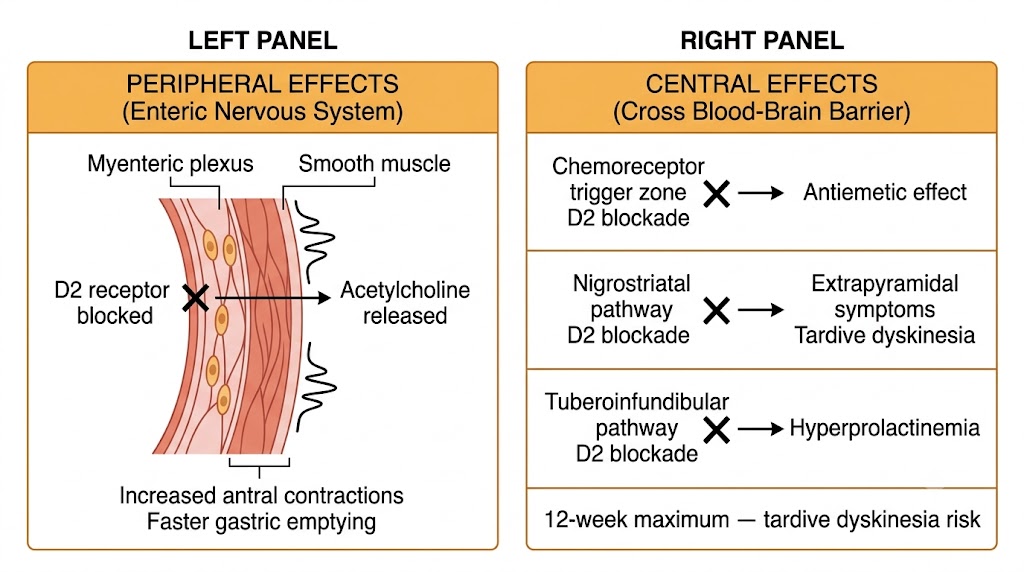
Two-panel diagram contrasting the peripheral enteric nervous system effects of metoclopramide with its central nervous system dopamine D2 receptor blockade effects
Metoclopramide blocks dopamine D2 receptors in both the enteric nervous system (prokinetic effect) and the central nervous system (antiemetic effect and adverse effects including tardive dyskinesia).
Metoclopramide

Metoclopramide blocks dopamine D2 receptors in both the enteric nervous system and the central nervous system. In the gut wall, D2 receptor blockade disinhibits acetylcholine release from the myenteric plexus, increasing antral contractility and accelerating gastric emptying. In the chemoreceptor trigger zone, the same mechanism provides antiemetic activity. At higher doses metoclopramide also blocks serotonin 5-HT3 receptors and partially activates 5-HT4 receptors.

The central nervous system D2 receptor blockade produces the full range of dopamine antagonist adverse effects. Extrapyramidal symptoms including akathisia, acute dystonia, and drug-induced parkinsonism arise from blockade in the nigrostriatal pathway. Tardive dyskinesia — repetitive involuntary orofacial and limb movements — results from D2 receptor upregulation after prolonged blockade and is often irreversible even after the drug is stopped. The FDA requires a black box warning: metoclopramide must not be used for longer than 12 weeks for any indication. Metoclopramide also causes hyperprolactinemia through dopamine blockade in the tuberoinfundibular pathway, producing galactorrhea and amenorrhea. It should not be used in patients with Parkinson disease, where additional D2 blockade worsens motor function.

Domperidone

Domperidone is a D2 receptor antagonist that does not readily cross the blood-brain barrier because it is a substrate for P-glycoprotein efflux transport at the barrier. This peripheral selectivity means it produces prokinetic effects in the gut and antiemetic effects via chemoreceptor trigger zone D2 blockade — the area postrema lies outside the blood-brain barrier and is accessible — without causing extrapyramidal adverse effects. However, domperidone prolongs the corrected QT interval through cardiac potassium channel blockade and carries a risk of serious ventricular arrhythmias. An electrocardiogram should be obtained before starting, concurrent QTc-prolonging drugs should be avoided, and the lowest effective dose should be used. Domperidone is not approved by the FDA and is unavailable in the United States except through expanded access programs.

Erythromycin

At subantimicrobial doses, erythromycin acts as a motilin receptor agonist, mimicking the endogenous hormone motilin that drives phase III interdigestive contractions. It produces powerful antral contractions and is among the most potent prokinetics available, particularly useful for acute gastroparetic crises. Its major limitation is rapid tachyphylaxis from motilin receptor downregulation within days to weeks of continuous use, limiting its role to short-term or acute use. Erythromycin also inhibits cytochrome P450 3A4 and adds QTc prolongation risk.

Metoclopramide Black Box Warning: 12-Week Maximum

Tardive dyskinesia risk rises with duration of use and cumulative dose and is often irreversible. The FDA black box warning prohibits use beyond 12 weeks. When prescribing metoclopramide for gastroparesis, document the start date and a planned stop date at initiation. Use the lowest effective dose. Inform patients of the tardive dyskinesia risk before starting. Review at every refill. Do not prescribe to patients with Parkinson disease or prior tardive dyskinesia from any dopamine antagonist.

Section 3

Antiemetics: Serotonin 5-HT3 Antagonists and Neurokinin 1 Receptor Antagonists

Ondansetron and palonosetron for acute chemotherapy-induced and postoperative nausea and vomiting, QTc risk with ondansetron, aprepitant for delayed chemotherapy-induced nausea and vomiting, and the CYP3A4 interaction between aprepitant and dexamethasone

Serotonin 5-HT3 receptor antagonists and neurokinin 1 receptor antagonists are the cornerstone of prophylaxis for chemotherapy-induced nausea and vomiting. They target different phases of the emetic response and are most effective in combination.

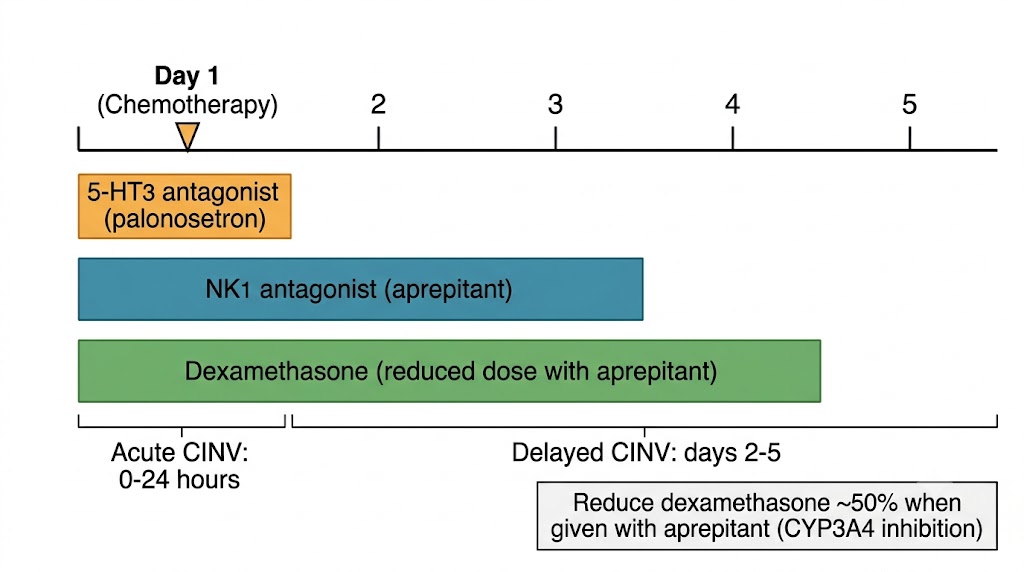
Timeline diagram showing the three-drug antiemetic regimen for highly emetogenic chemotherapy across days 1 through 5
Three-drug prophylaxis for highly emetogenic chemotherapy combines a serotonin 5-HT3 receptor antagonist, a neurokinin 1 receptor antagonist, and dexamethasone on day 1, with continuation for delayed chemotherapy-induced nausea and vomiting through day 4.
Serotonin 5-HT3 Receptor Antagonists

Serotonin 5-HT3 receptor antagonists block serotonin receptors on vagal afferent terminals in the gut wall and on neurons in the nucleus tractus solitarius, interrupting the peripheral serotonin-mediated afferent signal that drives acute chemotherapy-induced nausea and vomiting within the first 24 hours. They are also highly effective for postoperative nausea and vomiting. Ondansetron is the prototype and the most widely used; granisetron, dolasetron, and palonosetron are later agents. Palonosetron has a substantially longer half-life and higher receptor affinity than first-generation agents, with superior efficacy for delayed chemotherapy-induced nausea and vomiting compared to ondansetron.

The key adverse effect is QTc interval prolongation through cardiac potassium channel blockade. The FDA recommends against single intravenous doses of ondansetron greater than 32 milligrams. The risk is greatest in patients with pre-existing QTc prolongation, hypokalemia, hypomagnesemia, or concurrent QTc-prolonging drugs. Palonosetron has minimal cardiac channel affinity and does not cause clinically significant QTc prolongation. Constipation and headache are common non-cardiac adverse effects across the class.

Neurokinin 1 Receptor Antagonists

Substance P acting on neurokinin 1 receptors in the central nervous system mediates the delayed phase of chemotherapy-induced nausea and vomiting — the nausea that peaks at 48 to 72 hours post-chemotherapy and persists through day 5. Neurokinin 1 receptor antagonists block this pathway. Aprepitant is given orally for 3 days starting on the day of chemotherapy; fosaprepitant is the intravenous prodrug. Netupitant is available in a fixed-dose combination with palonosetron, conveniently combining both drug classes in a single capsule.

Aprepitant is a moderate inhibitor of cytochrome P450 3A4 and also induces cytochrome P450 2C9. The cytochrome P450 3A4 inhibition increases dexamethasone exposure substantially; when dexamethasone is used as part of a chemotherapy-induced nausea and vomiting prophylaxis regimen with aprepitant, the dexamethasone dose is typically reduced by approximately 50 percent. The cytochrome P450 2C9 induction reduces warfarin concentrations; the international normalized ratio should be monitored in anticoagulated patients receiving aprepitant.

Standard Regimen
Highly Emetogenic Chemotherapy Prophylaxis
  • Day 1: serotonin 5-HT3 receptor antagonist (palonosetron preferred) + neurokinin 1 receptor antagonist (aprepitant or fosaprepitant) + dexamethasone (dose reduced ~50% when given with aprepitant)
  • Days 2–4: dexamethasone continued for delayed chemotherapy-induced nausea and vomiting coverage
  • Monitor international normalized ratio if patient is on warfarin
  • Check QTc before ondansetron in high-risk patients; use palonosetron if QTc prolongation is a concern

Section 4

Antiemetics: Dopamine Antagonists, Dexamethasone, Scopolamine, and Dronabinol

Prochlorperazine and haloperidol for dopamine-mediated nausea, dexamethasone as an antiemetic adjunct, scopolamine for motion sickness, and dronabinol for refractory chemotherapy-induced nausea and vomiting

Dopamine Antagonist Antiemetics

Prochlorperazine, a phenothiazine, and haloperidol, a butyrophenone, both block dopamine D2 receptors at the chemoreceptor trigger zone and are used for nausea from multiple causes including low-to-moderate emetogenicity chemotherapy, opioid-induced nausea, and vestibular disorders. Both carry risks of extrapyramidal symptoms and QTc prolongation. Prochlorperazine has significant sedation and anticholinergic effects. Haloperidol at low antiemetic doses (0.5 to 2 milligrams) is commonly used in palliative care settings. Droperidol, a butyrophenone used for postoperative nausea and vomiting at very low doses, carries an FDA black box warning for QTc prolongation and fatal arrhythmias; its use has declined but it retains a role at doses of 0.625 milligrams intravenously when QTc risk is assessed as acceptable.

Promethazine is a phenothiazine with additional histamine H1 receptor and muscarinic receptor antagonism, making it effective for motion sickness and postoperative nausea and vomiting. It carries an FDA black box warning against use in children under 2 years old because of respiratory depression risk. Deep sedation limits outpatient utility.

Dexamethasone

Dexamethasone is an effective antiemetic adjunct through mechanisms that are not fully understood but may include reduction of prostaglandin synthesis in the brainstem and reduced serotonin release from enterochromaffin cells. It consistently improves complete response rates by 15 to 25 percentage points when added to serotonin 5-HT3 receptor antagonist-based regimens. Short antiemetic courses cause transient hyperglycemia, insomnia, and mood changes but are generally safe even in patients with diabetes with appropriate glucose monitoring.

Scopolamine

Scopolamine blocks muscarinic M1 receptors on vestibular nucleus neurons, interrupting the vestibular afferent pathway. It is the most effective drug for motion sickness. The transdermal patch delivers drug continuously over 72 hours. Anticholinergic adverse effects — dry mouth, blurred vision, urinary retention, confusion in elderly patients — are predictable from its mechanism. Hands must be washed after handling the patch to prevent inadvertent ocular exposure, which can precipitate acute angle-closure glaucoma.

Dronabinol

Dronabinol is synthetic delta-9-tetrahydrocannabinol that acts as a partial agonist at cannabinoid CB1 receptors in the central nervous system. It is FDA-approved for chemotherapy-induced nausea and vomiting refractory to conventional antiemetics and for anorexia in AIDS patients. Adverse effects include euphoria or dysphoria, sedation, tachycardia, and impaired psychomotor function, which are particularly poorly tolerated in older adults. It is a Schedule III controlled substance and used as a rescue antiemetic rather than first-line therapy.


Section 5

Gastroparesis: Pathophysiology and Management

Diabetic and idiopathic gastroparesis, the limited drug armamentarium, metoclopramide as the only FDA-approved agent, erythromycin for acute exacerbations, and domperidone through expanded access

Gastroparesis is delayed gastric emptying without mechanical obstruction. Pharmacological management is constrained by a small number of available agents and the significant toxicity of the most effective ones.

Pathophysiology

In diabetic gastroparesis, chronic hyperglycemia damages the interstitial cells of Cajal that generate gastric pacemaker activity and injures enteric neurons and the vagus nerve through autonomic neuropathy. The result is loss of coordinated antral contractility and pyloric relaxation. Idiopathic gastroparesis is the most common form overall; post-surgical gastroparesis follows vagotomy or fundoplication. Diagnosis requires gastric emptying scintigraphy with retention of greater than 10 percent of a standardized solid meal at 4 hours after ingestion, with mechanical obstruction excluded.

Drug Selection Framework

Metoclopramide 5 to 10 milligrams three to four times daily before meals is the only FDA-approved drug for gastroparesis in the United States and is first-line despite its tardive dyskinesia risk. Use the lowest effective dose, document the start date, and plan for a maximum 12-week course. For acute exacerbations or when oral therapy fails, intravenous metoclopramide is standard inpatient management. Low-dose erythromycin is a useful second-line agent for acute crises but loses efficacy within weeks of continuous use from tachyphylaxis. Domperidone, available through FDA expanded access for patients who cannot tolerate metoclopramide and have a normal baseline QTc, avoids extrapyramidal adverse effects but requires cardiac monitoring.

Non-pharmacological measures are integral: small frequent low-fat low-fiber meals, tight glycemic control in diabetic patients (acute hyperglycemia itself inhibits gastric motility), and in refractory cases gastric electrical stimulation device therapy for symptom relief.

Outpatient Management
Step-Through Approach
  • Step 1: metoclopramide 5 mg before meals — lowest dose, 12-week maximum, document start date
  • Step 2: erythromycin 125–250 mg before meals for acute exacerbations (expect tachyphylaxis within weeks)
  • Step 3: domperidone via expanded access if normal QTc and metoclopramide not tolerated
  • Step 4: refer for gastric electrical stimulation evaluation if refractory
  • Always: optimize glycemic control, dietary modification
Acute Inpatient Crisis
Hospital Management
  • Intravenous hydration and electrolyte correction (hypokalemia, hypomagnesemia from vomiting)
  • Intravenous metoclopramide 10 mg every 6 hours
  • Intravenous erythromycin 1–3 mg/kg every 6–8 hours as adjunct
  • Nasojejunal feeding if oral intake remains inadequate after stabilization
  • Parenteral nutrition only if jejunal feeding not feasible

Suggested References
Author / Organization Title Source
Hornby PJ Central neurocircuitry associated with emesis Am J Med 2001;111(Suppl 8A):106S–112S
Rao AS, Camilleri M Review article: metoclopramide and tardive dyskinesia Aliment Pharmacol Ther 2010;31(1):11–19
Acosta A, Camilleri M Prokinetics in gastroparesis Gastroenterol Clin North Am 2015;44(1):97–111
Rojas C, Slusher BS Pharmacological mechanisms of 5-HT3 and tachykinin NK1 receptor antagonism to prevent chemotherapy-induced nausea and vomiting Eur J Pharmacol 2012;684(1–3):1–7
Hesketh PJ et al. Antiemetics: ASCO guideline update J Clin Oncol 2020;38(24):2782–2797
Gan TJ et al. Fourth consensus guidelines for the management of postoperative nausea and vomiting Anesth Analg 2020;131(2):411–448
Camilleri M et al. ACG clinical guideline: management of gastroparesis Am J Gastroenterol 2013;108(1):18–37