CHAPTER 21  ·  HISTAMINE AND BRADYKININ PHARMACOLOGY

Section 1

H2 Receptor and Gastric Acid Secretion

The three convergent stimuli of parietal cell acid secretion and histamine as the dominant amplifying pathway

H2 receptor antagonists reduce gastric acid output by competing with histamine at the H2 receptor on gastric parietal cells. Understanding why they are effective — and where their limits lie compared to proton pump inhibitors — requires knowing that the parietal cell is regulated by three convergent stimulatory pathways, and that histamine is the dominant amplifier of all three.

Three Stimuli, One Final Common Step

Gastric parietal cells receive stimulatory input from three sources: histamine (acting at H2 receptors, Gs-coupled), gastrin (acting at cholecystokinin-2 receptors on the parietal cell and on enterochromaffin-like cells), and acetylcholine (acting at muscarinic M3 receptors, from vagal efferents). All three pathways converge on activation of the hydrogen-potassium ATPase — the proton pump — on the apical membrane of the parietal cell, which pumps hydrogen ions into the gastric lumen in exchange for potassium ions.

Histamine occupies a central amplifying role in this system. Gastrin and acetylcholine both stimulate enterochromaffin-like cells in the adjacent gastric mucosa to release histamine in a paracrine fashion, which then acts on parietal cell H2 receptors. H2 receptor activation raises cyclic adenosine monophosphate via Gs, activating protein kinase A, which activates the proton pump. Because histamine amplifies the response to the other two stimuli as well as acting directly, H2 receptor blockade reduces acid output driven by all three pathways — not just histamine-driven secretion alone.
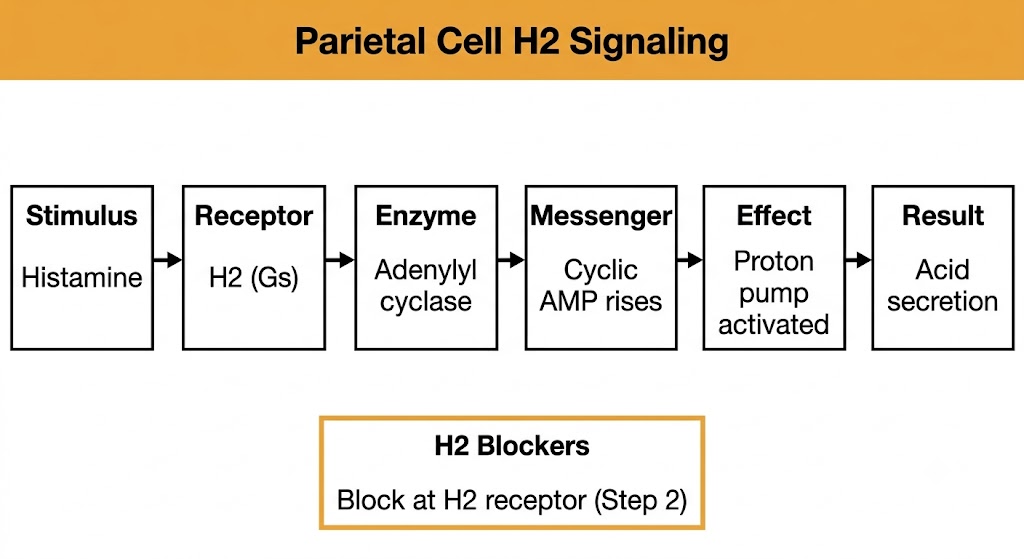
Horizontal flow diagram showing parietal cell H2 receptor signaling: histamine activates H2 receptor coupled to Gs, activating adenylyl cyclase, raising cyclic AMP, activating the proton pump, resulting in acid secretion. A box below labels the receptor step as the site of H2 blocker action.
H2 receptor signaling cascade in the gastric parietal cell: Gs-coupled activation leads to cyclic adenosine monophosphate-driven proton pump activation and acid secretion. Figure generated by Gemini AI.

H2 Blockers versus Proton Pump Inhibitors — Why PPIs Win on Potency

H2 blockers are competitive reversible antagonists at the H2 receptor — their inhibition can be overcome by high concentrations of histamine. This is why they provide partial but not complete acid suppression and are less effective than proton pump inhibitors for high-output states like Zollinger-Ellison syndrome.

Proton pump inhibitors irreversibly inhibit the hydrogen-potassium ATPase at the final common step of all three stimulatory pathways. They produce near-complete suppression of stimulated acid secretion regardless of how much histamine, gastrin, or acetylcholine is driving the parietal cell upstream. For erosive disease, Helicobacter pylori eradication, and Zollinger-Ellison syndrome, proton pump inhibitors are superior and first-line.

Section 2

H2 Blocker Agents

Cimetidine, famotidine, ranitidine, and nizatidine — potency, drug interactions, and the antiandrogenic profile of cimetidine

The four H2 blockers share the same mechanism — competitive reversible antagonism at the parietal cell H2 receptor — but differ markedly in potency and in off-target effects. Cimetidine is distinguished from the other agents by two high-yield adverse effect profiles: broad cytochrome P450 inhibition producing clinically significant drug interactions, and antiandrogenic activity producing gynecomastia in men. Famotidine has neither property and is the preferred agent in most clinical settings.

Cimetidine

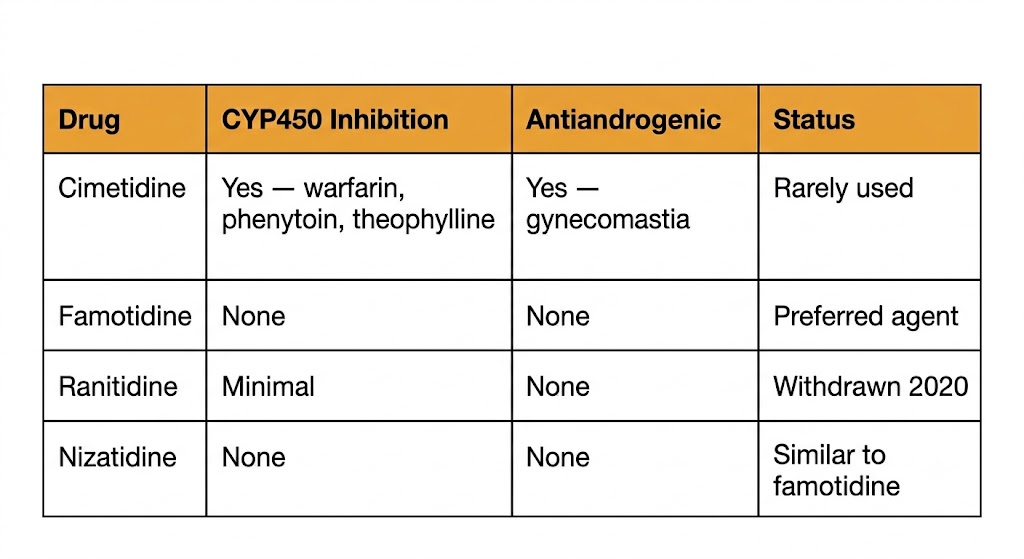
Cimetidine was the first H2 blocker introduced and remains important as a teaching example of drug interactions through enzyme inhibition. It inhibits multiple cytochrome P450 enzymes through binding at the heme iron via its imidazole ring — a broad inhibitory profile that elevates plasma concentrations of co-administered drugs metabolized by these enzymes. The three drug interactions tested most consistently on Step 1 involve warfarin (increased anticoagulant effect and bleeding risk), phenytoin (elevated levels and toxicity), and theophylline (elevated levels — narrow therapeutic index, risk of arrhythmia and seizures). Any patient on these agents who is started on cimetidine requires monitoring and likely dose reduction of the affected drug.

Cimetidine also binds androgen receptors and acts as an androgen antagonist. In men at therapeutic doses this produces gynecomastia (breast tissue enlargement) and impotence, both reversible on discontinuation. This is a direct receptor-level effect, not a consequence of drug interactions. The correct response to cimetidine-induced gynecomastia is to switch to famotidine. Famotidine has no cytochrome P450 inhibitory activity and no antiandrogenic effects.

Famotidine, Ranitidine, and Nizatidine

Famotidine is the most potent H2 blocker currently in clinical use. It lacks the cytochrome P450 inhibitory and antiandrogenic properties of cimetidine and is the preferred H2 blocker for patients on polypharmacy. It is primarily renally eliminated, and dose reduction is required in significant renal impairment.

Ranitidine was withdrawn from the United States market in 2020 following the discovery of N-nitrosodimethylamine contamination — a probable human carcinogen generated during storage degradation. It should not be taught as an active clinical agent; if encountered in a question, the withdrawal and its reason are the testable facts.

Nizatidine has a pharmacological profile similar to famotidine — no cytochrome P450 inhibition, no antiandrogenic effects, intermediate potency. It is lower yield than cimetidine or famotidine at the Step 1 level.

Reference table comparing four H2 blockers: cimetidine with low potency, cytochrome P450 inhibition, and antiandrogenic effects; famotidine with highest potency and no adverse interactions; ranitidine marked as withdrawn in 2020; nizatidine similar to famotidine.
H2 blocker comparison: potency, cytochrome P450 inhibition, and antiandrogenic effects. Figure generated by Gemini AI.

Section 3

Clinical Uses of H2 Blockers

Peptic ulcer disease, gastroesophageal reflux disease, and the clinical comparison with proton pump inhibitors

H2 blockers are effective for peptic ulcer disease and mild to moderate gastroesophageal reflux disease, but proton pump inhibitors are superior for healing erosive disease and for conditions driven by very high acid output. Knowing when each class is appropriate — and why — is the Step 1 clinical application of this module.

Peptic Ulcer Disease

H2 blockers accelerate healing of duodenal and gastric ulcers by reducing acid exposure. Proton pump inhibitors produce faster healing and are the standard of care for peptic ulcer disease. When peptic ulcer disease is caused by Helicobacter pylori infection — which accounts for most duodenal ulcers — eradication therapy (a proton pump inhibitor plus two antibiotics) is definitive treatment; H2 blockers are not part of standard eradication regimens. H2 blockers remain appropriate for mild uncomplicated disease and maintenance therapy.

Gastroesophageal Reflux Disease

H2 blockers are appropriate for mild to moderate gastroesophageal reflux disease without esophageal erosions, where they relieve heartburn and regurgitation. For erosive esophagitis — visible mucosal damage on endoscopy — proton pump inhibitors are required for healing. Proton pump inhibitors provide more complete and sustained acid suppression, which is necessary for mucosal repair; H2 blockers are inadequate as primary therapy for erosive disease.

H2 Blockers versus Proton Pump Inhibitors — Key Comparison

Feature H2 Blockers Proton Pump Inhibitors
Mechanism Competitive reversible antagonist at parietal cell H2 receptor Irreversible inhibitor of hydrogen-potassium ATPase (proton pump) — acts at final common step
Acid suppression Partial — can be overcome by high histamine levels Near-complete suppression of stimulated acid secretion
Erosive esophagitis Inadequate for healing First-line; superior healing rates
Zollinger-Ellison syndrome May be inadequate at high histamine drive First-line; high doses effective
H. pylori eradication Not used in eradication regimens Component of all standard triple therapy regimens
Over-the-counter availability Yes — famotidine widely available Yes — omeprazole and lansoprazole available over the counter

Section 4

Adverse Effects, Drug Interactions, and Anaphylaxis Adjunct Role

Cimetidine cytochrome P450 inhibition, antiandrogenic effects, class-wide considerations, and the role of H2 blockers as adjuncts in anaphylaxis management

The adverse effect profile of H2 blockers is largely favorable as a class, but cimetidine carries two uniquely high-yield toxicities. Beyond acid suppression, H2 blockers also have a secondary clinical role: alongside H1 antihistamines in anaphylaxis adjunct therapy, combined H1 plus H2 blockade provides broader histamine receptor coverage than H1 alone.

Cimetidine — Cytochrome P450 Inhibition

Cimetidine inhibits multiple cytochrome P450 enzymes, reducing hepatic metabolism of co-administered drugs and raising their plasma concentrations. The three interactions of highest Step 1 relevance are with warfarin (elevated international normalized ratio, bleeding risk), phenytoin (elevated levels, nystagmus and ataxia at toxic concentrations), and theophylline (elevated levels — theophylline has a narrow therapeutic index, with toxicity producing nausea, arrhythmias, and seizures). Famotidine and nizatidine do not inhibit cytochrome P450 to a clinically significant degree. When a clinical vignette presents a patient on warfarin, phenytoin, or theophylline who develops toxicity after starting an H2 blocker, cimetidine is the answer.

Cimetidine Drug Interactions — Three High-Yield Pairs

Cimetidine + warfarin: inhibits warfarin metabolism → elevated international normalized ratio → bleeding. Reduce warfarin dose; monitor closely.

Cimetidine + phenytoin: inhibits phenytoin metabolism → elevated phenytoin levels → toxicity (nystagmus, ataxia, confusion).

Cimetidine + theophylline: inhibits theophylline metabolism → elevated levels → toxicity (nausea, arrhythmias, seizures). Theophylline has a narrow therapeutic window — small rises are clinically significant.

The fix in all three cases: switch to famotidine, which has no cytochrome P450 inhibitory activity.

Cimetidine — Antiandrogenic Effects

Cimetidine binds androgen receptors and acts as an androgen antagonist independent of its acid-suppressing activity. In men at standard therapeutic doses this causes gynecomastia and impotence, both reversible on discontinuation. A Step 1 vignette presenting a man on long-term cimetidine for peptic ulcer disease who develops breast enlargement is a classic scenario; the answer is to switch to famotidine, which has no affinity for androgen receptors.

Class-Wide Adverse Effects

All H2 blockers are generally well tolerated. Minor adverse effects include headache, dizziness, and mild gastrointestinal symptoms. All are renally excreted and require dose reduction in patients with significant renal impairment to prevent accumulation.

H2 Blockers in Anaphylaxis — Adjunctive Role

In anaphylaxis, histamine contributes to cardiovascular collapse through both H1-mediated vasodilation and H2-mediated tachycardia and vasodilation in certain vascular beds. This dual receptor contribution is the pharmacological rationale for using combined H1 plus H2 blockade as adjunctive therapy after epinephrine — the combination provides broader histamine receptor coverage than H1 blockade alone and reduces the cutaneous manifestations of anaphylaxis more effectively. Diphenhydramine (H1 blocker) plus famotidine (H2 blocker) is a standard adjunct combination used in clinical practice.

The hierarchy must be clear: epinephrine remains the only first-line treatment. H1 and H2 antihistamines are adjuncts for cutaneous symptoms and do not reverse hemodynamic collapse or bronchospasm. Systemic corticosteroids are also given as adjuncts to suppress the late-phase inflammatory response, though their onset is delayed by several hours and they provide no benefit in the acute emergency. In patients taking beta-blockers who have refractory bronchospasm unresponsive to epinephrine, glucagon is used because it activates adenylyl cyclase via a receptor independent of the beta-adrenergic receptor.


Visual Reference

Module 3 Visual Summary

Parietal cell signaling, H2 blocker agent comparison, and cimetidine adverse effect profile

Suggested References
Author / Organization Title Source
Schubert ML, Peura DA Control of gastric acid secretion in health and disease Gastroenterology. 2008;134(7):1842–1860
Rendic S, Di Carlo FJ Human cytochrome P450 enzymes: a status report summarizing their reactions, substrates, inducers, and inhibitors Drug Metab Rev. 1997;29(1–2):413–580
Simons FE, Ardusso LR, Bilo MB, et al. World Allergy Organization guidelines for the assessment and management of anaphylaxis World Allergy Organ J. 2011;4(2):13–37
Lieberman P, Nicklas RA, Randolph C, et al. Anaphylaxis: a practice parameter update 2015 Ann Allergy Asthma Immunol. 2015;115(5):341–384
Moreau ME, Garbacki N, Molinaro G, Brown NJ, Marceau F, Adam A The kallikrein-kinin system: current and future pharmacological targets J Pharmacol Sci. 2005;99(1):6–38
Sica DA, Gehr TWB Angiotensin-converting enzyme inhibitors In: Oparil S, Weber MA, eds. Hypertension: A Companion to Brenner and Rector's The Kidney. 2nd ed. Philadelphia, PA: Elsevier Saunders; 2005:509–519
Haymore BR, Yoon J, Mikita CP, Klote MM, DeZee KJ Risk of angioedema with angiotensin receptor blockers in patients with prior angioedema associated with angiotensin-converting enzyme inhibitors: a meta-analysis Ann Allergy Asthma Immunol. 2008;101(5):495–499