Introduction to Medical Pharmacology
Module 2 — H1 Antihistamines: First and Second Generation
HBRD · Module 2 of 4Section 1
Inverse agonism at the H1 receptor and the pharmacokinetic basis of the generation difference
H1 antihistamines block the H1 receptor to prevent histamine from producing its vascular, bronchial, and sensory effects. All agents in the class are technically inverse agonists rather than simple competitive antagonists. The distinction between first- and second-generation agents comes down to a single pharmacokinetic difference: the ability to enter the central nervous system, which determines the entire clinical profile of each generation.
H1 receptors exist in an equilibrium between an inactive conformation and an active conformation. Histamine binds preferentially to the active conformation, stabilizing it and producing a signal. H1 antihistamines bind preferentially to the inactive conformation, stabilizing it and shifting the equilibrium away from active receptor — suppressing even the constitutive (baseline) receptor activity. This inverse agonist mechanism accounts for anti-inflammatory effects of H1 antihistamines beyond simple histamine blockade, and it is why they are more accurately termed inverse agonists than competitive antagonists, though the practical clinical consequence is the same: blockade of histamine-mediated responses.
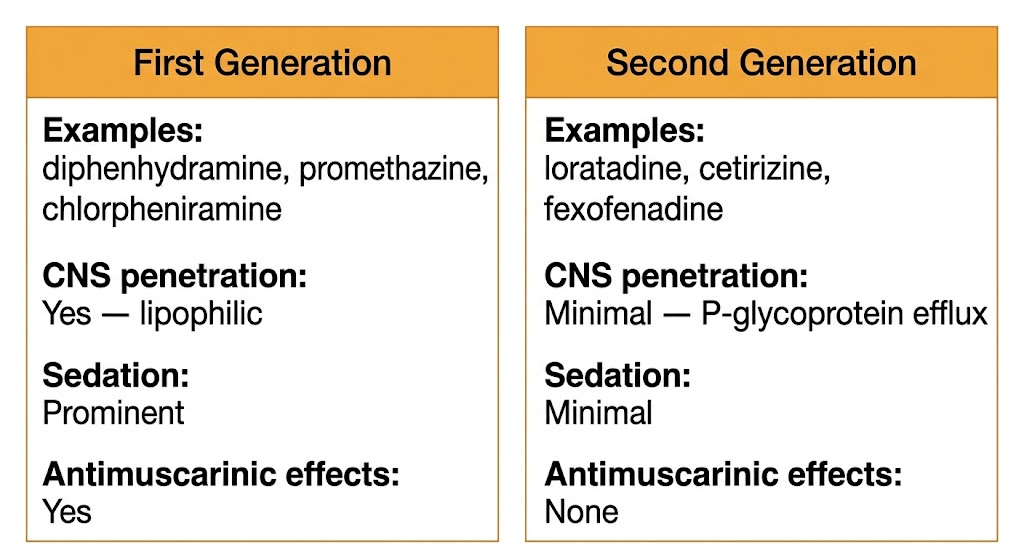
First-generation H1 antihistamines are sufficiently lipophilic to cross the blood-brain barrier by passive diffusion. Once in the central nervous system they block H1 receptors on tuberomammillary nucleus neurons, disrupting the histaminergic arousal system and producing sedation ranging from mild drowsiness to pronounced somnolence. Additive central nervous system depression with alcohol, opioids, and benzodiazepines is a significant safety hazard.
Second-generation agents achieve central nervous system exclusion through two complementary mechanisms. First, they are less lipophilic than first-generation agents, reducing passive diffusion across the blood-brain barrier. Second, and more importantly, they are substrates for P-glycoprotein, an efflux transporter expressed at high density on the luminal surface of brain endothelial cells that actively pumps drug substrates back into the bloodstream. The net result is that second-generation antihistamines produce peripheral H1 blockade with negligible central nervous system activity and minimal sedation at therapeutic doses.
Duration of action also differs between generations. First-generation agents generally require dosing every four to six hours. Second-generation agents have longer durations of action suitable for once-daily dosing — an important practical advantage for chronic allergic conditions.
Section 2
Diphenhydramine, promethazine, hydroxyzine, and chlorpheniramine — sedation, antimuscarinic burden, clinical uses, and toxicity
First-generation H1 antihistamines are effective peripheral H1 blockers but carry central nervous system and antimuscarinic side effects that limit their use wherever daytime alertness matters. The same properties that make them problematic for chronic allergy management create specific therapeutic niches in motion sickness, acute sedation, and nighttime pruritus management.
Diphenhydramine is the prototypical first-generation agent and the benchmark against which others are compared. It is the active ingredient in most over-the-counter sleep aids and allergy preparations. Promethazine is a phenothiazine-derived antihistamine with particularly pronounced antiemetic and sedative properties, widely used for motion sickness and postoperative nausea. Hydroxyzine has both antihistaminic and modest anxiolytic properties and is used for pruritus and preoperative anxiety. Chlorpheniramine has a relatively lower sedative and antimuscarinic burden than diphenhydramine and is a common component of combination cold preparations.
All first-generation agents cross the blood-brain barrier and block central nervous system H1 receptors, suppressing histaminergic arousal signals from the tuberomammillary nucleus. The resulting sedation, cognitive impairment, and psychomotor slowing are hazardous when patients need to drive or operate machinery. The sedation is additive with other central nervous system depressants — alcohol, opioids, benzodiazepines — and this combination can produce dangerous respiratory depression.
In young children, first-generation antihistamines can produce paradoxical excitation — restlessness, irritability, and hyperactivity rather than sedation — attributed to incomplete maturation of central nervous system inhibitory systems. Promethazine is contraindicated in children under two years of age due to risk of fatal respiratory depression.
First-generation antihistamines have significant affinity for muscarinic acetylcholine receptors in addition to H1 receptors. This off-target activity produces the classic anticholinergic adverse effect profile: dry mouth, urinary retention, constipation, blurred vision (cycloplegia), and tachycardia. In elderly patients, anticholinergic burden is a recognized contributor to cognitive impairment, confusion, falls, and urinary retention. First-generation antihistamines appear on the Beers Criteria list of drugs to avoid in older adults for this reason, and second-generation agents are the preferred alternative whenever antihistamine therapy is needed in this population.
Diphenhydramine Overdose — Anticholinergic Toxidrome
Diphenhydramine overdose produces a full anticholinergic toxidrome, particularly dangerous in children. The classic mnemonic: hot as a hare (hyperthermia), dry as a bone (anhidrosis, dry mucous membranes), red as a beet (flushing), blind as a bat (mydriasis, blurred vision), mad as a hatter (agitation, delirium, hallucinations), full as a flask (urinary retention). Physostigmine — a cholinesterase inhibitor that crosses the blood-brain barrier — is the antidote for severe central nervous system anticholinergic toxicity when indicated.
Use — Sedation Exploited
Motion Sickness and Nausea
Use — Sedation Exploited
Short-Term Insomnia
Use — Pruritus
Nighttime Pruritus
Section 3
Loratadine, cetirizine, and fexofenadine — individual profiles, pharmacokinetic distinctions, and the fruit juice interaction
Second-generation H1 antihistamines provide equivalent peripheral H1 blockade to first-generation agents while largely avoiding central nervous system and antimuscarinic effects. They are the standard of care for chronic allergic conditions in ambulatory patients. Individual agents within the class differ meaningfully in their sedation potential, elimination pathway, and clinically important interactions.
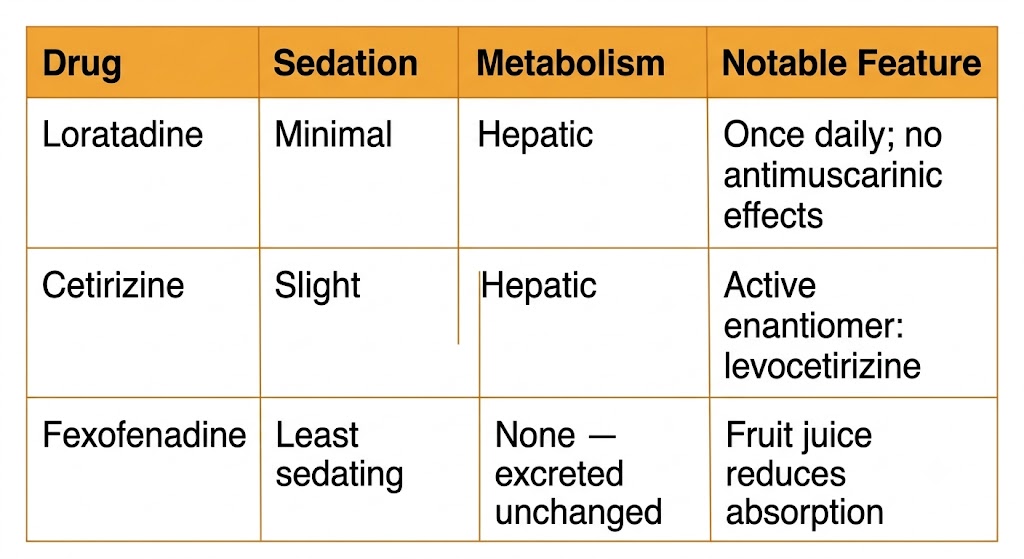
Loratadine is a tricyclic piperidine antihistamine with negligible anticholinergic activity and very low sedation at standard doses. It undergoes extensive first-pass hepatic metabolism to its active metabolite desloratadine, which is also available as a standalone agent. Once-daily dosing is appropriate. Because elimination is hepatic rather than renal, loratadine does not require dose adjustment in renal impairment — a useful clinical distinction from cetirizine.
Cetirizine is the active metabolite of hydroxyzine (a first-generation agent) and is primarily eliminated unchanged by the kidney. This renal-dominant clearance makes cetirizine the second-generation agent most sensitive to renal impairment — dose reduction is required when renal function is significantly reduced. Among second-generation agents, cetirizine is slightly more sedating than loratadine or fexofenadine in clinical trials, attributed to modestly greater central nervous system penetration; it is nonetheless far less sedating than any first-generation agent. Levocetirizine is the pharmacologically active enantiomer of cetirizine and is available at half the standard cetirizine dose with a comparable clinical profile.
Fexofenadine is the active metabolite of terfenadine, a first-generation agent that was withdrawn from the market due to QT-prolonging cardiac arrhythmias when plasma concentrations rose. Fexofenadine lacks terfenadine's cardiac toxicity and is the least sedating of all second-generation antihistamines — its negligible central nervous system penetration results from both low lipophilicity and robust P-glycoprotein efflux. It undergoes minimal hepatic metabolism and is eliminated primarily unchanged in feces and urine, making it a reasonable choice in patients with hepatic impairment.
Fexofenadine is subject to a well-characterized food-drug interaction: grapefruit juice, orange juice, and apple juice reduce its oral absorption by inhibiting an intestinal uptake transporter. The practical instruction is to take fexofenadine with water rather than fruit juice. This is a tested pharmacokinetic interaction at the Step 1 level.
Second-Generation Agents — Key Pharmacokinetic Distinctions
Loratadine: hepatic metabolism → no dose adjustment in renal impairment; desloratadine is the active metabolite.
Cetirizine: renal elimination unchanged → dose reduction required in significant renal impairment; slightly more sedating than the others; levocetirizine is the active enantiomer.
Fexofenadine: minimal hepatic metabolism, excreted unchanged → safe in hepatic impairment; least sedating; fruit juice reduces absorption — take with water.
Section 4
Matching antihistamine generation to clinical indication across allergic rhinitis, urticaria, anaphylaxis, motion sickness, and insomnia
H1 antihistamine selection requires matching the pharmacological profile of the agent to the clinical need. Second-generation agents are the default for chronic daytime allergy management. First-generation agents retain specific niches where their central nervous system and antimuscarinic effects are therapeutically exploited. For anaphylaxis, neither generation is first-line — epinephrine is.
Second-generation antihistamines are the preferred oral agents for allergic rhinitis and chronic urticaria in ambulatory patients. They control sneezing, pruritus, watery rhinorrhea, and conjunctival symptoms without impairing daytime function. For persistent allergic rhinitis, intranasal corticosteroids provide superior control of nasal congestion — which is driven partly by prostaglandins and leukotrienes in addition to histamine — and are the first-line treatment in current guidelines. Second-generation oral antihistamines are an important adjunct, particularly for ocular symptoms and pruritus.
In chronic spontaneous urticaria, second-generation antihistamines are first-line. Standard doses are used initially; if control is insufficient, doses may be increased under physician guidance. First-generation agents are sometimes used at bedtime when sedation at night is acceptable, but second-generation agents remain the preferred daytime treatment.
Epinephrine is the first-line and life-saving treatment for anaphylaxis. Antihistamines — both H1 and H2 blockers — are useful adjuncts that reduce pruritus, urticaria, and flushing, but they do not reverse the bronchospasm, laryngeal edema, or cardiovascular collapse that makes anaphylaxis fatal. They are administered after epinephrine, never as substitutes for it. A Step 1 question asking for initial management of anaphylaxis has one correct answer: epinephrine.
| Indication | Preferred Agent | Rationale |
|---|---|---|
| Allergic rhinitis (daytime) | Second-generation (loratadine, cetirizine, fexofenadine) | No sedation; once-daily dosing; no antimuscarinic effects |
| Chronic urticaria (daytime) | Second-generation preferred | No sedation; no antimuscarinic effects |
| Motion sickness | First-generation (diphenhydramine, promethazine); scopolamine for prophylaxis | Central nervous system and antimuscarinic effects both contribute to antiemetic efficacy |
| Short-term insomnia | Diphenhydramine | Sedation is the desired effect; tolerance develops rapidly |
| Anaphylaxis | Epinephrine first-line; antihistamines adjunctive only | Antihistamines do not reverse bronchospasm or hemodynamic collapse |
| Pruritus at night | Hydroxyzine or diphenhydramine | Sedation acceptable at bedtime; strong antipruritic effect |
| Patient with significant renal impairment needing antihistamine | Loratadine (hepatic elimination; no renal dose adjustment needed) | Cetirizine and fexofenadine require dose reduction or caution in renal failure |
| Elderly patient | Second-generation; avoid all first-generation agents | First-generation agents on Beers Criteria; anticholinergic risk, falls, cognitive impairment |
Visual Reference
Module 2 Visual Summary
Generation comparison, individual agent profiles, and clinical selection guide
| Author / Organization | Title | Source |
|---|---|---|
| Simons FE, Simons KJ | Histamine and H1-antihistamines: celebrating a century of progress | J Allergy Clin Immunol. 2011;128(6):1139–1150 |
| Church MK, Maurer M, Simons FE, et al. | Risk of first-generation H1-antihistamines: a GA2LEN position paper | Allergy. 2010;65(4):459–466 |
| Guaiana G, Barbui C, Cipriani A | Hydroxyzine for generalised anxiety disorder | Cochrane Database Syst Rev. 2010;(12):CD006815 |
| Chen C, Hanson E, Watson JW, Lee JS | P-glycoprotein limits the brain penetration of nonsedating but not sedating H1-antagonists | Drug Metab Dispos. 2003;31(3):312–318 |
| Devillier P, Roche N, Faisy C | Clinical pharmacokinetics and pharmacodynamics of desloratadine, fexofenadine and levocetirizine: a comparative review | Clin Pharmacokinet. 2008;47(4):217–230 |
| Simons FE | Advances in H1-antihistamines | N Engl J Med. 2004;351(21):2203–2217 |
| Renwick AG | The metabolism of antihistamines and drug interactions: the role of cytochrome P450 enzymes | Clin Exp Allergy. 1999;29(Suppl 3):116–124 |
| Dresser GK, Bailey DG, Leake BF, et al. | Fruit juices inhibit organic anion transporting polypeptide-mediated drug uptake to decrease the oral availability of fexofenadine | Clin Pharmacol Ther. 2002;71(1):11–20 |
| Zuberbier T, Aberer W, Asero R, et al. | The EAACI/GA2LEN/EDF/WAO guideline for the definition, classification, diagnosis and management of urticaria | Allergy. 2018;73(7):1393–1414 |
| Leurs R, Church MK, Taglialatela M | H1-antihistamines: inverse agonism, anti-inflammatory actions and cardiac effects | Clin Exp Allergy. 2002;32(4):489–498 |