CHAPTER 10 ยท CONGESTIVE HEART FAILURE

Section 1

Introduction

Not every patient with heart failure can be managed with the oral drug classes covered in Modules 2 through 5. In acute decompensation with significant hemodynamic compromise, additional categories of drugs become necessary: digoxin, a positive inotrope with a unique mechanism and a narrow margin between benefit and toxicity; intravenous inotropes such as dobutamine and milrinone, which increase cardiac output at the cost of increased myocardial oxygen demand; and vasopressors, drugs used to maintain blood pressure in the most severe presentation of heart failure, cardiogenic shock. This module introduces the core pharmacology of each.


Section 2

Digoxin

A positive inotrope with a distinctive mechanism, a narrow margin of safety, and a carefully limited role in modern heart failure care.

Mechanism of Action

Digoxin inhibits the sodium-potassium ATPase pump on the cardiac muscle cell membrane. With this pump inhibited, the sodium gradient that normally drives the sodium-calcium exchanger weakens, and the exchanger moves less calcium out of the cell. The resulting rise in intracellular calcium increases the amount of calcium available for each contraction, producing a modest increase in contractile force.

Unlike catecholamine-based inotropes, digoxin produces this effect without significantly increasing myocardial oxygen demand. Digoxin also increases vagal tone, slowing conduction through the atrioventricular node, an effect that is now considered at least as clinically important as its modest inotropic action.
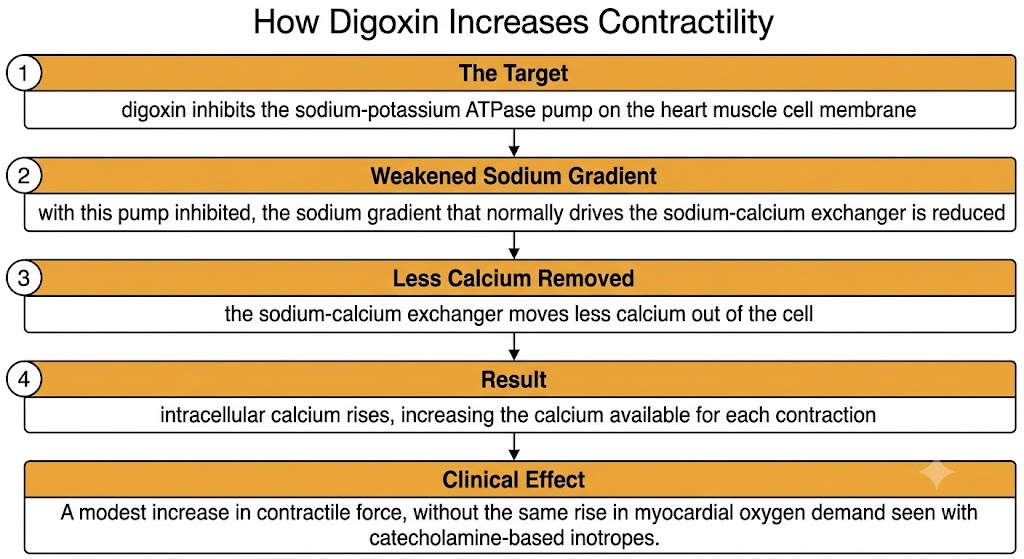
A vertical flow diagram showing how digoxin inhibits the sodium-potassium ATPase pump, weakening the sodium gradient that drives the sodium-calcium exchanger, leading to increased intracellular calcium and increased contractile force.
Digoxin increases contractility by inhibiting the sodium-potassium ATPase pump, which raises intracellular calcium through its effect on the sodium-calcium exchanger. Figure generated by Gemini AI.

Clinical Role

In modern heart failure care, digoxin does not improve survival. Its role is limited to reducing hospitalizations for heart failure in patients who remain symptomatic despite optimized therapy with the four pillars, and it requires a low target blood level rather than the traditional, higher therapeutic range once used historically.

Digoxin Toxicity

Digoxin has a narrow therapeutic index, meaning the gap between an effective dose and a toxic dose is small. Hypokalemia is the single most important risk factor for toxicity, since potassium and digoxin compete for the same binding site on the sodium-potassium ATPase pump, so low potassium effectively increases the drug action at any given blood level.

A classic and distinctive feature of digoxin toxicity is visual disturbance, including a yellow-green tinge to vision and halos around lights, caused by the drug effect on retinal photoreceptors. Digoxin toxicity can also cause dangerous cardiac arrhythmias, and any patient with risk factors for toxicity who develops new gastrointestinal symptoms, visual changes, or arrhythmia should be evaluated for it.

Section 3

Intravenous Inotropes

Two drugs that increase cardiac contractility through entirely different mechanisms, reserved for acute decompensation with low cardiac output.

Dobutamine

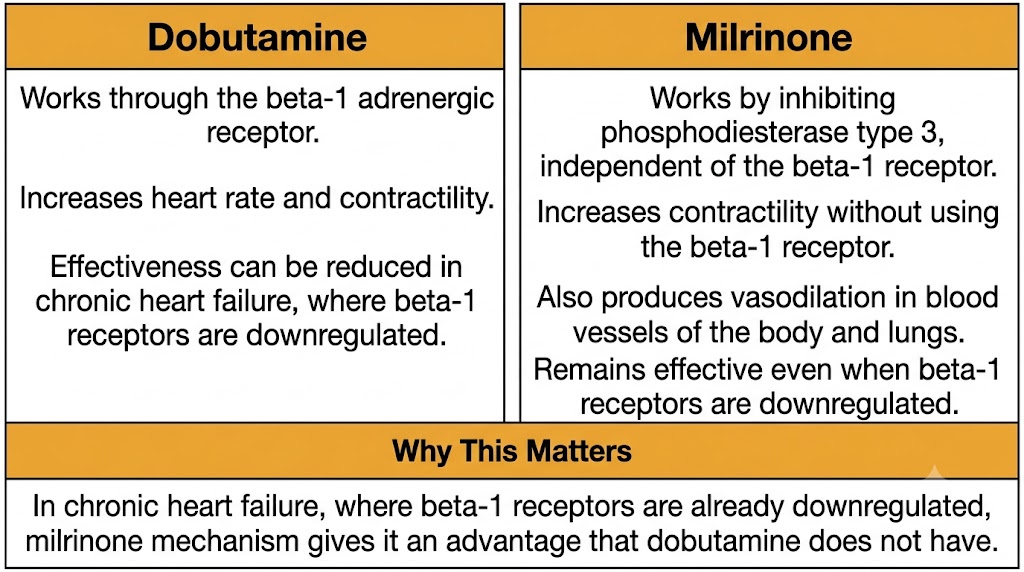
Dobutamine is a synthetic catecholamine that primarily stimulates beta-1 adrenergic receptors, increasing both heart rate and contractility. Because its mechanism depends on the beta-1 receptor, its effectiveness can be reduced in patients with chronic heart failure, whose hearts have already downregulated these receptors in response to the long-standing sympathetic overactivation described in Module 1.

Milrinone

Milrinone works through a completely different mechanism: it inhibits phosphodiesterase type 3, an enzyme that normally breaks down a signaling molecule inside both cardiac muscle and blood vessel smooth muscle cells. Blocking this enzyme increases the same signaling molecule that beta-1 stimulation also increases, producing increased contractility, but milrinone does this without using the beta-1 receptor at all.

Because milrinone's mechanism does not depend on the beta-1 receptor, it remains effective even in patients with downregulated receptors, an advantage over dobutamine in chronic heart failure. Milrinone also produces blood vessel relaxation in both the body and lungs, an effect dobutamine does not share, making it particularly useful when reducing the heart workload is also a treatment goal.

A two-panel diagram contrasting dobutamine, which works through the beta-1 adrenergic receptor, with milrinone, which inhibits phosphodiesterase type 3 independent of the beta-1 receptor and also produces vasodilation.
Dobutamine and milrinone both increase cardiac contractility but through different mechanisms, giving milrinone an advantage in patients with downregulated beta-1 receptors. Figure generated by Gemini AI.

Shared Risks

Both drugs increase the risk of dangerous arrhythmias and increase myocardial oxygen demand, since increased contractility and heart rate both raise the heart workload. For this reason, both are reserved for acute decompensation with evidence of poor organ perfusion rather than used for routine, ongoing heart failure management.


Section 4

Vasopressors in Cardiogenic Shock

A distinct category of drugs from the inotropes discussed in Section 3, used when blood pressure itself cannot be maintained.

Cardiogenic shock is the most severe presentation of heart failure: the heart can no longer maintain adequate blood pressure and organ perfusion, even with maximal support. While inotropes increase the force of cardiac contraction, vasopressors work through a different mechanism entirely, constricting blood vessels to raise blood pressure. This is an important distinction: a patient in cardiogenic shock may need one, the other, or both, depending on whether the primary problem is inadequate pumping force, inadequate vascular tone, or both together.

Norepinephrine, which acts primarily on alpha-1 adrenergic receptors to produce vasoconstriction, is the preferred vasopressor in cardiogenic shock. It is often combined with an inotrope such as dobutamine or milrinone from Section 3 when both vasoconstriction and improved contractility are needed.

Suggested References
Author / Organization Title Source
Gheorghiade M, van Veldhuisen DJ, Colucci WSContemporary use of digoxin in the management of cardiovascular disordersCirculation. 2006;113(21):2556-2564
The Digitalis Investigation GroupThe effect of digoxin on mortality and morbidity in patients with heart failure (DIG trial)N Engl J Med. 1997;336(8):525-533
Heidenreich PA, Bozkurt B, Aguilar D, et al2022 AHA/ACC/HFSA guideline for the management of heart failureJ Am Coll Cardiol. 2022;79(17):e263-e421
Cuffe MS, Califf RM, Adams KF, et alShort-term intravenous milrinone for acute exacerbation of chronic heart failure (OPTIME-CHF)JAMA. 2002;287(12):1541-1547
van Diepen S, Katz JN, Albert NM, et alContemporary management of cardiogenic shock: a scientific statement from the American Heart AssociationCirculation. 2017;136(16):e232-e268
Thiele H, Zeymer U, Neumann FJ, et alIntraaortic balloon support for myocardial infarction with cardiogenic shock (IABP-SHOCK II)N Engl J Med. 2012;367(14):1287-1296
De Backer D, Biston P, Devriendt J, et alComparison of dopamine and norepinephrine in the treatment of shock (SOAP II)N Engl J Med. 2010;362(9):779-789