Module 7 — HFpEF, Device Therapy, and Special Populations
Module 7 of 7Section 1
This final module of the chapter addresses four topics that round out the pharmacology of heart failure. First, heart failure with preserved ejection fraction, the syndrome introduced in Module 1, requires a different pharmacological approach than heart failure with reduced ejection fraction because its underlying disease process is different. Second, many patients with advanced heart failure receive implanted cardiac devices, which interact with drug therapy in important ways. Finally, two special populations, patients with chronic kidney disease and patients who are pregnant, require thoughtful modification of standard heart failure pharmacology.
Section 2
A syndrome with a fundamentally different underlying problem than heart failure with reduced ejection fraction, which explains why most heart failure with reduced ejection fraction drugs have not worked here.
Why HFpEF Has Resisted Therapy
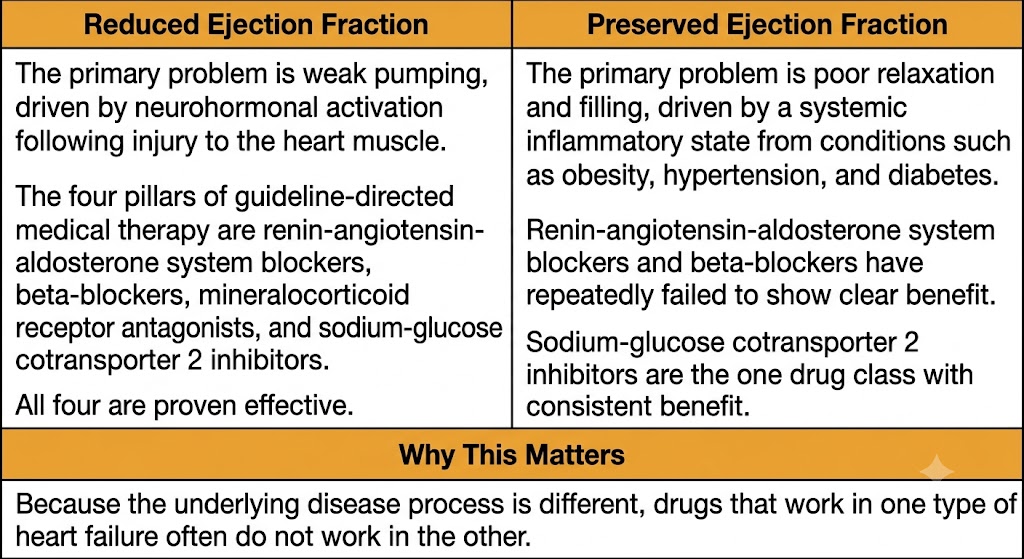
As introduced in Module 1, heart failure with reduced ejection fraction is primarily driven by neurohormonal activation following myocardial injury, the pathway targeted by the four pillars of guideline-directed medical therapy. Heart failure with preserved ejection fraction has a different primary driver: a systemic, low-grade inflammatory state generated by chronic conditions such as obesity, hypertension, and diabetes, which causes the heart muscle to become stiff and slow to relax rather than weak to contract.
Because the underlying problem is different, drug classes that block the renin-angiotensin-aldosterone system or the sympathetic nervous system, the cornerstones of heart failure with reduced ejection fraction therapy, do not address the primary driver of heart failure with preserved ejection fraction. This explains why angiotensin-converting enzyme inhibitors, angiotensin receptor blockers, and beta-blockers have repeatedly failed to show a clear survival benefit in heart failure with preserved ejection fraction, even though they are each pillars of therapy in heart failure with reduced ejection fraction.
What Works
Sodium-glucose cotransporter 2 inhibitors, introduced in Module 5, remain the one drug class with consistent, reproducible benefit across the heart failure with preserved ejection fraction population, and they are now the central pharmacological intervention for this syndrome. Loop diuretics continue to play an important symptomatic role for fluid overload, used carefully, since a stiff ventricle depends on adequate filling pressure and can be harmed by overly aggressive fluid removal.
Section 3
Implanted cardiac devices and heart failure drug therapy work together, not as substitutes for one another.
Many patients with advanced heart failure with reduced ejection fraction receive an implanted device, such as a defibrillator to prevent sudden cardiac death or a device that resynchronizes the timing of ventricular contraction. A central principle governs the relationship between these devices and drug therapy: device therapy does not replace guideline-directed medical therapy, and the two provide independent, additive benefit. Optimized drug therapy is continued in full even after a device is implanted, and in some patients, optimized drug therapy improves heart function enough over time that it changes whether or when a device is needed in the first place.
A Classic Drug Interaction
Amiodarone, an antiarrhythmic drug commonly used in patients with implanted defibrillators to reduce dangerous arrhythmias, raises blood digoxin levels significantly when the two drugs are used together. When amiodarone is started in a patient already taking digoxin, the digoxin dose must be reduced and levels rechecked, since failing to do so is a common and avoidable cause of digoxin toxicity, the toxicity syndrome introduced in Module 6.
Section 4
Two organ systems that frequently worsen one another, requiring careful but not avoidant prescribing.
Heart failure and chronic kidney disease frequently coexist and worsen each other in both directions. Reduced cardiac output lowers blood flow to the kidneys, activating the same renin-angiotensin-aldosterone system and sympathetic nervous system pathways described in Module 1 and further injuring the kidneys. Conversely, chronic kidney disease itself contributes to heart failure through fluid retention and its own activation of these same neurohormonal pathways. This bidirectional relationship is sometimes called the cardiorenal syndrome.
Most heart failure drug classes require caution, not avoidance, in patients with chronic kidney disease. As established in Module 2, a modest rise in creatinine after starting a renin-angiotensin-aldosterone system blocker is expected and is not by itself a reason to stop therapy. The general principle across nearly all heart failure pharmacology is that the cardioprotective benefit of guideline-directed medical therapy generally extends well into chronic kidney disease, and these drugs should not be reflexively withheld simply because a patient has reduced kidney function.
Section 5
A population in which the standard heart failure pharmacology used throughout this chapter must change substantially.
Heart failure can complicate pregnancy either through a pre-existing condition or through peripartum cardiomyopathy, a form of heart failure with reduced ejection fraction that develops in the final weeks of pregnancy or in the months following delivery, without a prior history of heart disease. Many patients recover much of their heart function over the following months.
As already established in Module 2, renin-angiotensin-aldosterone system blockers, including angiotensin-converting enzyme inhibitors, angiotensin receptor blockers, and sacubitril/valsartan, are absolutely contraindicated throughout pregnancy due to serious fetal harm, and must be stopped immediately if pregnancy is identified in a patient taking one of these drugs. Mineralocorticoid receptor antagonists are also avoided, since spironolactone in particular can interfere with normal fetal development due to its anti-androgen activity.
When a patient with heart failure becomes pregnant, alternative drugs are generally substituted: certain beta-blockers, hydralazine, and digoxin all have an established record of safer use in pregnancy and are commonly used in this setting under close obstetric and cardiology collaboration.
| Author / Organization | Title | Source |
|---|---|---|
| Redfield MM | Heart failure with preserved ejection fraction | N Engl J Med. 2016;375(19):1868-1877 |
| Solomon SD, McMurray JJV, Anand IS, et al | Angiotensin-neprilysin inhibition in heart failure with preserved ejection fraction (PARAGON-HF) | N Engl J Med. 2019;381(17):1609-1620 |
| Heidenreich PA, Bozkurt B, Aguilar D, et al | 2022 AHA/ACC/HFSA guideline for the management of heart failure | J Am Coll Cardiol. 2022;79(17):e263-e421 |
| Gheorghiade M, van Veldhuisen DJ, Colucci WS | Contemporary use of digoxin in the management of cardiovascular disorders | Circulation. 2006;113(21):2556-2564 |
| Ronco C, Haapio M, House AA, et al | Cardiorenal syndrome | J Am Coll Cardiol. 2008;52(19):1527-1539 |
| Sliwa K, Bohm M | Incidence and prevalence of peripartum cardiomyopathy | Ann Intern Med. 2014;161(12):876-877 |
| Mehra MR, Uriel N, Naka Y, et al | A fully magnetically levitated left ventricular assist device - final report (MOMENTUM 3) | N Engl J Med. 2019;380(17):1618-1627 |
| Halliday BP, Wassall R, Lota AS, et al | Withdrawal of pharmacological treatment for heart failure in patients with recovered dilated cardiomyopathy (TRED-HF) | Lancet. 2019;393(10166):61-73 |
| Bauersachs J, Konig T, van der Meer P, et al | Pathophysiology, diagnosis and management of peripartum cardiomyopathy: a position statement from the Heart Failure Association of the European Society of Cardiology Study Group on peripartum cardiomyopathy | Eur J Heart Fail. 2019;21(7):827-843 |