CHAPTER 15  ·  LOCAL ANESTHETICS
Section 1

Epinephrine as a Vasoconstrictor Additive

Alpha-1 receptor-mediated vasoconstriction at the injection site prolongs anesthesia and reduces systemic toxicity

Epinephrine is frequently added to local anesthetic solutions not for its own anesthetic properties but to counteract the vasodilation that most local anesthetics produce at the injection site. By constricting local blood vessels, epinephrine slows drug absorption into the systemic circulation, producing three clinically important benefits. It also has a diagnostic use as a marker of unintended intravascular injection.

Mechanism and Benefits

Epinephrine activates alpha-1 adrenergic receptors on vascular smooth muscle at the injection site, causing vasoconstriction and reducing local blood flow. This produces three benefits that make it a valuable additive to many local anesthetic formulations.

First, slowed systemic absorption prolongs the duration of anesthesia. The local anesthetic remains at the injection site longer when blood flow is reduced, extending the period of effective nerve blockade. This is the most clinically important benefit — a block that might last 60 minutes with lidocaine alone may last 90 to 120 minutes when epinephrine is added.

Second, reduced systemic absorption lowers the peak plasma concentration of the local anesthetic. Lower peak plasma levels mean reduced risk of systemic toxicity affecting the central nervous system and heart. This safety benefit is particularly relevant when large doses are used for major nerve blocks or epidural anesthesia.

Third, epinephrine serves as a marker for unintended intravascular injection. When a small test dose containing epinephrine is injected before the full local anesthetic dose, any sudden increase in heart rate — typically 20 or more beats per minute within 60 seconds — indicates the needle tip is inside a blood vessel. The injection is stopped immediately, preventing the potentially catastrophic consequence of depositing the full local anesthetic dose directly into the circulation.

Standard Concentration

The standard concentration of epinephrine used as a local anesthetic additive is 1:200,000, which equals 5 micrograms per milliliter. This concentration is sufficient to produce meaningful vasoconstriction without delivering a systemic epinephrine dose large enough to cause cardiovascular effects in most patients. Higher concentrations are occasionally used for specific indications but carry greater risk of cardiovascular side effects.

Contraindications to Epinephrine Addition

Epinephrine must not be added to local anesthetic solutions intended for injection into end-artery regions — anatomical areas where a single artery supplies the tissue with no collateral circulation. The fingers, toes, penis, tip of the nose, and ear pinnae are the classic end-artery regions. Vasoconstriction in these areas can reduce blood flow enough to cause ischemia and tissue necrosis. The mnemonic taught widely is "no epinephrine in the fingers, toes, nose, and hose" — a reminder of the end-artery locations.

Epinephrine is also contraindicated in intravenous regional anesthesia (the Bier block technique, described in Section 2), where the risk of systemic epinephrine release when the tourniquet is deflated adds unacceptable cardiovascular risk to an already high-risk situation. Patients with severe coronary artery disease or uncontrolled hypertension represent relative contraindications, where the cardiovascular effects of even small systemically absorbed epinephrine doses warrant caution.

Epinephrine Contraindications — End-Artery Regions

Never add epinephrine to local anesthetic solutions for injection into: fingers, toes, penis, tip of nose, ear pinnae. These end-artery regions have no collateral circulation — vasoconstriction causes ischemia and tissue necrosis. Also contraindicated in intravenous regional anesthesia (Bier block).
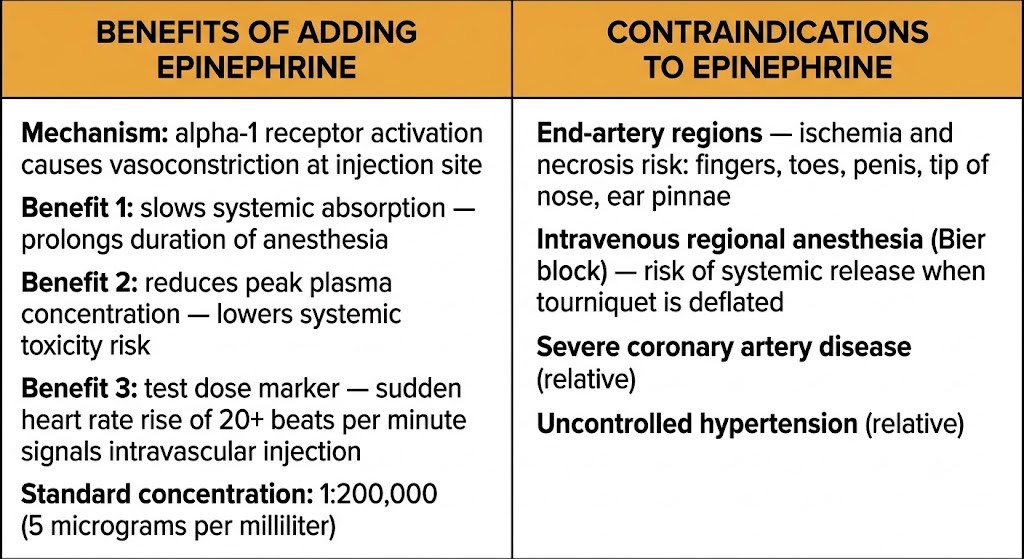
Two-panel diagram showing benefits of adding epinephrine to local anesthetic solutions (alpha-1 vasoconstriction, prolonged duration, reduced toxicity risk, intravascular injection marker) versus contraindications (end-artery regions, Bier block, coronary artery disease, hypertension).
Epinephrine as a local anesthetic additive: benefits of vasoconstriction at the injection site and contraindications including end-artery regions and intravenous regional anesthesia. Figure generated by Gemini AI.

Section 2

Types of Local Anesthesia — Techniques

Six approaches from topical application to neuraxial blockade, each with distinct indications and considerations

Local anesthetics are administered by several distinct techniques, each defined by where the drug is deposited and which nerves it reaches. The technique determines the distribution of anesthesia, the onset and duration of effect, and the specific risks involved. Understanding the key features of each technique is essential for examination preparation and for understanding why particular agents are chosen for particular procedures.

Technique 1
Topical Anesthesia
  • Applied directly to mucous membranes or skin surface
  • Drug penetrates epithelium to reach superficial nerve endings
  • EMLA cream (lidocaine plus prilocaine eutectic mixture) for intact skin — requires 45 to 60 minutes under occlusive dressing
  • Cocaine for nasal and pharyngeal mucosa — provides anesthesia and vasoconstriction simultaneously
  • Tetracaine eye drops for corneal anesthesia
Technique 2
Infiltration Anesthesia
  • Drug injected directly into tissue at or around the surgical site
  • Anesthetizes nerve endings and small nerve branches in the area
  • Most common technique — used for minor procedures, wound closure, skin biopsy
  • Appropriate for localized procedures not requiring a nerve block
Technique 3
Peripheral Nerve Block
  • Injection adjacent to a specific named nerve or nerve bundle
  • Produces anesthesia in the entire distribution of that nerve
  • Examples: femoral nerve block (thigh and knee surgery), brachial plexus block (upper extremity surgery), sciatic nerve block (lower extremity)
  • Ultrasound guidance now standard for accuracy and safety
Technique 4
Epidural Anesthesia
  • Injection into the epidural space — the potential space outside the dura mater surrounding the spinal cord
  • Drug diffuses to nerve roots as they exit the spinal column
  • Onset slower than spinal anesthesia — drug must diffuse through epidural fat and dura
  • Catheter allows continuous or repeated dosing — ideal for labor analgesia and postoperative pain
  • Used for: labor analgesia, cesarean section, major abdominal and lower extremity surgery
Technique 5
Spinal Anesthesia
  • Injection into the subarachnoid space — directly into the cerebrospinal fluid surrounding the spinal cord
  • Rapid onset, dense block — drug acts directly on nerve roots in cerebrospinal fluid
  • Single-dose technique — no catheter in standard practice
  • Produces sympathetic block first (causing hypotension), then sensory block, then motor block
  • Complication: post-dural puncture headache from cerebrospinal fluid leak through the dural puncture site
Technique 6
Intravenous Regional Anesthesia (Bier Block)
  • Intravenous injection of local anesthetic into an exsanguinated limb isolated by tourniquet
  • Drug saturates the limb tissues and nerve endings via the venous system
  • Agent: lidocaine only — never bupivacaine (cardiac arrest risk if tourniquet deflated early)
  • No epinephrine — risk of systemic release on tourniquet deflation
  • Tourniquet must remain inflated for minimum 20 minutes before deflation
  • Used for: short upper extremity procedures (hand and wrist surgery)
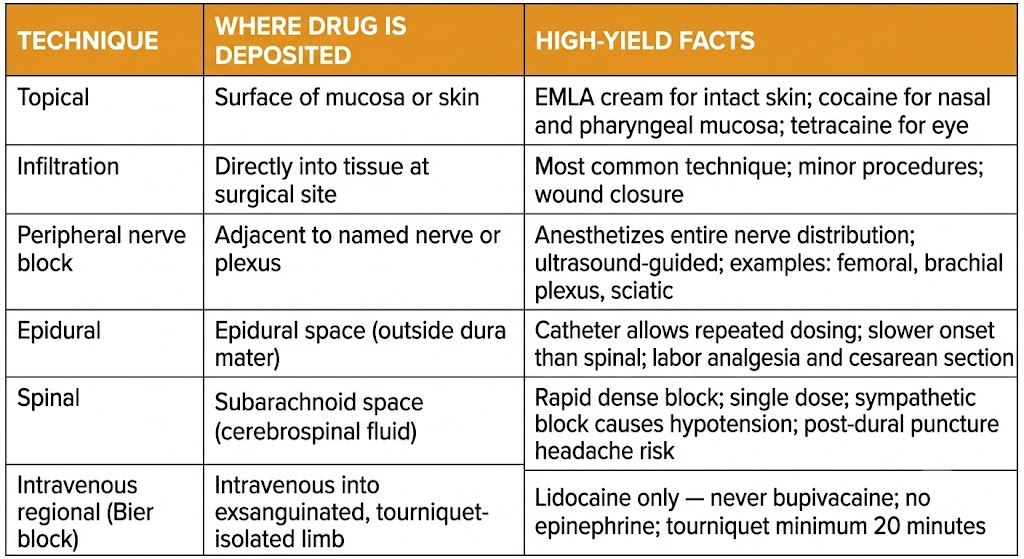
Reference table listing six regional anesthesia techniques — topical, infiltration, peripheral nerve block, epidural, spinal, and intravenous regional (Bier block) — with the site of drug deposition and high-yield clinical facts for each.
Six regional anesthesia techniques: site of drug deposition and high-yield clinical facts for each approach from topical application to neuraxial blockade. Figure generated by Gemini AI.

Section 3

Differential Block in Epidural Analgesia

Concentration determines whether sensory block, motor block, or both are achieved — the basis of the walking epidural

One of the most clinically useful properties of local anesthetics in epidural analgesia is the ability to achieve selective sensory blockade without complete motor paralysis by carefully controlling the drug concentration. This concentration-dependent selectivity is a direct consequence of the differential nerve fiber sensitivity described in Module 1.

Concentration-Dependent Selectivity

At low epidural concentrations, bupivacaine and ropivacaine block the small pain-transmitting fibers (type C and type A-delta) while leaving the large motor fibers (type A-alpha) largely intact. The patient experiences effective relief from labor pain — the intense visceral pain of uterine contractions — while retaining the ability to move the legs and bear weight. This is the pharmacological basis of what is colloquially called the "walking epidural."

At higher concentrations, the same agents block motor fibers as well, producing the denser sensory and motor block required for surgical anesthesia — for example, during a cesarean section. The drug is the same; the concentration determines the clinical effect.

Ropivacaine is particularly valued for its motor-sparing properties at lower concentrations compared to bupivacaine, making it a preferred agent for labor epidural analgesia where ambulation is desired. Both agents produce equivalent surgical anesthesia at appropriate higher concentrations.

Differential Block — Clinical Application

Low concentration epidural (e.g., dilute bupivacaine or ropivacaine): blocks pain fibers, preserves motor function — labor analgesia, walking epidural.

Higher concentration epidural (e.g., concentrated bupivacaine): blocks pain and motor fibers — surgical anesthesia for cesarean section, major surgery.

Same drug, same nerve roots, different concentration — different clinical outcome.


Section 4

Maximum Dose Limits

Exceeding weight-based dose limits risks systemic toxicity — the limits exist because of sodium channel blockade in the heart and brain

Every local anesthetic has a maximum recommended dose that should not be exceeded in a single administration. These limits reflect the concentration of drug that, if absorbed systemically, would risk producing central nervous system or cardiovascular toxicity. The limits are approximate, weight-based, and influenced by the site of injection, patient physiology, and whether epinephrine is added.

Approximate Dose Limits for Key Agents

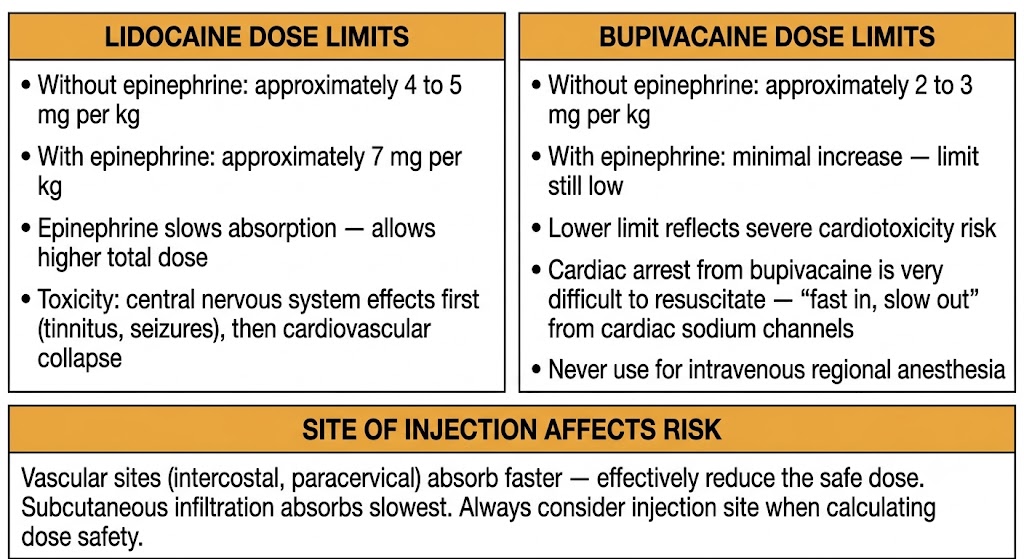
For lidocaine without epinephrine, the approximate maximum dose is 4 to 5 milligrams per kilogram of body weight. With epinephrine added, the limit increases to approximately 7 milligrams per kilogram — the vasoconstriction slows absorption enough to allow a larger total dose without reaching toxic plasma concentrations.

For bupivacaine, the maximum dose is approximately 2 to 3 milligrams per kilogram and does not increase substantially with epinephrine addition. The lower limit for bupivacaine reflects its cardiotoxic potential — at the plasma concentrations that cause toxicity, bupivacaine produces cardiac arrhythmias and cardiac arrest that are notoriously resistant to resuscitation.

Why the Limits Exist

The mechanism of systemic local anesthetic toxicity is the same as the mechanism of nerve blockade: sodium channel blockade. When systemic plasma concentrations rise high enough, local anesthetics block sodium channels in the brain and heart just as they block them in peripheral nerves. In the brain, this produces the progression of central nervous system toxicity described in Module 4 — from circumoral numbness and tinnitus through seizures. In the heart, sodium channel blockade slows conduction and depresses myocardial contractility.

The dose limits are not absolute thresholds below which toxicity never occurs — highly vascular injection sites such as intercostal or paracervical blocks produce faster absorption and higher peak plasma levels than subcutaneous infiltration at the same total dose. Clinicians must factor in site of injection, rate of injection, and patient characteristics (reduced hepatic function, low plasma protein binding in pregnancy) when determining safe dosing.

Agent Max dose (no epinephrine) Max dose (with epinephrine) Key reason for limit
Lidocaine ~4–5 mg/kg ~7 mg/kg Central nervous system then cardiovascular toxicity
Bupivacaine ~2–3 mg/kg Minimal increase Severe cardiotoxicity — cardiac arrest difficult to reverse
Two-panel diagram comparing lidocaine dose limits (4 to 5 mg per kg without epinephrine, 7 mg per kg with epinephrine) versus bupivacaine dose limits (2 to 3 mg per kg, minimal increase with epinephrine, severe cardiotoxicity risk), with a shared box on how injection site vascularity affects risk.
Maximum dose limits for lidocaine and bupivacaine with and without epinephrine, and the effect of injection site vascularity on systemic absorption and toxicity risk. Figure generated by Gemini AI.

Suggested References
Author / Organization Title Source
Hadzic A, ed. Hadzic's Peripheral Nerve Blocks and Anatomy for Ultrasound-Guided Regional Anesthesia. 2nd ed. New York: McGraw-Hill; 2011
Taddio A, Ohlsson A, Einarson TR, Stevens B, Koren G A systematic review of lidocaine-prilocaine cream (EMLA) in the treatment of acute pain in neonates Pediatrics. 1998;101(2):E1
Stoelting RK, Hillier SC Pharmacology and Physiology in Anesthetic Practice. 4th ed. Philadelphia: Lippincott Williams & Wilkins; 2006:179–207
Becker DE, Reed KL Local anesthetics: review of pharmacological considerations Anesth Prog. 2012;59(2):90–102
Neal JM, Brull R, Horn JL, et al. The second ASRA practice advisory on neurologic complications associated with regional anesthesia and pain medicine Reg Anesth Pain Med. 2015;40(5):401–430
Urmey WF, Talts KH, Sharrock NE One hundred percent incidence of hemidiaphragmatic paresis associated with interscalene brachial plexus anesthesia as diagnosed by ultrasonography Anesth Analg. 1991;72(4):498–503
Jaeger P, Nielsen ZJ, Henningsen MH, Hilsted KL, Mathiesen O, Dahl JB Adductor canal block versus femoral nerve block and quadriceps strength: a randomized, double-blind, placebo-controlled, crossover study in healthy volunteers Anesthesiology. 2013;118(2):409–415
Rosenberg PH, Veering BT, Urmey WF Maximum recommended doses of local anesthetics: a multifactorial concept Reg Anesth Pain Med. 2004;29(6):564–575
Butterworth JF, Mackey DC, Wasnick JD, eds. Morgan and Mikhail's Clinical Anesthesiology. 6th ed. New York: McGraw-Hill; 2018:937–992
Guay J, Nishimori M, Kopp S Epidural local anesthetics versus opioid-based analgesic regimens for postoperative gastrointestinal paralysis, vomiting and pain after abdominal surgery Cochrane Database Syst Rev. 2016;7:CD001893
Haas E, Onel E, Miller H, Ragupathi M, White PF A double-blind, randomized, active-controlled study for post-hemorrhoidectomy pain management with liposome bupivacaine, a novel local anesthetic formulation Am Surg. 2012;78(5):574–581