Succinylcholine is structurally two acetylcholine molecules joined end to end. This resemblance is not coincidental — it allows succinylcholine to bind and activate the nicotinic acetylcholine receptor at the motor end plate. What makes succinylcholine pharmacologically unique is not how it starts a block but how it sustains one: it depolarizes the membrane and then prevents it from repolarizing.
When succinylcholine reaches the neuromuscular junction, it binds to the nicotinic acetylcholine receptor and opens the ion channel, just as acetylcholine does. The resulting cation influx depolarizes the end-plate membrane and generates action potentials that spread along the muscle fiber. Clinically, this initial wave of electrical activity manifests as the visible, generalized muscle fasciculations that characterize succinylcholine administration — brief, unsynchronized contractions that precede paralysis by seconds.
Unlike acetylcholine, succinylcholine is not hydrolyzed by acetylcholinesterase in the synaptic cleft. It persists, continues to occupy the receptor, and holds the end-plate membrane in a continuously depolarized state. The voltage-gated sodium channels in the muscle membrane immediately adjacent to the end plate — the channels that must close and reset before the fiber can fire again — remain inactivated as long as the membrane is depolarized. Subsequent nerve impulses arriving at the junction find the end plate unresponsive. The muscle enters a flaccid paralysis despite ongoing receptor occupancy. This is phase I block: depolarization-dependent inactivation of the muscle membrane.
With prolonged or repeated succinylcholine dosing — most relevant in settings where an infusion is used for sustained paralysis — the character of the block can shift. The end-plate membrane partially repolarizes, the receptors undergo a conformational change toward a desensitized state, and the block begins to resemble nondepolarizing block in its monitoring characteristics: fade appears on train-of-four stimulation, and the block may be partially reversed by anticholinesterase agents. Phase II block is recognized by this shift in monitoring pattern. It is unpredictable in onset and impractical to manage pharmacologically; avoidance through appropriate dosing is preferred.
The fasciculations that follow succinylcholine administration are the direct result of its agonist activity at the nicotinic receptor. Succinylcholine activates receptors across motor end plates throughout the body simultaneously, producing brief asynchronous muscle contractions. These are not seizures and do not represent central nervous system activity — they are purely peripheral, occurring at the junction itself. Within 60 seconds, the persistent depolarization inactivates the surrounding sodium channels and flaccid paralysis follows. The fasciculations are clinically significant because they can cause postoperative myalgia and transiently raise intragastric and intraocular pressure.
Succinylcholine has the fastest onset and shortest duration of action of any neuromuscular blocking drug. Both properties are directly attributable to its unique metabolic pathway — hydrolysis by plasma cholinesterase rather than by the acetylcholinesterase that terminates acetylcholine signaling at the synapse.
Plasma cholinesterase — also called pseudocholinesterase — is a circulating enzyme produced by the liver and present in plasma throughout the body. It is distinct from acetylcholinesterase, which is anchored at the neuromuscular junction and synaptic membranes. Succinylcholine does not encounter acetylcholinesterase in significant amounts in the synaptic cleft; instead, it is hydrolyzed in the plasma before, during, and after its passage through the junction.
Plasma cholinesterase cleaves succinylcholine in two sequential steps, first to succinylmonocholine and then to succinic acid and choline, both inactive metabolites. This hydrolysis occurs rapidly in patients with normal plasma cholinesterase activity, and the resulting clinical duration of action is approximately 5 to 10 minutes after a standard intubating dose. Because termination depends on diffusion of succinylcholine out of the junction and into the plasma — where it is destroyed — the offset of block is spontaneous and does not require any reversal agent.
Plasma cholinesterase activity is reduced in several clinical circumstances that do not involve a genetic variant. Severe liver disease impairs synthesis of the enzyme. Pregnancy decreases plasma cholinesterase levels, though usually not to a clinically significant degree in most patients. Certain drugs — including organophosphates, echothiophate eye drops used for glaucoma, and some chemotherapeutic agents — inhibit plasma cholinesterase. In patients with reduced but not absent enzyme activity, succinylcholine duration is prolonged modestly and typically self-resolves with continued ventilatory support. The more dramatic prolongation seen in pseudocholinesterase deficiency is addressed in Section 6.
Despite a formidable list of adverse effects and contraindications, succinylcholine remains widely used because no other neuromuscular blocking drug matches its combination of rapid onset and brief duration. These two properties make it the standard agent for rapid sequence intubation — the technique used to secure the airway quickly in patients at high risk for aspiration of gastric contents.
Rapid sequence intubation is employed when the patient has a full stomach or other condition predisposing to aspiration — emergency presentations, bowel obstruction, pregnancy, obesity, or impaired consciousness. In these situations, the window between loss of consciousness and placement of a cuffed endotracheal tube must be minimized. Succinylcholine, administered intravenously, produces complete intubating conditions — full jaw relaxation and vocal cord opening — within 60 seconds. No nondepolarizing neuromuscular blocking drug achieves this onset speed at standard doses.
The brief duration of succinylcholine is equally important in this setting. If intubation fails after succinylcholine, the paralysis resolves within minutes and the patient can resume spontaneous ventilation. This built-in safety margin does not exist with long-acting nondepolarizing agents, where a failed intubation may leave the patient apneic for 30 to 60 minutes.
When succinylcholine is contraindicated — in patients with hyperkalemia risk, personal or family history of malignant hyperthermia, or known pseudocholinesterase deficiency — rocuronium at a high dose is the alternative for rapid sequence intubation. At doses approximately three times the standard intubating dose, rocuronium achieves onset conditions approaching those of succinylcholine. Unlike succinylcholine, rocuronium used in this context produces a prolonged block; however, its reversal agent sugammadex can rapidly terminate the block even at high doses, providing a reliable rescue strategy if intubation fails.
The most dangerous adverse effect of succinylcholine is life-threatening hyperkalemia. This is not a pharmacological rarity — it is a predictable consequence of administering a depolarizing agent to patients whose muscle membranes have undergone a specific pathological change. Recognizing the conditions that produce this change is essential for safe prescribing.
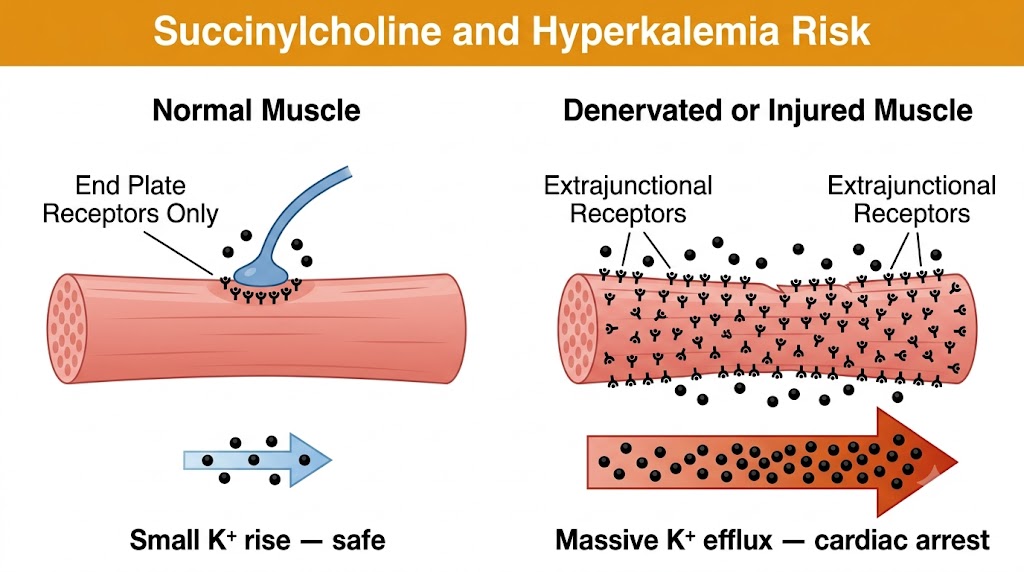
Under normal conditions, nicotinic acetylcholine receptors are concentrated at the motor end plate and are absent from the rest of the muscle fiber surface. When a muscle is denervated, immobilized, burned, or crushed, the fiber responds by upregulating nicotinic acetylcholine receptors across the entire extrajunctional membrane surface — a compensatory response to loss of normal neural input.
These extrajunctional receptors have altered channel properties compared to the normal junctional receptor. They remain open for longer durations when activated and are present in vastly greater numbers across the muscle surface. When succinylcholine is administered to a patient with extensive extrajunctional upregulation, it activates not just the normal end-plate receptors but the entire expanded receptor population across the muscle surface. The result is a massive, simultaneous efflux of potassium from muscle cells throughout the body. Serum potassium can rise by 1 to 2 milliequivalents per liter in normal patients — a modest, well-tolerated increase. In patients with extensive extrajunctional upregulation, the potassium rise can be 5 to 10 milliequivalents per liter or greater, sufficient to cause fatal ventricular fibrillation within minutes of administration.
The conditions that trigger extrajunctional upregulation share a common feature: they disrupt the normal relationship between the motor nerve and the muscle fiber. The major contraindicated conditions are burns covering a significant body surface area, crush injury, prolonged immobilization, and denervation from any cause — including spinal cord injury, stroke with hemiplegia, and peripheral nerve injuries. Patients with myopathies and certain muscular dystrophies also carry elevated risk.
The timing of risk onset is clinically important. In the immediate aftermath of a burn or crush injury — roughly the first 24 hours — receptor upregulation has not yet occurred and succinylcholine may be used safely for emergency airway management. After this window, the risk escalates progressively as upregulation develops and persists. The risk of hyperkalemia after burns and crush injury peaks at approximately 2 to 3 weeks but remains elevated for months, gradually resolving as the injury heals and normal innervation is restored. In patients with permanent denervation, the risk does not resolve.
Contraindicated after the first 24–48 hours: major burns, crush injury, prolonged immobilization, denervation (spinal cord injury, stroke with hemiplegia, peripheral nerve injury), rhabdomyolysis, and muscular dystrophies.
Mechanism: extrajunctional nicotinic receptor upregulation across the entire muscle surface leads to massive potassium efflux when succinylcholine activates the expanded receptor population.
Consequence: serum potassium rise sufficient to cause ventricular fibrillation and cardiac arrest.
Safe window: succinylcholine may be used in the first 24 hours after acute injury before upregulation occurs.
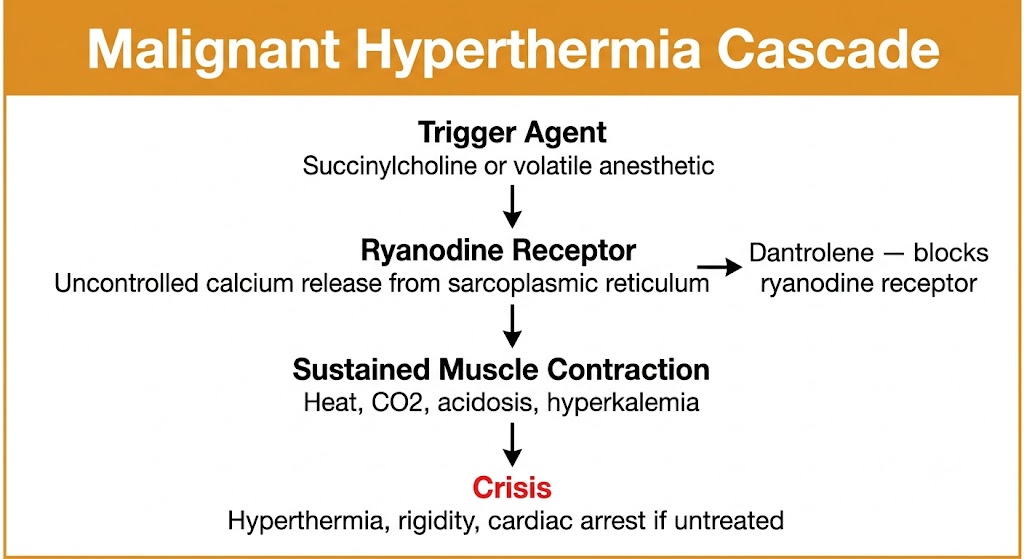
Malignant hyperthermia is a life-threatening hypermetabolic crisis of skeletal muscle triggered by specific anesthetic agents in genetically susceptible individuals. Succinylcholine is one of the two trigger agents — the other being volatile inhalational anesthetics such as halothane, sevoflurane, and desflurane. Recognition and rapid treatment are essential because the condition is fatal if untreated.
Malignant hyperthermia susceptibility is inherited as an autosomal dominant trait. The underlying defect is in the ryanodine receptor — the calcium release channel in the sarcoplasmic reticulum of skeletal muscle. In susceptible individuals, exposure to a triggering agent causes the ryanodine receptor to open uncontrollably, flooding the muscle cell cytoplasm with calcium from the sarcoplasmic reticulum. The resulting sustained muscle contraction and hypermetabolic state consumes adenosine triphosphate at an enormous rate, generates massive heat, and rapidly depletes oxygen while producing carbon dioxide and lactic acid.
The earliest and most sensitive sign of malignant hyperthermia is an unexpected rise in end-tidal carbon dioxide — a reflection of the hypermetabolic state — followed by tachycardia and muscle rigidity. Masseter muscle rigidity after succinylcholine administration (jaw rigidity that prevents mouth opening) is a particularly concerning early sign. As the crisis progresses, core body temperature rises rapidly — sometimes exceeding 40 degrees Celsius — along with metabolic acidosis, hyperkalemia from muscle breakdown, and myoglobinuria from rhabdomyolysis. Without treatment, cardiac arrest and death follow.
Dantrolene is the specific antidote for malignant hyperthermia. It acts directly on the ryanodine receptor, inhibiting calcium release from the sarcoplasmic reticulum and halting the runaway muscle activation. Dantrolene must be given immediately and in large doses; delay is fatal. Supportive measures — active cooling, treatment of acidosis and hyperkalemia, maintenance of urine output to prevent myoglobin-induced renal injury — accompany dantrolene administration. All triggering agents are discontinued immediately.
The personal and family history of malignant hyperthermia susceptibility is an absolute contraindication to succinylcholine. In susceptible patients, total intravenous anesthesia using agents that do not trigger the ryanodine receptor — such as propofol — is employed, and rocuronium replaces succinylcholine for neuromuscular blockade.
Trigger agents: succinylcholine and volatile inhalational anesthetics (halothane, sevoflurane, desflurane, isoflurane).
Mechanism: uncontrolled ryanodine receptor opening → uncontrolled calcium release from sarcoplasmic reticulum → sustained muscle contraction → hypermetabolic crisis.
Early warning signs: rising end-tidal carbon dioxide, tachycardia, masseter rigidity, temperature rise.
Treatment: dantrolene immediately; discontinue all triggers; active cooling; correct acidosis and hyperkalemia.
Contraindication: personal or family history of malignant hyperthermia susceptibility is an absolute contraindication to succinylcholine.
In a small fraction of the population, a genetic variant in the gene encoding plasma cholinesterase produces an enzyme with markedly reduced or absent activity against succinylcholine. When these individuals receive a standard succinylcholine dose, the drug is not metabolized normally, persists in the circulation, and continues to block neuromuscular transmission far beyond the expected 5 to 10 minutes — sometimes for hours.
Pseudocholinesterase deficiency is inherited in an autosomal recessive pattern. Homozygous individuals — those who inherit two copies of the atypical allele — have severely reduced or absent plasma cholinesterase activity and experience dramatic prolongation of succinylcholine effect, with apnea lasting 2 hours or longer after a standard intubating dose. Heterozygous individuals have intermediate enzyme activity and experience a more modest prolongation, typically 20 to 30 minutes, which may go unrecognized or be attributed to other causes.
The condition is identified clinically when a patient fails to resume spontaneous breathing in the expected timeframe after succinylcholine administration. Laboratory confirmation uses the dibucaine number — a test of how much a local anesthetic (dibucaine) inhibits the patient's plasma cholinesterase — to distinguish normal enzyme from the atypical variant. The atypical enzyme is inhibited much less by dibucaine than the normal enzyme.
There is no reversal agent for succinylcholine paralysis, including in the setting of pseudocholinesterase deficiency. Anticholinesterase agents are not helpful and would prolong the block further by inhibiting whatever residual plasma cholinesterase activity remains. Management is entirely supportive: continued mechanical ventilation until the block resolves spontaneously as succinylcholine is eventually eliminated by other pathways. Patients and their families should be counseled after recovery, and first-degree relatives should be tested before any elective procedure requiring neuromuscular blockade.
Fresh frozen plasma contains normal plasma cholinesterase and has been administered in cases of extremely prolonged block, but this approach is not standard practice and is rarely needed given the safety of prolonged mechanical ventilation.
| Author / Organization | Title | Source |
|---|---|---|
| Brunton LL, Knollmann BC (eds) | Goodman and Gilman's The Pharmacological Basis of Therapeutics, 14th ed. Chapter 12: Neuromuscular Blocking Agents | McGraw-Hill, 2023 |
| Katzung BG (ed) | Basic and Clinical Pharmacology, 15th ed. Chapter 27: Skeletal Muscle Relaxants | McGraw-Hill, 2021 |
| Martyn JAJ, Fagerlund MJ, Eriksson LI | Basic principles of neuromuscular transmission | Anaesthesia. 2009;64(Suppl 1):1-9 |
| Richtsfeld M, Bhatt SB, Bhatt RD | Succinylcholine-induced hyperkalemia in acquired pathologic states | Anesthesiology. 2006;104(1):158-69 |
| Larach MG, Gronert GA, Allen GC, et al | Clinical presentation, treatment, and complications of malignant hyperthermia in North America from 1987 to 2006 | Anesth Analg. 2010;110(2):498-507 |
| Rosenberg H, Pollock N, Schiemann A, et al | Malignant hyperthermia: a review | Orphanet J Rare Dis. 2015;10:93 |
| Viby-Mogensen J | Succinylcholine neuromuscular blockade in subjects homozygous for atypical plasma cholinesterase | Anesthesiology. 1981;55(4):429-34 |