CHAPTER 20  ·  NEUROMUSCULAR BLOCKING DRUGS
Section 1
Mechanism of Nondepolarizing Block
Competitive antagonism at the nicotinic receptor, the safety margin, and train-of-four monitoring

Nondepolarizing neuromuscular blocking drugs share a single pharmacological mechanism: competitive antagonism at the nicotinic acetylcholine receptor. They occupy one or both of the receptor's acetylcholine binding sites without activating the channel, preventing the end-plate potential from reaching the threshold needed to trigger a muscle action potential. Everything that follows — the absence of fasciculations, the graded depth of block, the responsiveness to reversal — flows directly from this competitive mechanism.

Competitive Antagonism and the Safety Margin

Because nondepolarizing block is competitive, the degree of paralysis at any moment reflects the balance between the blocking drug and acetylcholine at the receptor. At low drug concentrations, only a fraction of receptors are occupied and the large physiological safety margin of the neuromuscular junction — the excess end-plate potential amplitude beyond what is needed to fire the muscle — absorbs the partial block without any measurable weakness. As drug concentration rises and a larger fraction of receptors are occupied, the safety margin is progressively eroded. Clinically detectable weakness begins when approximately 70 to 80 percent of receptors are occupied; complete paralysis requires 90 to 95 percent occupancy.

This concentration-response relationship has two practical consequences. First, block can be titrated — partial neuromuscular block for surgical relaxation without complete apnea is achievable with careful dosing. Second, reversal is pharmacologically straightforward: any intervention that increases acetylcholine concentration in the synaptic cleft will shift the competition in favor of the natural transmitter and restore transmission.

Train-of-Four Monitoring

Train-of-four stimulation — delivery of four supramaximal electrical stimuli to a peripheral nerve at 0.5-second intervals — is the standard clinical tool for monitoring the depth of nondepolarizing block. In a patient with no neuromuscular blocking drug on board, all four evoked twitches are equal in amplitude. As nondepolarizing block deepens, the fourth twitch becomes progressively weaker than the first — a phenomenon called fade. Fade occurs because each stimulus in the sequence depletes the immediately releasable pool of acetylcholine at the nerve terminal, reducing the competition against the blocking drug with each successive impulse.

The train-of-four ratio — the amplitude of the fourth twitch expressed as a fraction of the first — quantifies the degree of residual block. A ratio below 0.9 indicates clinically significant residual block sufficient to impair protective airway reflexes and respiratory muscle function. Full recovery requires a train-of-four ratio of at least 0.9, and many anesthesiologists target 1.0 before extubation. This threshold, and the monitoring approach that establishes it, is addressed in detail in Module 4.


Section 2
Anticholinesterase Reversal
Neostigmine and pyridostigmine — mechanism, mandatory antimuscarinic pretreatment, and the limits of cholinesterase-based reversal

The traditional pharmacological strategy for reversing nondepolarizing neuromuscular block exploits the competitive nature of the block. By inhibiting acetylcholinesterase at the neuromuscular junction, anticholinesterase drugs allow acetylcholine to accumulate in the synaptic cleft, increasing its concentration until it can displace the blocking drug from a sufficient number of receptors to restore clinically adequate neuromuscular transmission.

Mechanism and Agents

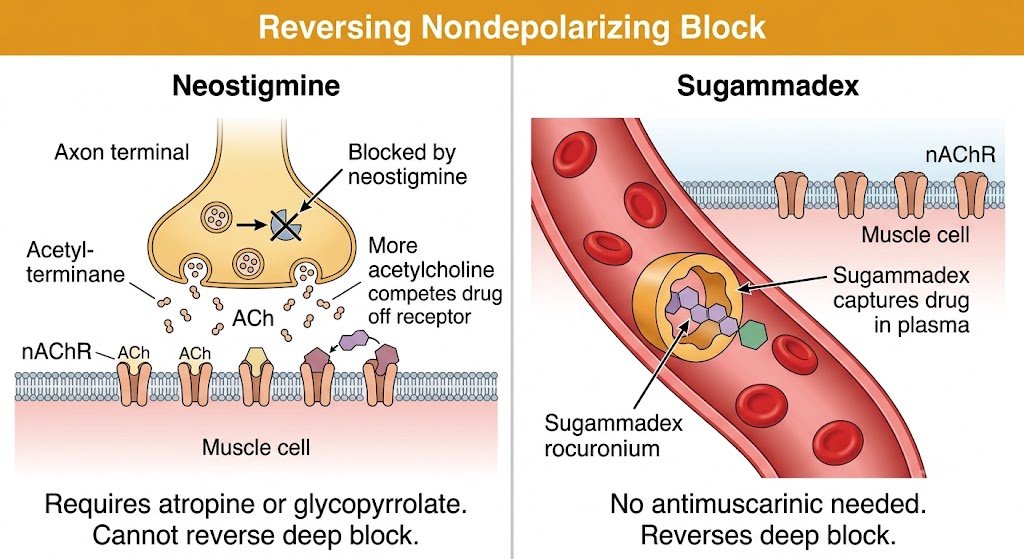
Neostigmine is the anticholinesterase most commonly used for reversal of nondepolarizing neuromuscular block. It inhibits both acetylcholinesterase at the neuromuscular junction and plasma cholinesterase, slowing the breakdown of acetylcholine and allowing it to accumulate at the end plate. The resulting rise in synaptic acetylcholine concentration increases competition for the nicotinic receptor and progressively restores twitch responses. Pyridostigmine is a longer-acting alternative occasionally used when a more prolonged reversal effect is desired, though neostigmine is the standard agent in most clinical settings.

Mandatory Antimuscarinic Pretreatment

Anticholinesterase drugs do not selectively inhibit acetylcholinesterase at the neuromuscular junction. They raise acetylcholine concentrations at muscarinic receptors throughout the body as well — in the heart, the airways, the gastrointestinal tract, and the salivary and lacrimal glands. The consequences of uncontrolled muscarinic excess are clinically dangerous: profound bradycardia and even asystole from cardiac muscarinic stimulation, bronchospasm from airway smooth muscle contraction, and copious secretions that can compromise the airway.

To prevent these muscarinic effects, an antimuscarinic drug must always be administered before or simultaneously with the anticholinesterase. Atropine and glycopyrrolate are the two agents used for this purpose. Atropine crosses the blood-brain barrier and acts more rapidly; glycopyrrolate does not cross the blood-brain barrier and has a more prolonged duration of action that better matches the duration of neostigmine. Neither the antimuscarinic nor the anticholinesterase should be given alone in this context — the combination is the standard of practice.

Limits of Anticholinesterase Reversal

Anticholinesterase reversal has a fundamental ceiling: it cannot reverse deep neuromuscular block. The strategy works by shifting a competitive equilibrium, and at high blocking drug concentrations the equilibrium cannot be shifted adequately even at maximum acetylcholinesterase inhibition. Attempting reversal when the train-of-four count is zero — meaning no twitches are detectable — reliably fails. The blocking drug must have already undergone sufficient spontaneous redistribution and elimination to reduce receptor occupancy to a level where reversal is pharmacologically feasible, typically when at least one or two train-of-four twitches have returned.

This limitation has significant clinical implications. Patients reversed prematurely — before sufficient spontaneous recovery has occurred — may appear to have adequate strength in the operating room but develop progressive respiratory failure from residual block in the recovery period. Post-operative residual neuromuscular blockade is a recognized cause of respiratory complications after surgery and is a major driver of the adoption of sugammadex, which does not share this ceiling limitation.

Anticholinesterase Reversal — The Required Combination

Neostigmine (or pyridostigmine) must always be given with an antimuscarinic drug. The pairing is mandatory, not optional.

Neostigmine + atropine: atropine has a faster onset, better matched to neostigmine's rapid muscarinic effects. Used when speed of heart rate protection is the priority.

Neostigmine + glycopyrrolate: glycopyrrolate has a duration better matched to neostigmine's overall effect and does not cross the blood-brain barrier. Preferred in most routine settings.

Giving neostigmine without an antimuscarinic risks bradycardia and bronchospasm. Giving atropine alone without neostigmine does nothing to reverse the block.


Section 3
Sugammadex — Selective Reversal
A fundamentally different reversal strategy that encapsulates rocuronium and vecuronium directly, bypassing the acetylcholinesterase pathway entirely

Sugammadex represents a conceptually distinct approach to reversing neuromuscular block. Rather than raising acetylcholine concentrations to compete the blocking drug off the receptor, sugammadex physically captures rocuronium and vecuronium molecules in the bloodstream, creating a tight complex that renders them pharmacologically inert. The drug-sugammadex complex is then excreted renally. The receptor is simply abandoned by the blocking drug as its free plasma concentration falls to near zero.

Mechanism — Encapsulation, Not Competition

Sugammadex is a modified gamma-cyclodextrin — a ring-shaped molecule with a hydrophobic core precisely shaped to accommodate the steroidal skeleton of rocuronium and vecuronium. When sugammadex is administered intravenously, it rapidly binds rocuronium or vecuronium molecules in the plasma with extremely high affinity, forming a stable, inactive complex. This pulls free drug out of the neuromuscular junction down a concentration gradient. As the blocking drug dissociates from nicotinic receptors and diffuses into the plasma, it is immediately captured by sugammadex and rendered inactive. The reversal is independent of the degree of residual spontaneous recovery — sugammadex can reverse even profound, complete neuromuscular block rapidly and reliably.

Clinical Advantages Over Anticholinesterase Reversal

Sugammadex offers three advantages that anticholinesterase reversal cannot match. First, it reliably reverses deep block — even when no train-of-four twitches are detectable — whereas neostigmine cannot. Second, it requires no antimuscarinic pretreatment because it does not affect acetylcholinesterase and therefore does not raise acetylcholine at muscarinic receptors. Third, when used at appropriate doses, sugammadex achieves complete reversal more rapidly and more consistently than neostigmine, reducing the risk of post-operative residual block.

Sugammadex is selective for rocuronium and vecuronium. It does not bind pancuronium reliably and has no effect on benzylisoquinolinium agents such as atracurium, cisatracurium, or mivacurium. Its selectivity for the steroidal neuromuscular blocking drugs reflects the geometric fit between the cyclodextrin cavity and the steroid nucleus — a fit that benzylisoquinolinium drugs, which lack a steroid skeleton, do not share.

Sugammadex — Key Points

Mechanism: encapsulates rocuronium and vecuronium in plasma, pulling them off the nicotinic receptor by mass action.

No antimuscarinic needed: does not affect acetylcholinesterase; no muscarinic side effects.

Reverses deep block: effective even at zero train-of-four count, unlike neostigmine.

Selectivity: rocuronium and vecuronium only. No effect on atracurium, cisatracurium, mivacurium, or pancuronium at standard doses.

Elimination: the sugammadex-drug complex is excreted renally; use with caution in severe renal impairment.

Two-panel diagram comparing neostigmine reversal (blocking acetylcholinesterase to raise acetylcholine at the receptor, requiring antimuscarinic pretreatment, unable to reverse deep block) with sugammadex reversal (encapsulating rocuronium in plasma, no antimuscarinic needed, reverses deep block).
Two reversal strategies contrasted: neostigmine inhibits acetylcholinesterase to raise acetylcholine at the receptor (requires antimuscarinic pretreatment; cannot reverse deep block), while sugammadex encapsulates rocuronium directly in the plasma (no antimuscarinic needed; reverses deep block). Figure generated by Gemini AI.

Section 4
Individual Agent Profiles
Duration of action, elimination pathways, cardiovascular effects, and the clinical niche of each nondepolarizing agent

The nondepolarizing neuromuscular blocking drugs differ from one another not in mechanism — all are competitive nicotinic antagonists — but in duration of action, route of elimination, onset speed, and cardiovascular profile. These differences determine which agent is selected for a given clinical situation.

Long-Acting Agent — Pancuronium

Pancuronium is the prototype long-acting nondepolarizing neuromuscular blocking drug, with a duration of action of 60 to 90 minutes or longer. It is eliminated primarily by renal excretion, with some hepatic metabolism, meaning its duration is substantially prolonged in patients with renal failure. The defining pharmacological feature of pancuronium is its vagolytic effect: it blocks cardiac muscarinic receptors, producing tachycardia and a modest increase in blood pressure. This cardiovascular effect was once considered acceptable but limits its use in patients where tachycardia is undesirable — those with coronary artery disease, hypertrophic cardiomyopathy, or fixed cardiac output. Pancuronium is reversed by neostigmine; sugammadex does not bind it reliably at standard doses.

Intermediate-Acting Agents — Vecuronium and Rocuronium

Vecuronium and rocuronium are the workhorse agents of modern anesthesia practice. Both have an intermediate duration of action of 25 to 40 minutes and are reversed by either neostigmine or sugammadex. Both are steroidal neuromuscular blocking drugs and therefore selective targets of sugammadex.

Vecuronium is notable for its exceptionally clean cardiovascular profile — it has no vagolytic effect, does not release histamine, and produces essentially no change in heart rate or blood pressure at clinical doses. It undergoes primarily hepatic elimination, with some renal excretion of active metabolites. Duration is prolonged in hepatic failure. Vecuronium established the standard against which other agents are compared for cardiovascular neutrality.

Rocuronium shares vecuronium's cardiovascular cleanliness but has one distinguishing property: the fastest onset of any nondepolarizing neuromuscular blocking drug. At standard doses, rocuronium produces intubating conditions in approximately 60 to 90 seconds — slower than succinylcholine's 60 seconds but substantially faster than other nondepolarizing agents. At high doses used for rapid sequence intubation, rocuronium approaches succinylcholine's onset speed and is the preferred alternative when succinylcholine is contraindicated. The ability to immediately reverse high-dose rocuronium with sugammadex in a failed intubation scenario provides a safety net that succinylcholine, with its spontaneous brief duration, provides in a different way. Rocuronium is eliminated primarily by biliary excretion and is prolonged in hepatic failure.

Hofmann Elimination Agents — Atracurium and Cisatracurium

Atracurium and cisatracurium are benzylisoquinolinium neuromuscular blocking drugs that undergo spontaneous chemical degradation at physiologic pH and temperature — a process called Hofmann elimination. This degradation occurs in the plasma and does not depend on hepatic or renal function. The clinical significance is substantial: atracurium and cisatracurium are the agents of choice in patients with combined hepatic and renal failure, where steroidal agents would accumulate unpredictably.

The two agents differ in one clinically important respect. Atracurium releases histamine at higher doses, which can produce flushing, hypotension, and bronchospasm — a concern in atopic patients or those with reactive airway disease. Cisatracurium is a purified isomer of atracurium with approximately four times the potency and no clinically significant histamine release at standard doses. Cisatracurium has largely replaced atracurium in clinical practice for this reason, while retaining all the organ-independence advantages of Hofmann elimination. Neither agent is a target for sugammadex.

Short-Acting Agent — Mivacurium

Mivacurium is the only short-acting nondepolarizing neuromuscular blocking drug. Like succinylcholine, it is hydrolyzed by plasma cholinesterase — and like succinylcholine, its duration is substantially prolonged in patients with pseudocholinesterase deficiency. In patients with normal plasma cholinesterase activity, mivacurium has a duration of approximately 15 to 20 minutes and often undergoes sufficient spontaneous recovery that neostigmine reversal is unnecessary. It is a benzylisoquinolinium agent and releases histamine at higher doses. Mivacurium is not a target for sugammadex.

Drug Interactions — Potentiation of Block

Several drug classes potentiate nondepolarizing neuromuscular block and can produce unexpectedly prolonged paralysis if not anticipated. Aminoglycoside antibiotics — gentamicin, tobramycin, and related agents — inhibit presynaptic calcium channels, reducing acetylcholine release, and also have a postsynaptic blocking effect. The combination of aminoglycosides with a nondepolarizing blocking drug can produce profound, difficult-to-reverse neuromuscular block, particularly in patients with renal failure where both the antibiotic and the neuromuscular blocking drug may accumulate. Volatile inhalational anesthetics potentiate nondepolarizing block through mechanisms that include enhanced receptor sensitivity. Calcium channel blocking drugs reduce presynaptic acetylcholine release and add to the neuromuscular blocking effect. Magnesium, used in obstetric practice for pre-eclampsia, competes with calcium at presynaptic terminals and potentiates block through the same mechanism, requiring dose reduction of neuromuscular blocking drugs in patients receiving magnesium infusions.

Agent Duration Elimination Cardiovascular Effect Notes
Pancuronium Long (60–90 min) Renal Vagolytic — tachycardia Prolonged in renal failure; no sugammadex
Vecuronium Intermediate (25–40 min) Hepatic None Prototype clean profile; reversed by sugammadex
Rocuronium Intermediate (25–40 min) Biliary/hepatic None Fastest onset of nondepolarizers; reversed by sugammadex; used for rapid sequence intubation when succinylcholine contraindicated
Atracurium Intermediate (20–35 min) Hofmann elimination Histamine release at high doses Organ failure patients; no sugammadex
Cisatracurium Intermediate (25–40 min) Hofmann elimination None Preferred over atracurium; no histamine release; no sugammadex
Mivacurium Short (15–20 min) Plasma cholinesterase Histamine release at high doses Prolonged by pseudocholinesterase deficiency; no sugammadex

Suggested References
Author / Organization Title Source
Brunton LL, Knollmann BC (eds) Goodman and Gilman's The Pharmacological Basis of Therapeutics, 14th ed. Chapter 12: Neuromuscular Blocking Agents McGraw-Hill, 2023
Katzung BG (ed) Basic and Clinical Pharmacology, 15th ed. Chapter 27: Skeletal Muscle Relaxants McGraw-Hill, 2021
Nicholson WT, Sprung J, Jankowski CJ Sugammadex: a novel agent for the reversal of neuromuscular blockade Pharmacotherapy. 2007;27(8):1181-8
Caldwell JE Reversal of residual neuromuscular block with neostigmine at one to four hours after a single intubating dose of vecuronium Anesth Analg. 1995;80(6):1168-74
Bom A, Bradley M, Cameron K, et al A novel concept of reversing neuromuscular block: chemical encapsulation of rocuronium bromide by a cyclodextrin-based synthetic host Angew Chem Int Ed. 2002;41(2):266-70
Martyn JAJ, Fagerlund MJ, Eriksson LI Basic principles of neuromuscular transmission Anaesthesia. 2009;64(Suppl 1):1-9
Naguib M Sugammadex: another milestone in clinical neuromuscular pharmacology Anesth Analg. 2007;104(3):575-81