Neuromuscular blocking drugs cannot be safely administered without a means of assessing depth of block and adequacy of recovery. Train-of-four stimulation provides the clinical window into receptor occupancy at the neuromuscular junction, and the threshold for safe extubation is more demanding than subjective assessment alone can reliably detect.
Train-of-four stimulation delivers four electrical impulses to a peripheral nerve at half-second intervals and measures the evoked muscle responses. In the absence of neuromuscular blocking drug, all four twitches are equal. As nondepolarizing block deepens, successive twitches weaken because each nerve impulse depletes the releasable pool of acetylcholine at the presynaptic terminal, progressively reducing competition against the blocking drug. The result is the characteristic fade pattern of nondepolarizing block — the fourth twitch is smaller than the first. The train-of-four ratio, defined as the amplitude of the fourth twitch divided by the amplitude of the first, quantifies this fade.
Depolarizing block from succinylcholine produces a different pattern: all four twitches are equally depressed with no fade, because the block does not depend on the presynaptic acetylcholine release mechanism. This difference in train-of-four pattern — fade with nondepolarizing agents, no fade with succinylcholine — helps distinguish the two block types clinically when the agent administered is uncertain.
A train-of-four ratio of at least 0.9 is required before extubation to ensure adequate recovery of neuromuscular function. This threshold is not arbitrary. Studies measuring upper airway muscle function, hypoxic ventilatory response, and aspiration risk have consistently shown that a ratio below 0.9 is associated with clinically significant impairment of pharyngeal and laryngeal muscle function — even when the patient appears to have adequate grip strength, sustained head lift, or satisfactory tidal volume in the recovery room. These subjective tests of recovery are unreliable at the margin and cannot substitute for objective monitoring.
The ulnar nerve stimulated at the wrist, with measurement of the adductor pollicis response, is the standard monitoring site because it most accurately reflects block at the muscles of the larynx and diaphragm. Monitoring the facial nerve overestimates recovery — the orbicularis oculi recovers earlier than deeper muscles, so a satisfactory response there does not guarantee adequate recovery at the airway.
Post-operative residual neuromuscular block — a train-of-four ratio below 0.9 at the time of extubation — is more common than is generally appreciated and is a recognized cause of post-operative respiratory complications including hypoxemia, airway obstruction, aspiration, and reintubation. Studies conducted in the era before routine quantitative monitoring identified residual block in 30 to 40 percent of patients arriving in the recovery room after nondepolarizing neuromuscular block.
The risk of residual block is reduced by two complementary strategies: objective monitoring to guide the timing of reversal and extubation, and the use of sugammadex rather than neostigmine for reversal when deep or moderate block is present. Neostigmine administered at a train-of-four count of zero — before any spontaneous recovery — reliably fails to produce adequate reversal and may itself contribute to residual block by maximally inhibiting acetylcholinesterase without achieving the receptor occupancy shift needed to complete reversal.
Two neuromuscular diseases produce dramatically altered sensitivity to neuromuscular blocking drugs, and they do so through opposite mechanisms at opposite ends of the synapse. Understanding the pharmacological consequence of each — and why it differs from the other — is a high-yield distinction at Step 1 level.
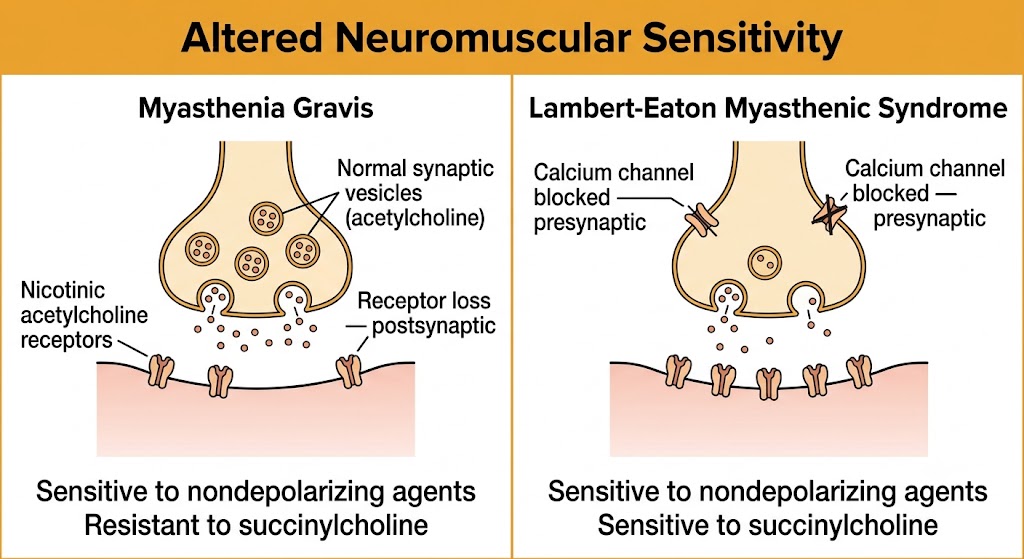
Myasthenia gravis is an autoimmune disease in which autoantibodies target the nicotinic acetylcholine receptor on the postsynaptic motor end plate, causing receptor internalization and destruction. The result is a dramatic reduction in functional receptor density — in severely affected patients, receptor numbers may be reduced by 70 to 80 percent from normal. This reduction narrows the safety margin of neuromuscular transmission: the end-plate potential is already close to the threshold for transmission failure, and the patients experience fluctuating weakness that worsens with repetitive activity.
The pharmacological consequences follow directly from receptor depletion. Nondepolarizing neuromuscular blocking drugs, which work by occupying a fraction of available receptors, are active against a far smaller receptor pool — meaning that doses producing trivial block in a normal patient may cause profound, prolonged paralysis in a myasthenia gravis patient. These patients are exquisitely sensitive to nondepolarizing agents and require dramatically reduced doses with meticulous train-of-four monitoring. Conversely, myasthenia gravis patients may show partial resistance to succinylcholine: the depolarizing agent must depolarize enough receptors to cause fasciculations and block, and the reduced receptor population means more drug is needed to achieve this critical threshold. This partial succinylcholine resistance is relative, not absolute, and the drug remains effective at higher doses.
Lambert-Eaton myasthenic syndrome is a paraneoplastic or autoimmune condition in which autoantibodies target voltage-gated calcium channels on the presynaptic motor nerve terminal. Because calcium influx is required to trigger acetylcholine vesicle fusion and release, disruption of these channels reduces the amount of acetylcholine released into the synaptic cleft with each nerve impulse. Clinically, patients with Lambert-Eaton myasthenic syndrome exhibit proximal limb weakness that paradoxically improves briefly with repeated activity — a distinguishing feature from myasthenia gravis, in which weakness worsens with repetition. Lambert-Eaton myasthenic syndrome is strongly associated with small cell lung cancer, which expresses voltage-gated calcium channels that trigger the autoimmune response.
The pharmacological sensitivity pattern in Lambert-Eaton myasthenic syndrome is opposite to that of myasthenia gravis in one key respect and similar in another. Because acetylcholine release is already impaired, there is less acetylcholine available to compete against nondepolarizing neuromuscular blocking drugs — these patients are sensitive to nondepolarizing agents, just as myasthenia gravis patients are, though by a different mechanism. The sensitivity to succinylcholine is also increased in Lambert-Eaton myasthenic syndrome, unlike myasthenia gravis — because the reduced acetylcholine release means the postsynaptic receptor population is underactivated at baseline, and any depolarizing stimulus is relatively more effective. Both conditions demand extreme caution with all neuromuscular blocking drugs and careful monitoring.
Several drug classes encountered in routine anesthetic and critical care practice potentiate nondepolarizing neuromuscular block, producing deeper or more prolonged paralysis than the blocking drug alone would generate. Anticipating these interactions — and knowing which antagonizes them — is essential for safe management.
Aminoglycoside antibiotics — including gentamicin, tobramycin, amikacin, and neomycin — potentiate nondepolarizing neuromuscular block through two complementary mechanisms. Presynaptically, they inhibit calcium-dependent acetylcholine release from the nerve terminal, reducing the amount of transmitter available to compete with the blocking drug. Postsynaptically, they have a direct blocking effect on the nicotinic acetylcholine receptor. The combination of reduced acetylcholine release and reduced receptor sensitivity produces a substantial potentiation of nondepolarizing block.
This interaction is clinically most significant when aminoglycosides are administered in the peri-operative period — for example, as prophylaxis against surgical infection — in a patient who has received a nondepolarizing neuromuscular blocking drug. Patients with renal failure are at particular risk because both the aminoglycoside and the neuromuscular blocking drug may accumulate due to impaired elimination. Calcium administration partially reverses the aminoglycoside-induced presynaptic block by restoring calcium-dependent acetylcholine release, though this does not fully reverse a clinically established block.
All volatile inhalational anesthetics — halothane, isoflurane, sevoflurane, and desflurane — potentiate nondepolarizing neuromuscular block. The mechanisms include enhanced sensitivity of the postsynaptic nicotinic receptor to the blocking drug and a modest presynaptic effect on acetylcholine release. The potentiation is dose-dependent and is clinically relevant: patients maintained on volatile anesthetics require smaller doses of nondepolarizing blocking drugs to maintain a given depth of block compared to patients under total intravenous anesthesia. The interaction resolves as the volatile agent is eliminated during emergence from anesthesia, which can unmask inadequate neuromuscular block reversal as the potentiating effect dissipates.
Magnesium competes with calcium at presynaptic voltage-gated calcium channels, reducing calcium influx and thereby reducing acetylcholine release per nerve impulse. It also has a mild postsynaptic stabilizing effect on the end-plate membrane. Patients receiving magnesium infusions for pre-eclampsia or eclampsia are therefore at increased sensitivity to nondepolarizing neuromuscular blocking drugs, and standard doses may produce unexpectedly deep or prolonged block. Dose reduction and careful monitoring are required. Because magnesium acts by blocking calcium channels, calcium administration can partially reverse magnesium-induced potentiation of block in emergency situations.
Calcium channel blocking drugs used for cardiovascular indications — including verapamil, diltiazem, and the dihydropyridines — reduce acetylcholine release from the presynaptic terminal by the same calcium-dependent mechanism as magnesium, though typically to a lesser clinical degree. Patients on chronic calcium channel blocker therapy may show modestly increased sensitivity to nondepolarizing agents, and the interaction may become significant in the setting of high doses, renal impairment, or co-administration of other potentiating agents.
Aminoglycosides: pre- and postsynaptic block; significant in renal failure; partially reversed by calcium.
Volatile anesthetics: postsynaptic sensitization; dose-dependent; resolves with emergence.
Magnesium: reduces acetylcholine release; clinically important in obstetric patients on magnesium for pre-eclampsia; partially reversed by calcium.
Calcium channel blockers: mild presynaptic effect; most significant in combination with other potentiating agents or renal failure.
The choice between neostigmine-based reversal and sugammadex depends on which neuromuscular blocking drug was used, the depth of block at the time reversal is attempted, and patient-specific factors. Getting this decision right is the difference between a patient who wakes with intact airway reflexes and one who arrives in the recovery room with residual paralysis.
Neostigmine is appropriate when a nondepolarizing neuromuscular blocking drug of any class has been used and at least partial spontaneous recovery has occurred — defined as at least one or two detectable train-of-four twitches. At this level of spontaneous recovery, the competitive equilibrium can be shifted adequately by anticholinesterase inhibition, and reversal can be completed reliably. Neostigmine must always be paired with an antimuscarinic drug, and the adequacy of reversal must be confirmed with objective monitoring before extubation.
Sugammadex is the preferred reversal agent when rocuronium or vecuronium has been used and any of the following apply: the block is deep (few or no train-of-four twitches detectable), reversal is urgent, or previous attempts at neostigmine reversal have been inadequate. Sugammadex can reliably reverse even complete block within minutes when given at appropriate doses. It is also the agent of choice when the patient has conditions that make muscarinic stimulation hazardous — reactive airway disease, cardiac conduction abnormalities — and in whom the muscarinic side effects of neostigmine would be poorly tolerated even with antimuscarinic pretreatment. Sugammadex is not effective for benzylisoquinolinium agents or pancuronium.
The choice of neuromuscular blocking drug at the outset determines what reversal options are available at the end of the case. A systematic approach to initial agent selection reduces end-of-case complications.
Succinylcholine remains the first choice for rapid sequence intubation in patients without contraindications. Its combination of rapid onset and brief spontaneous duration makes it uniquely suited to the failed-airway scenario. When succinylcholine is contraindicated — hyperkalemia risk, malignant hyperthermia susceptibility, pseudocholinesterase deficiency — high-dose rocuronium is the alternative, with the understanding that sugammadex must be immediately available for rescue reversal.
For maintenance of surgical relaxation requiring intermediate duration, rocuronium and vecuronium are the standard choices when sugammadex access is assured. Cisatracurium is preferred in patients with combined hepatic and renal failure, where steroidal agents would accumulate unpredictably. Pancuronium, once a staple of long cardiac surgical cases, is now less commonly used because of its vagolytic cardiovascular effects and long duration that may extend into the post-operative period.
In patients with myasthenia gravis, the preference is to avoid neuromuscular blocking drugs entirely where possible, using regional anesthesia or very carefully titrated volatile anesthetics alone for surgical relaxation. When neuromuscular block is unavoidable, short-acting agents at dramatically reduced doses with meticulous objective monitoring represent the safest approach.
Two mechanisms: depolarizing block (succinylcholine — persistent nicotinic agonism, no reversal) and nondepolarizing block (competitive nicotinic antagonism, reversible).
Succinylcholine risks: hyperkalemia in upregulation states (burns, crush, denervation — after first 24 hours), malignant hyperthermia, prolonged block in pseudocholinesterase deficiency.
Nondepolarizing agent selection: rocuronium/vecuronium (intermediate, sugammadex-reversible); cisatracurium/atracurium (organ failure — Hofmann elimination); pancuronium (long-acting, vagolytic); mivacurium (short, plasma cholinesterase).
Reversal: neostigmine + antimuscarinic for partial block; sugammadex for rocuronium/vecuronium at any depth. Target train-of-four ratio of 0.9 before extubation.
Special populations: myasthenia gravis — exquisitely sensitive to nondepolarizers, relatively resistant to succinylcholine. Lambert-Eaton myasthenic syndrome — sensitive to both classes.
| Author / Organization | Title | Source |
|---|---|---|
| Brunton LL, Knollmann BC (eds) | Goodman and Gilman's The Pharmacological Basis of Therapeutics, 14th ed. Chapter 12: Neuromuscular Blocking Agents | McGraw-Hill, 2023 |
| Katzung BG (ed) | Basic and Clinical Pharmacology, 15th ed. Chapter 27: Skeletal Muscle Relaxants | McGraw-Hill, 2021 |
| Murphy GS, Szokol JW, Marymont JH, et al | Residual neuromuscular blockade and critical respiratory events in the postanesthesia care unit | Anesth Analg. 2008;107(1):130-7 |
| Naguib M, Brull SJ, Johnson KB | Conceptual and technical insights into the basis of neuromuscular monitoring | Anaesthesia. 2017;72(Suppl 1):16-37 |
| Drachman DB | Myasthenia gravis | N Engl J Med. 1994;330(25):1797-810 |
| Tim RW, Sanders DB | Lambert-Eaton myasthenic syndrome: clinical diagnosis, immune-mediated mechanisms, and update on therapies | Ann Neurol. 1994;37(Suppl 1):S63-73 |
| Martyn JAJ, Fagerlund MJ, Eriksson LI | Basic principles of neuromuscular transmission | Anaesthesia. 2009;64(Suppl 1):1-9 |