Deoxyribonucleic acid alkylation chemistry, interstrand cross-links, and the cycle-nonspecific mechanism
Alkylating agents were the first cytotoxic drugs used in clinical oncology and remain among the most widely used agents in cancer chemotherapy, appearing in regimens for lymphoma, leukemia, breast cancer, ovarian cancer, sarcoma, and brain tumors.
The defining biochemical event of alkylating agent action is the formation of a highly reactive electrophilic intermediate that attacks nucleophilic sites on deoxyribonucleic acid. The primary cytotoxic lesion is alkylation at the N7 position of guanine, the most nucleophilic site in double-stranded deoxyribonucleic acid. This can result in depurination, miscoding during replication, or the more lethal cross-linking reactions that prevent strand separation.
Interstrand cross-links, which covalently bridge complementary strands and physically prevent replication fork progression, are the most cytotoxic lesion produced by bifunctional alkylating agents. Because alkylation damages deoxyribonucleic acid regardless of cell cycle position, alkylating agents are cycle-nonspecific, and their dose-response curves are more nearly linear than those of cycle-specific antimetabolites, making dose escalation a meaningful strategy up to the limits imposed by organ toxicity.
Alkylating agents are classified into five major subgroups. Nitrogen mustards (cyclophosphamide, ifosfamide, mechlorethamine, melphalan, chlorambucil, bendamustine) generate aziridinium ion intermediates that alkylate deoxyribonucleic acid. Nitrosoureas (carmustine, lomustine, streptozocin) have high lipophilicity enabling central nervous system penetration. Platinum compounds (cisplatin, carboplatin, oxaliplatin) form platinum-deoxyribonucleic acid adducts after aquation. Alkyl sulfonates (busulfan) have particular selectivity for hematopoietic stem cells. Triazenes and hydrazines (dacarbazine, temozolomide, procarbazine) require metabolic or spontaneous activation to generate methylating species.
All bifunctional agents — those bearing two reactive groups — produce interstrand cross-links more readily and are generally more cytotoxic than monofunctional agents, which produce primarily single-strand adducts.
Prodrug activation, acrolein toxicity, mesna protection, and ifosfamide encephalopathy
Cyclophosphamide is among the most widely used cytotoxic drugs in oncology and rheumatology, appearing in regimens for breast cancer, lymphoma, leukemia, ovarian cancer, sarcoma, and autoimmune diseases. Its unique toxicity profile is determined by a metabolic pathway that generates both the active alkylating species and a toxic byproduct, acrolein.
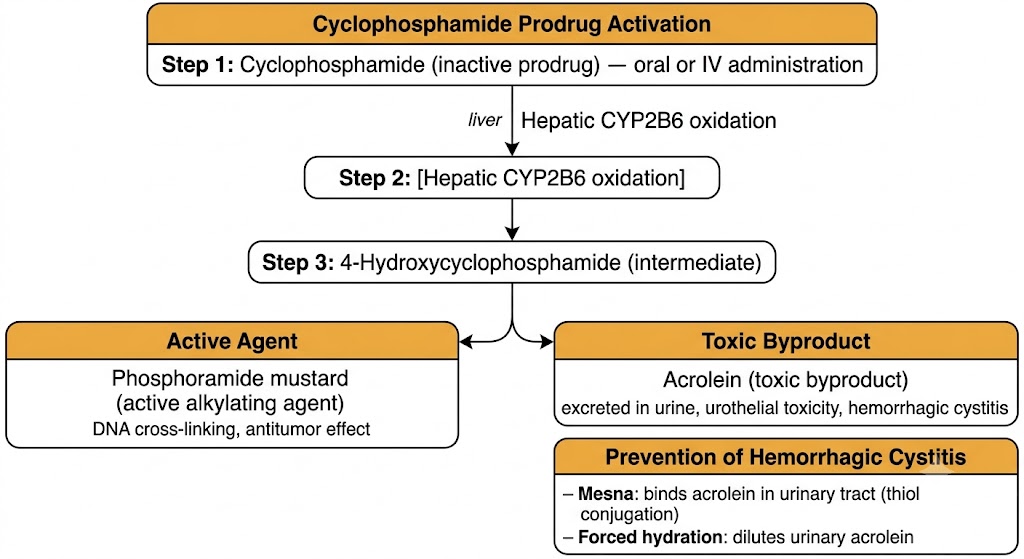
Cyclophosphamide is an inactive prodrug requiring hepatic oxidation by cytochrome P450 enzymes, principally cytochrome P450 2B6, to generate 4-hydroxycyclophosphamide. This intermediate spontaneously decomposes in tissues to yield phosphoramide mustard, the active bifunctional alkylating species, and acrolein, a reactive aldehyde that is the primary cause of cyclophosphamide-induced hemorrhagic cystitis. Acrolein is excreted unchanged in urine and achieves high concentrations in the bladder lumen, causing direct urothelial cytotoxicity.
Two strategies prevent hemorrhagic cystitis: forced hydration dilutes urinary acrolein concentrations and promotes rapid elimination, and mesna (sodium 2-mercaptoethane sulfonate) binds acrolein in the urinary tract through a thiol exchange reaction, forming a non-toxic conjugate excreted renally. Mesna is required whenever ifosfamide is used and is reserved for high-dose cyclophosphamide regimens; forced hydration alone suffices for standard-dose cyclophosphamide.
Cyclophosphamide is well absorbed orally (bioavailability above 75%) and undergoes autoinduction of its activating cytochrome P450 enzymes with repeated dosing. It crosses the blood-brain barrier to a limited extent. Significant drug interactions involve inducers and inhibitors of cytochrome P450 2B6 and cytochrome P450 3A4: rifampin increases activation and may increase toxicity; azole antifungals reduce activation and may reduce efficacy.
Ifosfamide is a structural isomer of cyclophosphamide that has a substantially higher rate of side-chain oxidation, generating chloroacetaldehyde, a neurotoxic metabolite responsible for ifosfamide encephalopathy. This presents with confusion, somnolence, cerebellar ataxia, visual hallucinations, seizures, or coma, typically beginning 12 to 48 hours after the start of infusion. Risk factors include hypoalbuminemia, renal impairment, and prior cisplatin exposure.
Treatment for established ifosfamide encephalopathy is methylene blue given intravenously at 50 mg every 4 to 8 hours. Methylene blue corrects the mitochondrial dysfunction caused by chloroacetaldehyde, restoring normal cellular energy metabolism in affected neurons. It is also used prophylactically at 50 mg three times daily in subsequent cycles when encephalopathy has occurred previously. Ifosfamide also produces a higher acrolein load per gram than cyclophosphamide, making mesna prophylaxis mandatory at all doses. Renal tubular toxicity, manifesting as Fanconi syndrome (proximal tubular dysfunction with phosphate, bicarbonate, glucose, and amino acid wasting), is more prominent with ifosfamide and may be dose-limiting in pediatric patients.
The key distinguishing feature of ifosfamide encephalopathy is the temporal relationship to infusion onset (typically 12 to 48 hours). It is underrecognized because early manifestations overlap with opioid side effects and metabolic derangements. Do not delay treatment while awaiting confirmatory testing: give methylene blue 50 mg intravenously every 4 to 8 hours and discontinue ifosfamide immediately. Risk factors that warrant heightened vigilance: hypoalbuminemia below 3.5 g per deciliter, serum creatinine above 1.2 mg per deciliter, prior cisplatin nephrotoxicity, and high ifosfamide dose per cycle.
Mechlorethamine is the original nitrogen mustard, chemically unstable in aqueous solution, and the most reactive and vesicant of the class. It appears in the MOPP regimen for Hodgkin lymphoma and has largely been replaced in most other settings. Sodium thiosulfate is the antidote for mechlorethamine extravasation. Melphalan is used in multiple myeloma conditioning regimens before autologous stem cell transplantation; oral bioavailability is highly variable (15 to 90%), mandating intravenous dosing for high-dose conditioning, with dose reduction required in renal impairment. Chlorambucil is an oral nitrogen mustard used in chronic lymphocytic leukemia and low-grade lymphomas, well tolerated with predominantly myelosuppressive dose-limiting toxicity. Bendamustine combines a nitrogen mustard alkylating group with a benzimidazole ring that contributes purine analog-like properties; it is active in chronic lymphocytic leukemia, follicular lymphoma, and mantle cell lymphoma.
Aquation chemistry, nephrotoxicity prevention, the Calvert formula, and oxaliplatin neuropathy
The platinum compounds form the backbone of regimens for testicular, ovarian, bladder, lung, head and neck, and colorectal cancers. Although they share the platinum-deoxyribonucleic acid adduct mechanism, the three compounds differ substantially in their toxicity profiles, pharmacokinetics, and clinical indications.
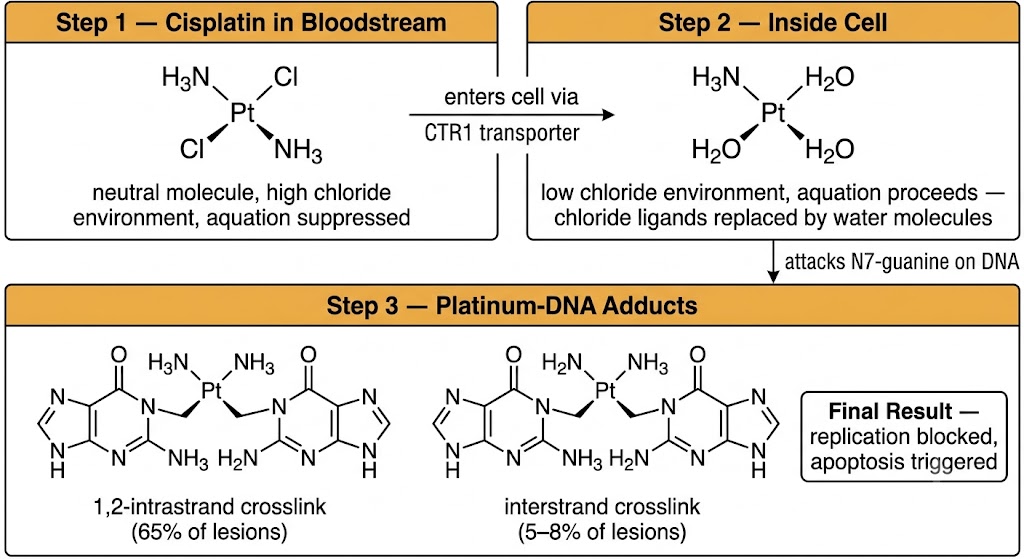
Cisplatin undergoes a mandatory activation step called aquation in which its two chloride ligands are sequentially replaced by water molecules in the low-chloride environment of the cell interior. The resulting electrophilic platinum species attacks the N7 position of guanine, forming predominantly 1,2-intrastrand adducts between adjacent guanines (approximately 65% of lesions) and interstrand cross-links (approximately 5 to 8%). The extracellular chloride-rich environment suppresses aquation and allows cisplatin to circulate as the neutral parent compound before entering cells.
Cisplatin nephrotoxicity is dose-dependent, cumulative, and potentially severe. Prevention requires at least 1 to 2 liters of normal saline infused before cisplatin, aggressive saline diuresis during and after the infusion, and supplemental magnesium in every cycle (magnesium wasting from tubular injury is often the earliest sign of nephrotoxicity). Ototoxicity is sensorineural, dose-dependent, cumulative, and largely irreversible, affecting high-frequency hearing first; audiometric monitoring is recommended in high-risk patients.
Carboplatin replaces cisplatin's two chloride ligands with a cyclobutanedicarboxylate bidentate ligand, which hydrolyzes more slowly, producing a less reactive platinum species. This accounts for carboplatin's substantially lower nephrotoxicity, neurotoxicity, and emetogenicity compared to cisplatin. The dose-limiting toxicity of carboplatin is myelosuppression, predominantly thrombocytopenia, which is predictably related to the area under the concentration-time curve rather than body surface area.
Because carboplatin is eliminated almost exclusively by renal filtration, glomerular filtration rate is the primary determinant of drug exposure. The Calvert formula (dose in mg = target area under the curve multiplied by [glomerular filtration rate + 25]) provides area under the curve-based dosing that accounts for individual variation in renal function and is the standard approach for all carboplatin administration. Because cisplatin and carboplatin form identical platinum-deoxyribonucleic acid adducts, platinum resistance mechanisms confer complete cross-resistance between the two agents. Carboplatin cannot substitute for cisplatin in curative-intent regimens such as BEP (bleomycin, etoposide, cisplatin) for testicular germ cell tumors, where the clinical outcome data are specific to cisplatin.
Oxaliplatin produces structurally distinct platinum-deoxyribonucleic acid adducts that are not recognized by mismatch repair proteins. This explains why oxaliplatin retains activity in mismatch repair-deficient tumors that are cisplatin-resistant. The combination of oxaliplatin with fluorouracil and leucovorin (FOLFOX) is standard therapy for metastatic colorectal cancer and adjuvant stage III colon cancer.
The dose-limiting toxicity of oxaliplatin is peripheral neuropathy with two distinct phases: an acute cold-triggered sensory syndrome (dysesthesias triggered by cold contact, occurring within hours of infusion and reversible within days) and a cumulative sensory neuropathy (stocking-glove distribution, progressive with cumulative dose, partially reversible after treatment discontinuation). Nephrotoxicity and significant ototoxicity are not observed with oxaliplatin at standard doses, an important clinical advantage over cisplatin.
Central nervous system penetration, delayed myelosuppression, MGMT methylation, and transplant conditioning
These agents occupy distinct pharmacological niches defined by central nervous system penetration (nitrosoureas), selectivity for hematopoietic stem cells (busulfan), and oral bioavailability with a validated predictive biomarker (temozolomide).
Carmustine and lomustine achieve central nervous system penetration not possible with most other alkylating agents because of their high lipophilicity, allowing passive diffusion across the blood-brain barrier. This makes them clinically useful for glioblastoma multiforme, anaplastic glioma, and primary central nervous system lymphoma. Carmustine is also available as a biodegradable polymer wafer (Gliadel) implanted in the surgical resection cavity after glioblastoma debulking, providing sustained local drug delivery without significant systemic exposure.
The most clinically distinctive feature of nitrosourea toxicity is delayed and prolonged myelosuppression. Unlike other alkylating agents whose nadir occurs at 10 to 14 days, nitrosoureas produce a nadir at 4 to 6 weeks, with recovery requiring 6 to 8 weeks from administration. This delayed kinetic profile means nitrosourea cycles are administered no more frequently than every 6 weeks. Clinicians unfamiliar with nitrosoureas who apply standard 3-week intervals will administer a second cycle before the first cycle's nadir has occurred, producing overlapping suppressions that can cause aplasia. Pulmonary fibrosis is a cumulative long-term toxicity of carmustine, typically appearing after total doses above 1,200 mg per square meter. Streptozocin is a nitrosourea with selective tropism for pancreatic beta cells used in metastatic pancreatic neuroendocrine tumors; its dose-limiting toxicity is nephrotoxicity, not myelosuppression.
Busulfan's clinical importance lies almost entirely in its use as a myeloablative conditioning agent before allogeneic and autologous hematopoietic stem cell transplantation. Oral busulfan has highly variable bioavailability (40 to 100%), and intravenous busulfan is now preferred for conditioning because it achieves more predictable plasma exposure. Therapeutic drug monitoring of busulfan plasma area under the curve is performed during conditioning to ensure target exposure (typically 900 to 1,350 micromolar per minute per day) and reduce the risk of hepatic sinusoidal obstruction syndrome from overexposure or graft failure from underexposure. Hepatic sinusoidal obstruction syndrome, formerly called hepatic veno-occlusive disease, is a life-threatening complication of high-dose busulfan conditioning characterized by tender hepatomegaly, jaundice, ascites, and thrombocytopenia. Defibrotide is approved for established severe hepatic sinusoidal obstruction syndrome.
Temozolomide is an orally bioavailable imidazotetrazine prodrug that spontaneously hydrolyzes at physiological pH to generate a methylating species. It methylates deoxyribonucleic acid predominantly at O6-guanine, producing lesions that cause cell death by generating persistent mismatches that trigger futile cycles of mismatch repair, ultimately causing double-strand breaks and apoptosis. Temozolomide is 100% orally bioavailable, crosses the blood-brain barrier effectively, and is used as the standard of care for newly diagnosed glioblastoma in the Stupp protocol (concurrent daily temozolomide with radiation, followed by adjuvant temozolomide for 6 cycles).
The critical predictive biomarker for temozolomide response is O6-methylguanine-deoxyribonucleic acid methyltransferase promoter methylation status. O6-methylguanine-deoxyribonucleic acid methyltransferase is a deoxyribonucleic acid repair enzyme that directly reverses O6-guanine alkylation. Tumors that silence O6-methylguanine-deoxyribonucleic acid methyltransferase expression through promoter methylation cannot repair these lesions and are more than twice as likely to respond to temozolomide. Patients with O6-methylguanine-deoxyribonucleic acid methyltransferase-methylated glioblastoma have substantially better outcomes with temozolomide than those with unmethylated tumors. O6-methylguanine-deoxyribonucleic acid methyltransferase methylation testing is now standard in the initial workup of any newly diagnosed glioblastoma. Myelosuppression, predominantly lymphopenia and thrombocytopenia, is the dose-limiting toxicity; Pneumocystis jirovecii pneumonia prophylaxis with trimethoprim-sulfamethoxazole is mandatory during concurrent chemoradiation and recommended during adjuvant temozolomide due to sustained lymphodepletion.
A methylated O6-methylguanine-deoxyribonucleic acid methyltransferase promoter means the tumor cannot repair O6-guanine alkylation effectively and is sensitized to temozolomide. An unmethylated promoter means robust repair is intact and temozolomide benefit is substantially reduced. In elderly patients or those with poor performance status, O6-methylguanine-deoxyribonucleic acid methyltransferase methylation guides treatment selection: temozolomide alone is preferred in methylated patients (equivalent outcomes, less toxicity than chemoradiation), while hypofractionated radiation alone is preferred in unmethylated patients.
Procarbazine is a methylhydrazine compound used in the PCV regimen (procarbazine, lomustine, vincristine) for anaplastic oligodendroglioma with 1p/19q co-deletion, and historically in MOPP for Hodgkin lymphoma. It requires metabolic activation by cytochrome P450 enzymes and monoamine oxidase, and is itself a weak monoamine oxidase inhibitor. Concomitant use of sympathomimetics, tricyclic antidepressants, selective serotonin reuptake inhibitors, or tyramine-rich foods risks hypertensive crisis or serotonin syndrome. Alcohol causes a disulfiram-like reaction.
Dacarbazine is a triazene requiring hepatic cytochrome P450-mediated hydroxylation to generate the same active methylating species as temozolomide. Because it requires enzymatic activation rather than spontaneous hydrolysis, it is available only as an intravenous formulation and does not achieve meaningful central nervous system concentrations. It is used in ABVD for Hodgkin lymphoma and in combination regimens for malignant melanoma and soft tissue sarcoma. Severe nausea and vomiting are prominent acute toxicities; it is classified as highly emetogenic at high doses.
O6-methylguanine-deoxyribonucleic acid methyltransferase, nucleotide excision repair, glutathione conjugation, and cytochrome P450 interactions
Resistance to alkylating agents arises from multiple simultaneous mechanisms operating at the levels of deoxyribonucleic acid repair, drug inactivation, and apoptosis signaling.
O6-methylguanine-deoxyribonucleic acid methyltransferase overexpression is the best-characterized resistance mechanism specific to methylating alkylating agents (temozolomide, carmustine, lomustine). O6-methylguanine-deoxyribonucleic acid methyltransferase directly reverses O6-guanine alkylation in a stoichiometric suicide reaction, consuming one enzyme molecule per repair event. Tumors with high constitutive O6-methylguanine-deoxyribonucleic acid methyltransferase expression efficiently repair O6-guanine lesions before they can generate lethal mismatches.
Nucleotide excision repair is the primary pathway for removing bulky platinum-deoxyribonucleic acid adducts and nitrosourea interstrand cross-links. Tumors with high nucleotide excision repair capacity repair platinum adducts more efficiently and are more resistant to cisplatin and carboplatin. Glutathione and glutathione S-transferase conjugation represents a broad-spectrum detoxification mechanism. Tumors with elevated glutathione levels or glutathione S-transferase overexpression are resistant to nitrogen mustards, platinum compounds, and anthracyclines.
Rifampin, a potent inducer of cytochrome P450 2B6 and cytochrome P450 3A4, accelerates cyclophosphamide and ifosfamide activation, increasing formation of active phosphoramide mustard and acrolein, potentially worsening toxicity. Azole antifungals (fluconazole, voriconazole, itraconazole), which are potent cytochrome P450 3A4 inhibitors, reduce cyclophosphamide activation, potentially compromising antitumor effect — a clinically relevant interaction in hematology patients who frequently receive prophylactic azoles during conditioning regimens. Nephrotoxic agents (aminoglycosides, amphotericin B, non-steroidal anti-inflammatory drugs) administered concurrently with cisplatin compound renal toxicity and reduce glomerular filtration rate, potentially prolonging carboplatin and methotrexate clearance in subsequent cycles.
| Author / Organization | Title | Source |
|---|---|---|
| Colvin OM | An overview of cyclophosphamide development and clinical applications | Curr Pharm Des. 1999;5(8):555–560 |
| Fu D, Calvo JA, Samson LD | Balancing repair and tolerance of DNA damage caused by alkylating agents | Nat Rev Cancer. 2012;12(2):104–120 |
| Emadi A, Jones RJ, Brodsky RA | Cyclophosphamide and cancer: golden anniversary | Nat Rev Clin Oncol. 2009;6(11):638–647 |
| Sweiss KI, Beri R, Shord SS | Encephalopathy after high-dose ifosfamide: a retrospective cohort study and review of the literature | Drug Saf. 2008;31(11):989–996 |
| Dasari S, Tchounwou PB | Cisplatin in cancer therapy: molecular mechanisms of action | Eur J Pharmacol. 2014;740:364–378 |
| Calvert AH, Newell DR, Gumbrell LA, et al | Carboplatin dosage: prospective evaluation of a simple formula based on renal function | J Clin Oncol. 1989;7(11):1748–1756 |
| Mohty M, Malard F, Abecassis M, et al | Sinusoidal obstruction syndrome/veno-occlusive disease: current situation and perspectives — a position statement from the European Society for Blood and Marrow Transplantation | Bone Marrow Transplant. 2015;50(6):781–789 |
| Stupp R, Mason WP, van den Bent MJ, et al | Radiotherapy plus concomitant and adjuvant temozolomide for glioblastoma | N Engl J Med. 2005;352(10):987–996 |
| Hegi ME, Diserens AC, Gorlia T, et al | MGMT gene silencing and benefit from temozolomide in glioblastoma | N Engl J Med. 2005;352(10):997–1003 |
| Galluzzi L, Senovilla L, Vitale I, et al | Molecular mechanisms of cisplatin resistance | Oncogene. 2012;31(15):1869–1883 |
| Kelland L | The resurgence of platinum-based cancer chemotherapy | Nat Rev Cancer. 2007;7(8):573–584 |