Dynamic instability, the mitotic spindle, and the two opposing mechanisms of antimicrotubule drug action
Microtubules are hollow cylindrical polymers built from heterodimers of alpha-tubulin and beta-tubulin that assemble and disassemble in a process called dynamic instability, rapidly switching between phases of polymerization and depolymerization. This dynamic behavior is essential for the formation of the mitotic spindle, chromosome alignment, and the mechanical separation of sister chromatids during cell division. Antimicrotubule agents disrupt dynamic instability and halt cell division at the metaphase-to-anaphase transition.
Two pharmacologically distinct mechanisms are exploited by antimicrotubule drugs. Vinca alkaloids (vincristine, vinblastine, vinorelbine) bind to the beta-tubulin subunit at the vinca domain and, at clinical concentrations, suppress dynamic instability at microtubule plus ends by binding to a small number of tubulin subunits, preventing efficient addition or loss of tubulin dimers. The net effect is kinetic stabilization of the dynamic instability state, generating a mitotic arrest with malformed or absent spindles. At higher concentrations, vinca alkaloids produce complete tubulin depolymerization.
Taxanes (paclitaxel, docetaxel, cabazitaxel) and epothilones bind to the interior of the microtubule lumen at the taxane domain on beta-tubulin, stabilizing the polymer by reducing the off-rate of tubulin subunits and suppressing dynamic instability of the plus end. By locking microtubules in a stabilized, non-dynamic state, taxanes prevent the conformational changes necessary for kinetochore detachment and chromatid separation during anaphase. Both vinca alkaloids and taxanes ultimately trigger apoptosis through sustained activation of the spindle assembly checkpoint, which prevents cell cycle progression and, after a threshold duration of mitotic arrest, triggers caspase-dependent apoptosis. Because this mechanism requires cells to enter and attempt mitosis, antimicrotubule agents are M-phase specific.
Neurotoxicity, myelosuppression, syndrome of inappropriate antidiuretic hormone secretion, and the intrathecal safety imperative
The vinca alkaloids are among the oldest and most broadly used cytotoxic agents in oncology. Despite their shared mechanism of action, the three principal vinca alkaloids in current clinical use exhibit strikingly different toxicity profiles largely explained by differences in their tissue distribution and preferential affinity for different populations of microtubules in neural versus hematopoietic cells.
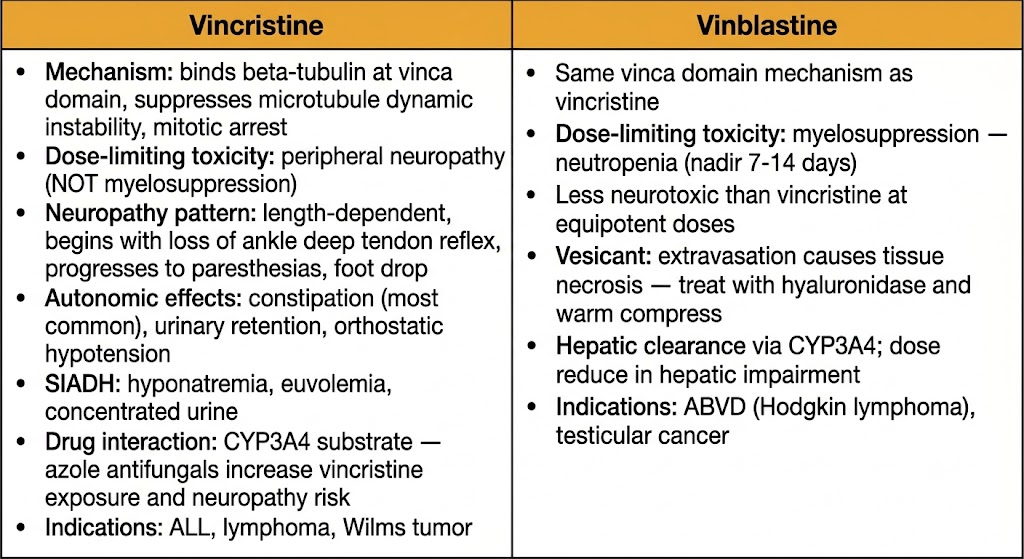
Vincristine is distinguished from other vinca alkaloids by two features: its dose-limiting toxicity is peripheral neurotoxicity rather than myelosuppression, and it produces essentially no myelosuppression at standard doses. Vincristine binds to axonal microtubules in peripheral sensory and motor neurons, impairing axonal transport and producing a progressive, length-dependent, primarily sensory peripheral neuropathy. Symptoms begin distally (loss of deep tendon reflexes, especially the ankle jerk, followed by paresthesias in the feet) and progress proximally with cumulative dose. Autonomic neuropathy manifests as constipation (the most common autonomic effect), urinary retention, and orthostatic hypotension. Vincristine is metabolized by cytochrome P450 3A4 and is a P-glycoprotein substrate; azole antifungals and other cytochrome P450 3A4 inhibitors increase vincristine exposure and neuropathy risk.
Syndrome of inappropriate antidiuretic hormone secretion is an uncommon but clinically important adverse effect of vincristine resulting from vincristine-induced disruption of the hypothalamic-neurohypophyseal axis, causing dysregulated antidiuretic hormone secretion independent of plasma osmolality. Patients present with hyponatremia, inappropriately concentrated urine, and euvolemia. Severe hyponatremia requires fluid restriction and, in symptomatic patients, careful correction with hypertonic saline.
Vinblastine differs from vincristine in that its dose-limiting toxicity is myelosuppression (predominantly neutropenia, nadir at 7 to 14 days) rather than neurotoxicity. Neurotoxicity occurs but is less severe than with vincristine at equipotent doses. Vinblastine is used in ABVD (doxorubicin, bleomycin, vinblastine, dacarbazine) for Hodgkin lymphoma. Like all vinca alkaloids, vinblastine is a vesicant: extravasation causes severe local tissue necrosis requiring prompt management with hyaluronidase infiltration and warm compress application. Vinorelbine is a semisynthetic vinca alkaloid with unique selectivity for mitotic microtubules over axonal microtubules compared to vincristine and vinblastine, producing intermediate neurotoxicity. It is used in non-small cell lung cancer, breast cancer, and cervical cancer, and is available in both intravenous and oral formulations. Myelosuppression (neutropenia) is dose-limiting with vinorelbine. All three vinca alkaloids are substrates for P-glycoprotein and cytochrome P450 3A4.
Inadvertent intrathecal administration of a vinca alkaloid produces an ascending myeloencephalopathy that is nearly uniformly fatal. Within hours, severe radicular back and leg pain develops, followed over 24 to 72 hours by ascending motor weakness, loss of sphincter control, and progressive paralysis. The syndrome ascends to involve the brainstem and cortex, producing respiratory failure, coma, and death. There is no established effective treatment.
Four mandatory system safeguards prevent this error: (1) Vinca alkaloids are dispensed only in minibags, never in syringes. (2) Every vinca alkaloid container bears a prominently visible warning: For Intravenous Use Only — Fatal If Given By Other Routes. (3) Every vinca alkaloid minibag is sealed inside an outer overpacking bag with the same warning. (4) Intrathecal chemotherapy is prepared, transported, and administered in a separate time window and location from intravenous vinca alkaloid administration — the two procedures are never performed at the same time in the same space. These are mandatory safety requirements, not suggestions.
Cremophor EL hypersensitivity, premedication protocol, cumulative peripheral neuropathy, and cytochrome P450 drug interactions
Paclitaxel and docetaxel have become foundational drugs in oncology, with activity in breast, ovarian, lung, gastric, esophageal, and head and neck cancers. Their clinical use is defined by two major management challenges: the vehicle-related hypersensitivity reactions of conventional paclitaxel, and the cumulative peripheral neuropathy that limits dose intensity for both agents.
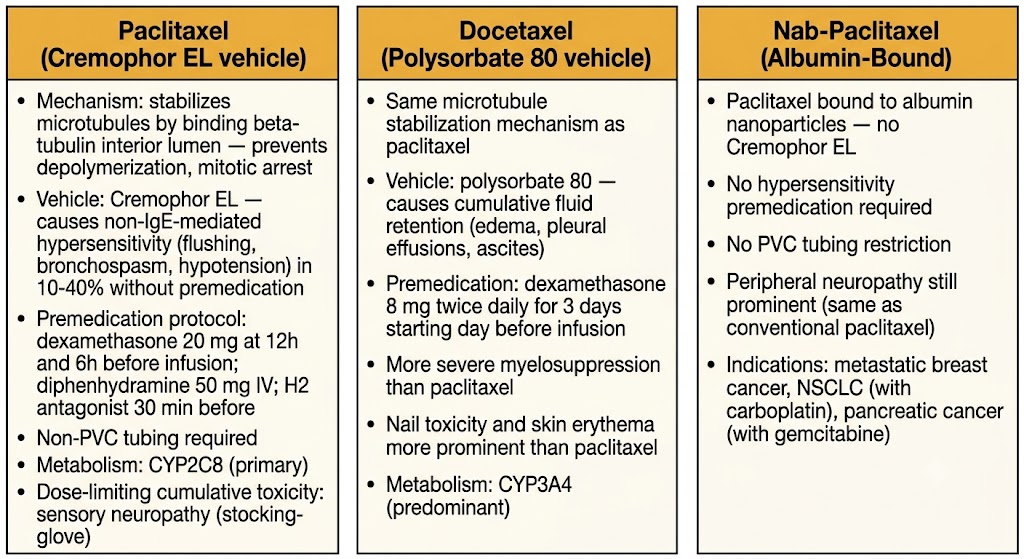
Paclitaxel stabilizes microtubules by binding to the beta-tubulin subunit on the interior of the microtubule lumen, promoting tubulin polymerization even in the absence of guanosine triphosphate and inhibiting depolymerization. Because paclitaxel is highly hydrophobic, the original clinical formulation required solubilization in Cremophor EL (polyoxyethylated castor oil), a non-ionic surfactant vehicle that is itself a potent cause of non-immunoglobulin E-mediated hypersensitivity reactions in approximately 10 to 40% of patients without premedication. The Cremophor EL reaction manifests within the first 10 minutes of infusion as flushing, urticaria, bronchospasm, and hypotension — an anaphylactoid reaction that does not require prior sensitization.
Standard premedication with dexamethasone 20 mg orally or intravenously at 12 and 6 hours before infusion, diphenhydramine 50 mg intravenously, and an H2 receptor antagonist (ranitidine or cimetidine) 30 minutes before infusion reduces the incidence of severe hypersensitivity reactions to approximately 1 to 2%. Paclitaxel infusion must use non-polyvinyl chloride tubing because Cremophor EL leaches the plasticizer di(2-ethylhexyl) phthalate from polyvinyl chloride tubing at clinically significant concentrations. Paclitaxel is primarily metabolized by cytochrome P450 2C8, with secondary contributions from cytochrome P450 3A4. The dose-limiting cumulative toxicity is peripheral sensory neuropathy in a stocking-glove distribution, reversible in most patients after treatment completion but incompletely reversible in a significant minority.
Docetaxel shares the beta-tubulin binding site and microtubule stabilization mechanism with paclitaxel but is formulated in polysorbate 80 rather than Cremophor EL, producing a different vehicle-related toxicity: fluid retention (edema, pleural effusions, ascites) that is cumulative and substantially attenuated by pretreatment with dexamethasone 8 mg twice daily for 3 days starting the day before docetaxel. This premedication reduces the incidence and severity of the fluid retention syndrome and also reduces hypersensitivity reactions. The dose-limiting acute toxicity is myelosuppression, more severe than paclitaxel at equivalent doses. Docetaxel also causes nail toxicity (onycholysis, nail discoloration) and a characteristic skin erythema more prominently than paclitaxel. Docetaxel is metabolized predominantly by cytochrome P450 3A4, making interactions with cytochrome P450 3A4 inhibitors and inducers clinically important.
Nab-paclitaxel (albumin-bound paclitaxel) is a 130-nanometer nanoparticle formulation in which paclitaxel is bound noncovalently to human serum albumin, eliminating the need for Cremophor EL. Because Cremophor EL is absent, the standard three-drug hypersensitivity premedication protocol is not required, and non-polyvinyl chloride tubing is not required. Nab-paclitaxel is approved for metastatic breast cancer, non-small cell lung cancer (in combination with carboplatin), and pancreatic adenocarcinoma (in combination with gemcitabine). Despite the absence of Cremophor EL, nab-paclitaxel produces peripheral neuropathy at least as prominent as conventional paclitaxel.
Cabazitaxel is a semisynthetic taxane developed specifically to overcome P-glycoprotein-mediated taxane resistance, as it has low affinity for P-glycoprotein compared to docetaxel and paclitaxel. It is approved for castration-resistant prostate cancer after prior docetaxel-based therapy. The dose-limiting toxicity is myelosuppression, with febrile neutropenia at a rate substantially higher than docetaxel; primary granulocyte colony-stimulating factor prophylaxis is recommended for all patients. Ixabepilone is a semisynthetic analog of epothilone B that binds to the same beta-tubulin site as taxanes, retains activity against tumor cells with P-glycoprotein overexpression and tubulin structural changes that confer taxane resistance, and is approved for metastatic breast cancer after failure of anthracycline and taxane therapy. Ixabepilone is formulated in Cremophor EL and requires the same three-drug premedication protocol as conventional paclitaxel.
| Author / Organization | Title | Source |
|---|---|---|
| Jordan MA, Wilson L | Microtubules as a target for anticancer drugs | Nat Rev Cancer. 2004;4(4):253–265 |
| Mitchison TJ, Kirschner MW | Dynamic instability of microtubule growth | Nature. 1984;312(5991):237–242 |
| Gidding CE, Kellie SJ, Kamps WA, de Graaf SS | Vincristine revisited | Crit Rev Oncol Hematol. 1999;29(3):267–287 |
| Groninger E, Meeuwsen-de Boer GJ, Koopmans P, et al | Pharmacokinetics of vincristine monotherapy in childhood acute lymphoblastic leukemia | Pediatr Res. 2002;52(1):113–118 |
| Dyer C | Doctors suspended after injecting wrong drug into spine | BMJ. 2001;322(7281):257 |
| Rowinsky EK, Donehower RC | Paclitaxel (taxol) | N Engl J Med. 1995;332(15):1004–1014 |
| Taxol (paclitaxel) prescribing information | Taxol (paclitaxel) prescribing information | Princeton, NJ: Bristol-Myers Squibb; 2011 |
| Gradishar WJ, Tjulandin S, Davidson N, et al | Phase III trial of nanoparticle albumin-bound paclitaxel compared with polyethylated castor oil-based paclitaxel in women with breast cancer | J Clin Oncol. 2005;23(31):7794–7803 |
| Von Hoff DD, Ervin T, Arena FP, et al | Increased survival in pancreatic cancer with nab-paclitaxel plus gemcitabine | N Engl J Med. 2013;369(18):1691–1703 |
| Kavallaris M | Microtubules and resistance to tubulin-binding agents | Nat Rev Cancer. 2010;10(3):194–204 |
| Orr GA, Verdier-Pinard P, McDaid H, Horwitz SB | Mechanisms of taxol resistance related to microtubules | Oncogene. 2003;22(47):7280–7295 |
| Gottesman MM, Fojo T, Bates SE | Multidrug resistance in cancer: role of ATP-dependent transporters | Nat Rev Cancer. 2002;2(1):48–58 |