CHAPTER 18  ·  ANTIPARKINSON'S DISEASE DRUGS
Section 1

Mechanism and Drug Class Overview

How dopamine agonists bypass the degenerating nigrostriatal neurons to stimulate striatal receptors directly

Dopamine agonists act by directly stimulating dopamine receptors in the striatum, bypassing the need for surviving nigrostriatal neurons to produce and release dopamine. This mechanism gives them two important advantages over levodopa: they do not depend on the number of remaining dopaminergic neurons to exert their effect, and they produce more sustained, continuous receptor stimulation than the intermittent peaks and troughs of oral levodopa.

Mechanism of Action

All dopamine agonists used in Parkinson's disease act primarily at dopamine D2 and D3 receptors in the striatum. D2 receptor stimulation is responsible for the motor benefits of the class. D3 receptor activity contributes to effects on mood and reward circuitry — a pharmacological basis for some of the class's behavioral adverse effects, including impulse control disorders.

Because dopamine agonists act directly at the receptor rather than requiring conversion from a precursor, they remain effective even as the disease progresses and neuronal dopamine synthesis capacity falls. This also means their duration of action is determined by the drug's own half-life rather than by the rate of dopamine synthesis — most dopamine agonists have substantially longer half-lives than levodopa, producing smoother and more sustained receptor stimulation.

Role in Treatment

Dopamine agonists are used in two clinical contexts. In younger patients — typically those under 65 — they are often used as initial monotherapy to delay the introduction of levodopa and thereby postpone the onset of levodopa-associated motor complications such as wearing-off and dyskinesias. In patients already on levodopa, dopamine agonists are added as adjunctive therapy to smooth motor fluctuations and allow reduction of the total levodopa dose.
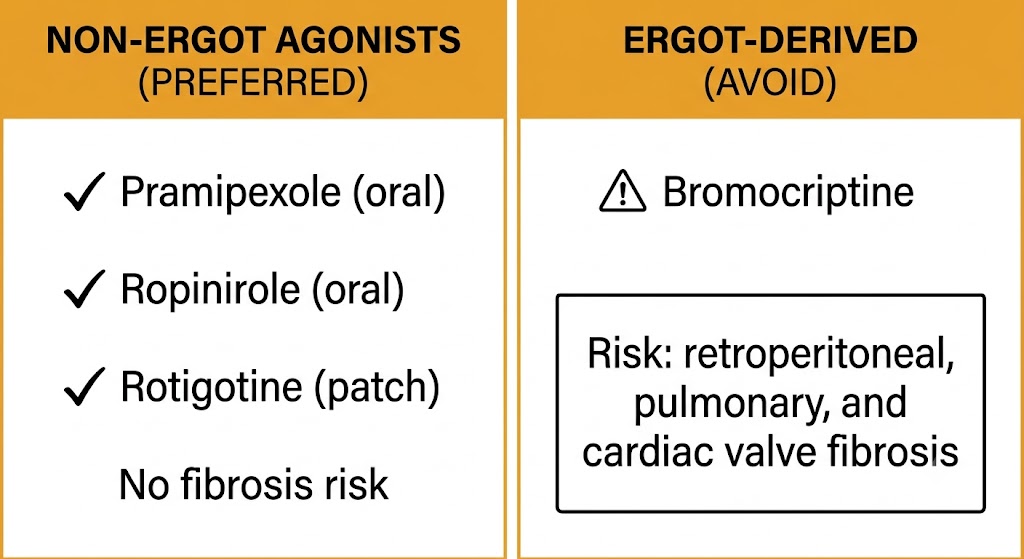
Two-panel comparison showing non-ergot dopamine agonists (pramipexole, ropinirole, rotigotine) with checkmarks on the left labeled preferred, and bromocriptine with a warning triangle and fibrosis risk box on the right labeled avoid.
Non-ergot dopamine agonists are preferred in current practice (left); ergot-derived bromocriptine is avoided due to fibrosis risk (right). Figure generated by Gemini AI.

Section 2

Non-Ergot Dopamine Agonists

Pramipexole, ropinirole, and rotigotine — the preferred agents in current practice

Non-ergot dopamine agonists are the standard of care for dopamine agonist therapy in Parkinson's disease. They provide effective D2 and D3 receptor stimulation without the fibrotic adverse effects that limited the earlier ergot-derived agents. Three agents are in common use: pramipexole and ropinirole as oral agents, and rotigotine as a transdermal patch.

Oral — Non-Ergot
Pramipexole
  • D2 and D3 agonist — high D3 affinity
  • Available immediate-release and extended-release
  • Renally excreted — dose reduce in kidney impairment
  • Used as monotherapy in early disease and adjunct with levodopa
  • Also approved for restless legs syndrome
Oral — Non-Ergot
Ropinirole
  • D2 and D3 agonist — similar profile to pramipexole
  • Available immediate-release and extended-release
  • Hepatically metabolized via CYP1A2
  • Used as monotherapy and adjunct
  • Also approved for restless legs syndrome
Transdermal Patch — Non-Ergot
Rotigotine
  • D1, D2, and D3 agonist
  • Continuous transdermal delivery — once-daily patch
  • Avoids first-pass metabolism and gastrointestinal adverse effects
  • Useful when oral dosing is impractical
  • Skin reactions at patch site are common
Advantage Over Levodopa for Motor Complications

Because dopamine agonists have longer half-lives than levodopa and stimulate receptors more continuously, initiating therapy with a dopamine agonist in younger patients delays the onset of wearing-off and dyskinesias. When levodopa is eventually added, the total exposure to levodopa pulsatile stimulation — the primary driver of motor complications — has been reduced.


Section 3

Ergot-Derived Agents and Apomorphine

Historical context for bromocriptine, and the unique rescue role of apomorphine

Before non-ergot agonists became available, bromocriptine was the primary dopamine agonist used in Parkinson's disease. It has been largely replaced in clinical practice due to the risk of serious fibrotic complications associated with the ergot scaffold. Apomorphine occupies a distinct niche as a rapidly acting injectable agent used for acute rescue during severe off episodes.

Bromocriptine — Ergot-Derived

Bromocriptine is an ergot alkaloid that acts as a D2 receptor agonist. It was the first dopamine agonist widely used for Parkinson's disease. Its use has declined sharply because ergot-derived dopamine agonists carry a risk of fibrotic reactions — retroperitoneal fibrosis, pulmonary fibrosis, and cardiac valve fibrosis — that are not seen with non-ergot agents. For Step 1 purposes, the key fact is that ergot-derived agonists are no longer preferred because of fibrosis risk, and non-ergot agents are the current standard.

Apomorphine — Rescue Agent

Apomorphine is a potent D1 and D2 receptor agonist that is structurally related to dopamine but is not an ergot compound. Its defining pharmacological feature is rapid onset of action — within 10 to 20 minutes of subcutaneous injection — making it the only approved acute rescue therapy for sudden, severe off episodes in patients with advanced Parkinson's disease.

Apomorphine is also available as a subcutaneous infusion for continuous delivery in patients with refractory on-off fluctuations, analogous in concept to the levodopa-carbidopa intestinal gel. Because apomorphine is a powerful emetic — it stimulates dopamine receptors in the chemoreceptor trigger zone — patients must be pretreated with the antiemetic trimethobenzamide before initiating apomorphine therapy. Ondansetron and other serotonin-3 receptor antagonists are contraindicated with apomorphine due to risk of severe hypotension.

Avoid
Ergot-Derived Agonists
  • Bromocriptine — prototype, largely obsolete for Parkinson's disease
  • Risk: retroperitoneal, pulmonary, and cardiac valve fibrosis
  • Non-ergot agents preferred in all current guidelines
Rescue Use Only
Apomorphine
  • Subcutaneous injection — onset 10 to 20 minutes
  • Used for acute severe off episodes
  • Highly emetogenic — requires antiemetic pretreatment
  • Ondansetron contraindicated — severe hypotension risk

Section 4

Adverse Effects — Class-Wide

The shared adverse effect profile of all dopamine agonists, with emphasis on the highest-yield Step 1 points

Dopamine agonists share a class-wide adverse effect profile that reflects dopamine receptor stimulation at sites outside the motor system. Several of these effects are highly testable at the Step 1 level and distinguish dopamine agonists from levodopa in important ways.

Nausea and Orthostatic Hypotension

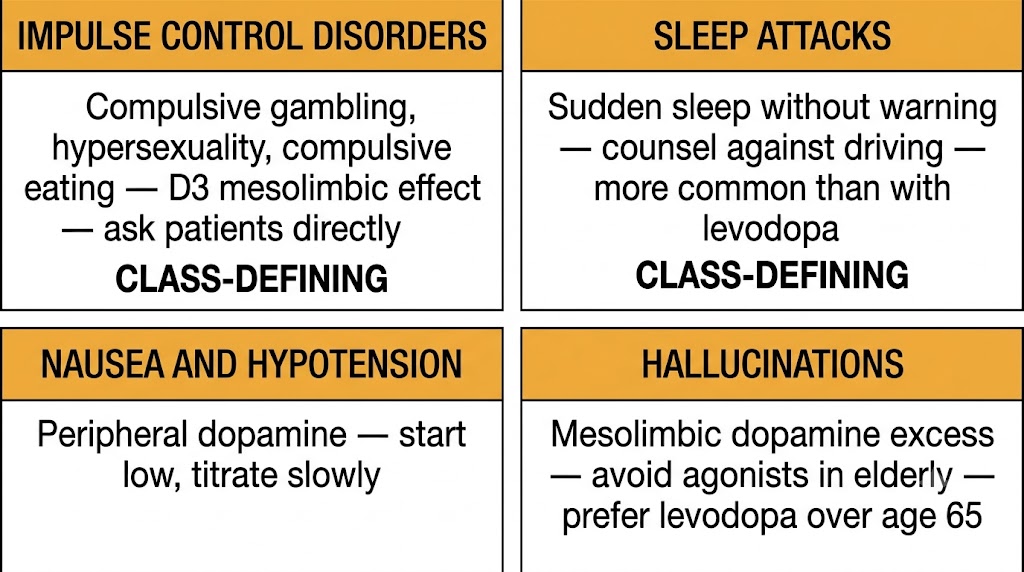
Like levodopa, dopamine agonists cause nausea through stimulation of dopamine receptors in the chemoreceptor trigger zone and gastrointestinal tract. Orthostatic hypotension results from dopamine-mediated vasodilation and is particularly prominent with initiation of therapy. Both effects are managed by starting at low doses and titrating slowly, and by taking medication with food.

Impulse Control Disorders

Impulse control disorders are a class-defining adverse effect of dopamine agonists that does not occur with levodopa alone at equivalent therapeutic doses. Patients may develop compulsive gambling, hypersexuality, compulsive eating, or compulsive shopping. These behaviors are driven by D3 receptor stimulation in the mesolimbic reward pathway and can develop insidiously — patients and families may not spontaneously report them. Clinicians must ask specifically. Reducing the dose or switching to levodopa typically resolves the behavior.

Daytime Somnolence and Sleep Attacks

Dopamine agonists can cause excessive daytime sleepiness and, in some patients, sudden onset of sleep — sleep attacks — without warning drowsiness. Patients taking dopamine agonists must be counseled about the risk of falling asleep while driving or operating machinery. This adverse effect is more prominent with dopamine agonists than with levodopa.

Neuropsychiatric Effects

Hallucinations and psychosis occur with dopamine agonists, as with levodopa, due to mesolimbic dopamine excess. These effects are more common in older patients and those with cognitive impairment, and are among the reasons why dopamine agonists are used more cautiously in elderly patients — levodopa is generally preferred over dopamine agonists in patients over 65.

Four-panel grid showing class-wide adverse effects of dopamine agonists: impulse control disorders and sleep attacks labeled class-defining in the top row, nausea and hypotension and hallucinations in the bottom row.
Class-wide adverse effects of dopamine agonists. Impulse control disorders and sleep attacks are class-defining features not seen with levodopa alone. Figure generated by Gemini AI.
Impulse Control Disorders — Ask Every Patient

Impulse control disorders are a class effect of dopamine agonists mediated by D3 receptor stimulation in the mesolimbic reward pathway. They include compulsive gambling, hypersexuality, compulsive eating, and compulsive spending. Patients rarely volunteer these symptoms. The clinician must ask directly at every visit. Dose reduction or discontinuation of the agonist resolves the behavior in most cases.


Suggested References
Author / Organization Title Source
Katzung BG, Trevor AJ Basic and Clinical Pharmacology, 15th edition McGraw-Hill, 2021
Brunton LL, Knollmann BC Goodman and Gilman's The Pharmacological Basis of Therapeutics, 13th edition McGraw-Hill, 2018
Le T, Bhushan V First Aid for the USMLE Step 1 McGraw-Hill, current edition
Connolly BS, Lang AE Pharmacological treatment of Parkinson disease: a review JAMA, 2014
Weintraub D et al. Impulse control disorders in Parkinson disease: a cross-sectional study of 3090 patients Archives of Neurology, 2010