CHAPTER 18  ·  ANTIPARKINSON'S DISEASE DRUGS
Section 1

Monoamine Oxidase B Inhibitors — Mechanism and Agents

Blocking the principal enzyme that degrades dopamine in the brain to extend the effect of each levodopa dose

Monoamine oxidase B is the primary enzyme responsible for oxidative degradation of dopamine within the brain. By inhibiting this enzyme, monoamine oxidase B inhibitors slow the breakdown of dopamine in the striatum, prolonging the effect of dopamine released from surviving neurons and from levodopa-derived sources. The result is a more sustained dopamine signal without increasing the levodopa dose.

Mechanism of Action

Monoamine oxidase exists in two isoforms. Monoamine oxidase A is found predominantly in the gut and liver and metabolizes norepinephrine, serotonin, and tyramine. Monoamine oxidase B is the predominant isoform in the brain and preferentially metabolizes dopamine and phenylethylamine. Selective monoamine oxidase B inhibitors block dopamine degradation in the striatum while leaving monoamine oxidase A activity intact, which is why they carry a much lower risk of the tyramine-induced hypertensive crisis that makes nonselective monoamine oxidase inhibitors dangerous.
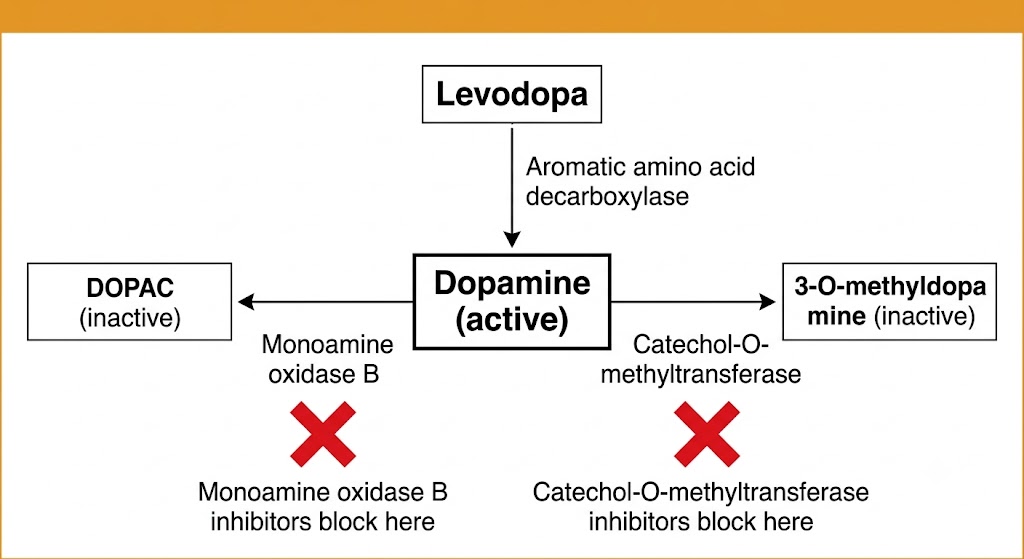
Flow diagram showing levodopa converting to dopamine, then branching to two inactive metabolites via monoamine oxidase B on the left and catechol-O-methyltransferase on the right, each with a red X marking where the respective inhibitors block degradation.
Dopamine degradation pathways: monoamine oxidase B inhibitors block the left pathway to DOPAC; catechol-O-methyltransferase inhibitors block the right pathway to 3-O-methyldopamine. Both strategies extend dopamine availability. Figure generated by Gemini AI.
Agents — Selegiline, Rasagiline, and Safinamide

Selegiline was the first selective monoamine oxidase B inhibitor used in Parkinson's disease. It is an irreversible inhibitor and is metabolized to amphetamine and methamphetamine — active metabolites that contribute to insomnia and can cause anxiety or cardiovascular stimulation at higher doses. These amphetamine metabolites are the primary clinical liability of selegiline and a high-yield Step 1 distinction.

Rasagiline is also an irreversible monoamine oxidase B inhibitor but lacks the amphetamine metabolites of selegiline. Its metabolite aminoindan is pharmacologically inert, giving rasagiline a cleaner adverse effect profile. Rasagiline is the preferred monoamine oxidase B inhibitor in current practice for this reason.

Safinamide is a reversible monoamine oxidase B inhibitor with an additional mechanism — it also blocks voltage-gated sodium channels, reducing abnormal glutamate release in the basal ganglia. It is approved as adjunctive therapy with levodopa for patients experiencing motor fluctuations.

Selegiline — The Amphetamine Metabolite

Selegiline is metabolized to amphetamine and methamphetamine. This is a classic Step 1 pharmacology fact. The metabolites can cause insomnia — selegiline should be taken in the morning and at midday, never in the evening. They can also cause anxiety, palpitations, and elevated blood pressure. Rasagiline avoids all of these problems because its metabolite aminoindan is inactive.

Section 2

Monoamine Oxidase B Inhibitors — Clinical Use and Adverse Effects

When to use monoamine oxidase B inhibitors, how they interact with other drugs, and the tyramine caution

Monoamine oxidase B inhibitors are used both as early monotherapy in mild Parkinson's disease and as adjunctive therapy with levodopa to reduce wearing-off. Their most important clinical consideration is drug interaction risk — both with other drugs used in Parkinson's disease and with foods containing tyramine.

Clinical Use

In early, mild Parkinson's disease, monoamine oxidase B inhibitors can provide modest symptomatic benefit as monotherapy, delaying the need for levodopa. In more advanced disease, they are used adjunctively with levodopa to reduce wearing-off by prolonging the dopamine signal after each dose. The effect is more modest than adding a catechol-O-methyltransferase inhibitor or a dopamine agonist, but the tolerability profile — particularly for rasagiline — is favorable.

Drug Interactions

The most dangerous interaction is with meperidine (pethidine), which is absolutely contraindicated with any monoamine oxidase inhibitor, including selective monoamine oxidase B inhibitors. The combination can produce a serotonin syndrome-like reaction with hyperthermia, agitation, rigidity, and cardiovascular instability. Other opioids also require caution. Concurrent use with serotonergic drugs — particularly selective serotonin reuptake inhibitors and serotonin-norepinephrine reuptake inhibitors — carries a risk of serotonin syndrome and requires monitoring.

Sympathomimetic drugs are also potentially problematic, particularly with selegiline given its amphetamine metabolites. Tyramine-containing foods pose a lower risk than with nonselective monoamine oxidase inhibitors — selective monoamine oxidase B inhibitors at therapeutic doses leave enough monoamine oxidase A activity intact to handle normal dietary tyramine — but patients are still counseled to avoid very large quantities of tyramine-rich foods.

Irreversible — Amphetamine Metabolites
Selegiline
  • Selective monoamine oxidase B inhibitor
  • Metabolized to amphetamine and methamphetamine
  • Insomnia — take morning and midday only
  • Anxiety, palpitations at higher doses
  • Transdermal patch formulation available (nonselective at higher doses)
Irreversible — Cleaner Profile
Rasagiline
  • Selective monoamine oxidase B inhibitor
  • Metabolized to aminoindan — pharmacologically inert
  • No amphetamine metabolites
  • Preferred over selegiline in current practice
  • Once-daily dosing
Reversible — Adjunct Only
Safinamide
  • Reversible selective monoamine oxidase B inhibitor
  • Also blocks voltage-gated sodium channels — reduces glutamate release
  • Approved as adjunct with levodopa for motor fluctuations
  • Not used as monotherapy

Section 3

Catechol-O-Methyltransferase Inhibitors — Mechanism and Agents

Blocking peripheral levodopa metabolism to extend the plasma half-life of each dose and smooth motor control

Catechol-O-methyltransferase is an enzyme that methylates levodopa in the periphery, converting it to 3-O-methyldopa — an inactive metabolite that competes with levodopa for entry into the brain via the large neutral amino acid transporter. By inhibiting catechol-O-methyltransferase, these drugs extend the plasma half-life of levodopa, delivering more drug to the brain over a longer period from each dose and reducing the peak-to-trough fluctuations that drive wearing-off.

Mechanism of Action

Catechol-O-methyltransferase inhibitors act primarily in the periphery to block the conversion of levodopa to 3-O-methyldopa. This has two beneficial effects: it increases the fraction of each levodopa dose that reaches the brain, and it reduces the plasma concentration of 3-O-methyldopa, which competes with levodopa for blood-brain barrier transport. The net result is a higher and more sustained brain levodopa level from the same oral dose. Catechol-O-methyltransferase inhibitors are always given in combination with carbidopa-levodopa — they have no antiparkinsonian effect on their own.

Agents — Entacapone, Tolcapone, and Opicapone

Entacapone acts only peripherally, has a short duration of action requiring dosing with each levodopa dose, and has an excellent safety record. It is the most widely used catechol-O-methyltransferase inhibitor. Tolcapone inhibits catechol-O-methyltransferase both peripherally and centrally, providing somewhat greater efficacy, but it carries a black box warning for potentially fatal hepatotoxicity. Liver function must be monitored regularly, and tolcapone is reserved for patients who have not responded adequately to entacapone. Opicapone is a once-daily peripheral catechol-O-methyltransferase inhibitor with a longer duration of action than entacapone and a favorable tolerability profile.

Tolcapone Hepatotoxicity — Black Box Warning

Tolcapone carries a black box warning for potentially fatal fulminant hepatic failure. This distinguishes it from entacapone and opicapone, which do not carry this risk. For Step 1: when choosing between catechol-O-methyltransferase inhibitors, tolcapone is the one with the liver toxicity warning. Liver function tests must be monitored at baseline and periodically throughout treatment.


Section 4

Catechol-O-Methyltransferase Inhibitors — Clinical Use and Adverse Effects

Adjunctive therapy for wearing-off, and the shared adverse effect profile of the class

Catechol-O-methyltransferase inhibitors are used exclusively as adjuncts to levodopa in patients experiencing wearing-off. By extending each dose of levodopa, they reduce the frequency of off periods without requiring an increase in the levodopa dose — which would worsen dyskinesias. Their adverse effects are largely predictable from their mechanism: more levodopa reaching the brain means more dopaminergic adverse effects.

Clinical Use

Catechol-O-methyltransferase inhibitors are added to an existing carbidopa-levodopa regimen when a patient develops wearing-off. They are not used as initial therapy and have no role before levodopa is started. When entacapone is added, the levodopa dose often needs to be reduced slightly because bioavailability increases — dyskinesias may emerge or worsen if the dose is not adjusted.

Adverse Effects

Because catechol-O-methyltransferase inhibitors increase levodopa bioavailability, they amplify all dopaminergic adverse effects of levodopa — nausea, orthostatic hypotension, dyskinesias, and hallucinations. A patient who was previously stable on levodopa may develop dyskinesias after adding a catechol-O-methyltransferase inhibitor, requiring levodopa dose reduction.

A distinctive and memorable adverse effect of the entire class is orange discoloration of the urine. This is caused by excretion of catechol-O-methyltransferase inhibitor metabolites and is harmless, but patients must be warned in advance to avoid unnecessary alarm.

Peripheral — First Choice
Entacapone
  • Peripheral catechol-O-methyltransferase inhibitor only
  • Short duration — must be taken with each levodopa dose
  • No hepatotoxicity risk
  • Most widely used agent in the class
  • Orange urine discoloration
Peripheral and Central — Restricted
Tolcapone
  • Peripheral and central catechol-O-methyltransferase inhibitor
  • Greater efficacy than entacapone
  • Black box warning — potentially fatal hepatotoxicity
  • Liver function monitoring required
  • Reserved for inadequate response to entacapone
Peripheral — Once Daily
Opicapone
  • Peripheral catechol-O-methyltransferase inhibitor
  • Once-daily dosing — longer duration than entacapone
  • No hepatotoxicity risk
  • Taken at bedtime, separate from levodopa doses
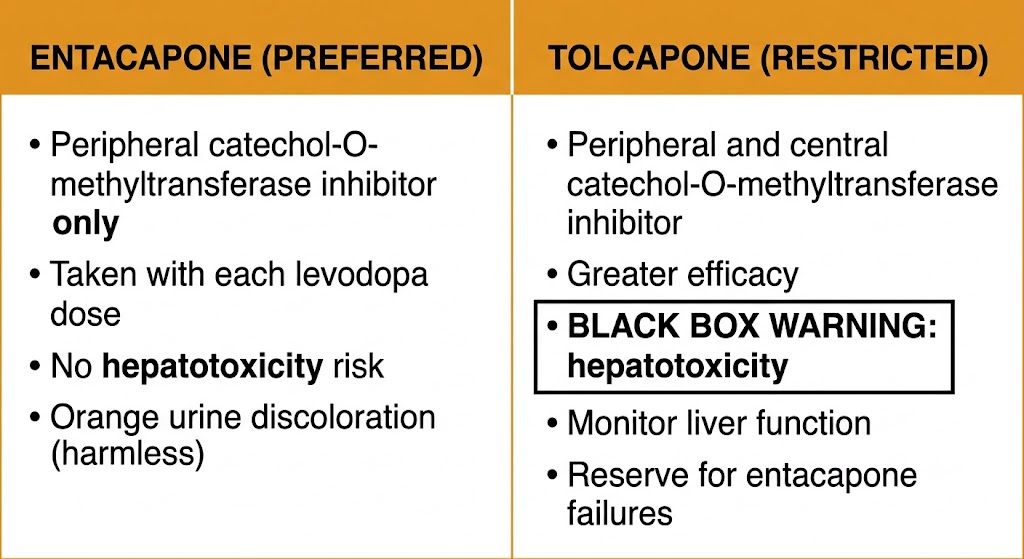
Two-panel comparison of entacapone labeled preferred on the left and tolcapone labeled restricted on the right, with a bordered black box warning for hepatotoxicity prominently displayed in the tolcapone panel.
Entacapone versus tolcapone: entacapone is the preferred first-line catechol-O-methyltransferase inhibitor; tolcapone carries a black box warning for hepatotoxicity and is reserved for refractory cases. Figure generated by Gemini AI.

Suggested References
Author / Organization Title Source
Katzung BG, Trevor AJ Basic and Clinical Pharmacology, 15th edition McGraw-Hill, 2021
Brunton LL, Knollmann BC Goodman and Gilman's The Pharmacological Basis of Therapeutics, 13th edition McGraw-Hill, 2018
Le T, Bhushan V First Aid for the USMLE Step 1 McGraw-Hill, current edition
Connolly BS, Lang AE Pharmacological treatment of Parkinson disease: a review JAMA, 2014
Olanow CW et al. Drug insight: tolcapone and entacapone — a comparison of their pharmacological and clinical profiles Nature Clinical Practice Neurology, 2006