CHAPTER 26  ·  RENAL PHARMACOLOGY
Section 1

Nephron Segmental Physiology

Understanding where and how each diuretic acts requires knowing the transport machinery of each tubular segment

Diuretics are among the most widely used drugs in clinical medicine. Each class targets a specific nephron segment, and the therapeutic effects — and electrolyte complications — follow directly from which transporter is blocked and what fraction of filtered sodium that segment normally handles.

Proximal Convoluted Tubule

The proximal convoluted tubule reabsorbs roughly 65% of filtered sodium, driven by the sodium-hydrogen exchanger isoform 3 on the luminal surface working with carbonic anhydrase to couple sodium reabsorption to bicarbonate reclamation. Carbonic anhydrase inhibitors act at this site, though it is not the primary target of loop diuretics or thiazides.

Thick Ascending Limb — The Loop Diuretic Target

The thick ascending limb reabsorbs approximately 25% of filtered sodium via the sodium-potassium-2-chloride cotransporter isoform 2 (the Na-K-2Cl cotransporter). This segment is impermeable to water, so sodium reabsorption here without accompanying water is what builds the hypertonic medullary interstitium required for antidiuretic hormone-dependent urinary concentration. When the Na-K-2Cl cotransporter is blocked by loop diuretics, the medullary gradient collapses and a large volume of isotonic fluid floods the more distal tubular segments — producing the most powerful natriuresis achievable with any diuretic class.

Distal Convoluted Tubule — The Thiazide Target

The distal convoluted tubule handles 5 to 8% of filtered sodium through the electroneutral sodium-chloride cotransporter, the target of thiazide diuretics. Because the fractional sodium delivery here is smaller, thiazide-induced natriuresis is more modest than loop-diuretic natriuresis — but this makes thiazides well suited for sustained outpatient blood pressure control. The collecting duct handles only 2 to 3% of sodium via the epithelial sodium channel, regulated by aldosterone and targeted by potassium-sparing diuretics.


Section 2

Loop Diuretics — Mechanism and Pharmacokinetics

The most potent natriuretic class, acting at the thick ascending limb to disrupt both sodium reabsorption and the medullary concentration gradient

Loop diuretics block the Na-K-2Cl cotransporter isoform 2 at its chloride-binding site, inhibiting the coupled entry of one sodium, one potassium, and two chloride ions per transport cycle. This abolishes the lumen-positive electrical potential in the thick ascending limb, which normally drives paracellular reabsorption of calcium and magnesium — explaining why loop diuretics cause both calciuresis and magnesiuresis.

Luminal Delivery via Organic Anion Transporters

Loop diuretics reach the tubular lumen not by glomerular filtration but by active secretion through organic anion transporters on the proximal tubule basolateral membrane. In chronic kidney disease, competing endogenous organic anions accumulate and crowd out the diuretic at these transporters, reducing luminal drug concentration below the threshold needed for cotransporter blockade. The clinical response is dose escalation, not dose reduction.

Individual Agents

Furosemide is the most widely used loop diuretic but has highly variable oral bioavailability — as low as 10% to as high as 90% across patients — due in part to variable intestinal absorption. Torsemide has superior and more consistent oral bioavailability (80 to 90%), a longer half-life of 3 to 4 hours versus 1.5 to 2 hours for furosemide, and predominantly hepatic metabolism, making its pharmacokinetics more predictable in renal impairment. The TRANSFORM-HF trial found no significant mortality difference between the two agents at one year, though secondary outcomes marginally favored torsemide.

Bumetanide is approximately 40 times as potent as furosemide on a milligram basis with superior oral bioavailability. Ethacrynic acid is the only loop diuretic that is not a sulfonamide derivative, giving it a niche in patients with true sulfonamide hypersensitivity; it carries the highest ototoxic risk of the class and is used sparingly. Loop diuretic ototoxicity — high-frequency sensorineural hearing loss — is amplified by concurrent aminoglycoside use through additive cochlear hair cell damage.
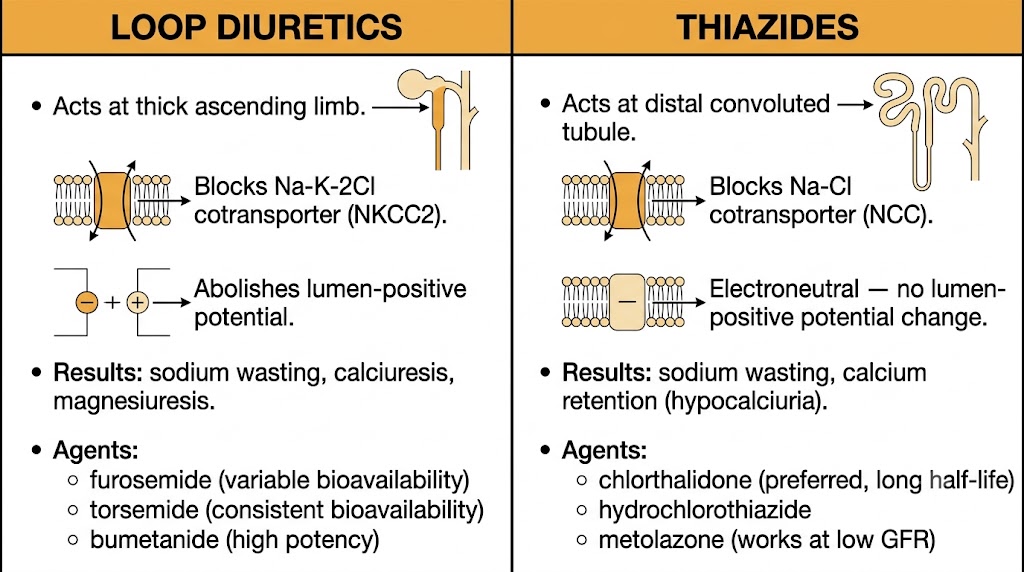
Two-panel diagram comparing loop diuretic and thiazide mechanisms of action
Loop diuretics and thiazides act at different nephron segments, producing opposite effects on urinary calcium handling.
Dose-Response Characteristics

Loop diuretics follow a sigmoidal dose-response curve. Below a threshold luminal concentration there is no natriuresis; above a ceiling concentration, additional dose increases produce no additional effect. In chronic kidney disease, the threshold is higher and the ceiling natriuresis is lower. The appropriate response to inadequate diuresis is dose escalation to threshold, not dose escalation beyond the ceiling.

Section 3

Thiazide Diuretics — Mechanism and Key Agents

Distal convoluted tubule Na-Cl cotransporter blockade with important calcium-retaining effects opposite to those of loop diuretics

Thiazides inhibit the sodium-chloride cotransporter in the distal convoluted tubule. Because cotransport at this site is electroneutral — no lumen-positive potential is generated — thiazides do not cause the paracellular calcium wasting seen with loop diuretics. Instead, they have the opposite effect on calcium handling.

Calcium-Retaining Mechanism

By blocking the sodium-chloride cotransporter, thiazides reduce intracellular sodium in the distal convoluted tubule cell. This enhances basolateral sodium-calcium exchange, which draws calcium into the cell from the tubular lumen through the apical calcium channel known as TRPV5. The net result is calcium retention in the body — the opposite of loop diuretics, which promote urinary calcium loss. This mechanism underlies the clinical use of thiazides in reducing stone recurrence in calcium nephrolithiasis and their contraindication in hypercalcemia.

Key Agents and Clinical Distinctions

Chlorthalidone is a thiazide-like agent with a half-life of 40 to 60 hours, far exceeding hydrochlorothiazide's 6 to 15 hours. This longer duration provides more consistent 24-hour blood pressure coverage. The ALLHAT trial demonstrated that chlorthalidone-based therapy reduced cardiovascular events more effectively than amlodipine- or lisinopril-based therapy in high-risk hypertensive patients, establishing it as the guideline-preferred agent for most patients with hypertension.

Metolazone retains diuretic efficacy even at glomerular filtration rates below 30 milliliters per minute, where conventional thiazides and hydrochlorothiazide lose effectiveness. This is attributed partly to a proximal tubular action. In clinical practice, metolazone is used almost exclusively as an add-on agent to loop diuretics in diuretic-resistant volume overload, exploiting sequential nephron blockade. The combination can produce dramatic natriuresis and requires electrolyte and renal function monitoring within 24 to 48 hours of initiation.

Loop Diuretics
Calcium Effect
  • Block thick ascending limb Na-K-2Cl cotransporter
  • Abolish lumen-positive potential
  • Paracellular calcium reabsorption impaired
  • Net effect: calciuresis (calcium wasting)
  • Use: hypercalcemia management
  • Avoid in: calcium nephrolithiasis
Thiazides
Calcium Effect
  • Block distal convoluted tubule Na-Cl cotransporter
  • Electroneutral — no lumen-positive potential
  • Enhance TRPV5-mediated luminal calcium entry
  • Net effect: calcium retention (hypocalciuria)
  • Use: calcium nephrolithiasis prevention
  • Avoid in: hypercalcemia

Section 4

Electrolyte Complications

Hypokalemia, hypomagnesemia, hyponatremia, metabolic alkalosis, and hyperuricemia — each follows mechanistically from tubular site of action

The electrolyte consequences of diuretic therapy are not side effects to memorize in isolation — they follow directly from the transporter physiology of each class. Understanding the mechanisms allows prediction and management of electrolyte abnormalities before they become clinical problems.

Hypokalemia

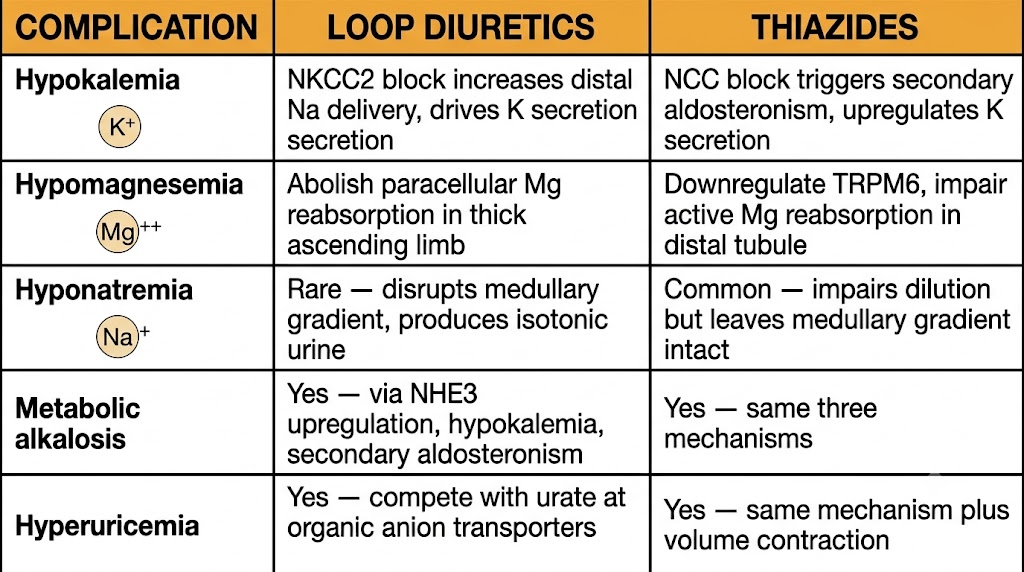
Loop diuretics block Na-K-2Cl cotransporter-mediated potassium reabsorption in the thick ascending limb and simultaneously increase sodium delivery to the collecting duct. Elevated luminal sodium stimulates the epithelial sodium channel, creating a more electronegative lumen that drives potassium secretion via the renal outer medullary potassium channel in the collecting duct. Thiazides produce hypokalemia through a different pathway: sodium-chloride cotransporter blockade triggers volume-mediated secondary hyperaldosteronism, which upregulates the epithelial sodium channel and renal outer medullary potassium channel, driving potassium loss independent of the primary cotransporter blockade.

Hypomagnesemia and Refractory Hypokalemia

Loop diuretics eliminate the lumen-positive potential that normally drives paracellular magnesium reabsorption in the thick ascending limb. Thiazides downregulate the epithelial magnesium channel TRPM6 in the distal convoluted tubule, impairing active magnesium reabsorption. The clinical consequence is critical: magnesium depletion prevents adequate suppression of renal outer medullary potassium channel-mediated potassium secretion, making hypokalemia refractory to potassium replacement alone. Concurrent magnesium repletion is required before potassium levels will normalize.

Hyponatremia — Thiazide-Specific Risk

Hyponatremia is far more common and dangerous with thiazides than with loop diuretics because of a fundamental difference in their effects on urinary concentration. Loop diuretics disrupt the medullary concentration gradient, producing near-isotonic urine regardless of antidiuretic hormone status. Thiazides acting only in the distal convoluted tubule impair dilution but leave the medullary gradient intact — so a patient on a thiazide can still respond to antidiuretic hormone with highly concentrated urine. In a patient with non-osmotic antidiuretic hormone secretion driven by pain, nausea, or volume depletion, this combination produces profound hyponatremia. Elderly women on thiazides represent the classic at-risk group.

Metabolic Alkalosis and Hyperuricemia

Metabolic alkalosis develops through three reinforcing mechanisms: angiotensin II-driven upregulation of the sodium-hydrogen exchanger in the proximal convoluted tubule increases bicarbonate reabsorption; hypokalemia drives cellular hydrogen-potassium exchange that raises extracellular bicarbonate; and secondary aldosteronism increases proton secretion in the collecting duct. Hyperuricemia arises because loop and thiazide diuretics compete with urate at organic anion transporter sites in the proximal convoluted tubule, reducing urate secretion; volume contraction additionally upregulates the urate transporter URAT1, increasing urate reabsorption. Glucose intolerance is more pronounced with thiazides and has been linked to hypokalemia impairing beta-cell insulin secretion.

Table comparing electrolyte complications of loop diuretics and thiazides
Electrolyte complications of loop diuretics and thiazides arise from distinct mechanisms but share several clinically important end-points.

Section 5

Clinical Applications and Drug Interactions

Heart failure, hypertension, nephrolithiasis, hypercalcemia — and the drug interactions that diminish efficacy or cause toxicity

The clinical applications of loop diuretics and thiazides follow from their mechanisms of action. Choosing correctly between them — and recognizing interactions that blunt their effects or amplify toxicity — is fundamental to managing the most common conditions for which diuretics are prescribed.

Heart Failure and Acute Volume Overload

Loop diuretics are the standard of care for symptomatic volume overload in heart failure. Intravenous furosemide provides faster and more reliable natriuresis than oral therapy in acute decompensated heart failure, particularly when bowel wall edema impairs oral absorption. The DOSE trial established that high-dose intravenous furosemide at 2.5 times the total oral daily dose was not inferior to low-dose therapy and produced greater net fluid loss and more rapid symptom relief — supporting dose escalation rather than conservative dosing in the acute setting.

Hypertension

Chlorthalidone is the preferred thiazide-class agent for hypertension based on ALLHAT outcome data. For resistant hypertension, the PATHWAY-2 trial demonstrated that spironolactone added as a fourth agent outperformed bisoprolol and doxazosin in reducing blood pressure, establishing mineralocorticoid receptor antagonism as the preferred fourth-line strategy.

Hypercalcemia and Nephrolithiasis

Acute hypercalcemia is managed with aggressive intravenous saline to restore intravascular volume and promote calciuresis, followed by loop diuretics to sustain calcium excretion. Thiazides are absolutely contraindicated in hypercalcemia because they reduce urinary calcium and would worsen the condition. For calcium nephrolithiasis, thiazides reduce urinary calcium excretion by 30 to 50% and are a first-line pharmacological strategy for stone recurrence prevention. High fluid intake must accompany thiazide therapy for nephrolithiasis, as the protective benefit depends on high urine volume as well as reduced calcium concentration.

Key Drug Interactions

Nonsteroidal anti-inflammatory drugs attenuate the natriuretic response to both loop and thiazide diuretics by inhibiting cyclooxygenase-dependent prostaglandin synthesis. Renal prostaglandins normally oppose tubular sodium reabsorption and dilate the afferent arteriole to maintain glomerular filtration rate. Removing this tone reduces glomerular filtration rate and blunts the diuretic response — a clinically significant interaction frequently overlooked when patients self-medicate with over-the-counter nonsteroidal anti-inflammatory drugs.

Lithium toxicity is a well-established complication of diuretic use. Both classes trigger compensatory upregulation of sodium-hydrogen exchanger-mediated reabsorption in the proximal convoluted tubule, which reabsorbs lithium along with sodium. Thiazides can double or triple lithium plasma concentrations within days of initiation. When a diuretic is required in a lithium-treated patient, amiloride is preferred because it does not promote proximal lithium reabsorption. Digoxin toxicity risk is amplified by diuretic-induced hypokalemia and hypomagnesemia, as both cations normally compete with digoxin for sodium-potassium-ATPase binding; their depletion lowers the toxic threshold.

Diuretic Resistance — Six Questions Before Adding Metolazone

Before labeling a patient diuretic-resistant and escalating to sequential nephron blockade, confirm: (1) adequate bioavailability — switch to intravenous if bowel edema is possible; (2) dose is above the threshold, not merely above the prior dose; (3) dosing frequency matches the drug's duration of action to minimize post-diuretic sodium avidity; (4) no concurrent nonsteroidal anti-inflammatory drugs, contrast agents, or aminoglycosides; (5) potassium and magnesium are repleted; (6) hypoalbuminemia has been considered as a pharmacokinetic barrier to loop diuretic efficacy. Only after these steps should metolazone be added.

Suggested References
Author / Organization Title Source
Ellison DH, Felker GM Diuretic treatment in heart failure N Engl J Med. 2017;377(20):1964–1975
Hoorn EJ, Ellison DH Diuretic resistance Am J Kidney Dis. 2017;69(1):136–142
Bhalla V, Hallows KR Mechanisms of ENaC regulation and clinical implications J Am Soc Nephrol. 2008;19(10):1845–1854
Brater DC Diuretic therapy N Engl J Med. 1998;339(6):387–395
Felker GM, Lee KL, Bull DA, et al Diuretic strategies in patients with acute decompensated heart failure N Engl J Med. 2011;364(9):797–805
Mentz RJ, Anstrom KJ, Eisenstein EL, et al Effect of torsemide vs furosemide after discharge on all-cause mortality in patients hospitalized with heart failure: the TRANSFORM-HF randomized clinical trial JAMA. 2023;329(3):214–223
Fink HA, Akornor JW, Garimella PS, et al Diet, fluid, or supplements for secondary prevention of nephrolithiasis: a systematic review and meta-analysis of randomized trials Eur Urol. 2009;56(1):72–80
ALLHAT Officers and Coordinators Major outcomes in high-risk hypertensive patients randomized to angiotensin-converting enzyme inhibitor or calcium channel blocker vs diuretic JAMA. 2002;288(23):2981–2997
Liamis G, Milionis H, Elisaf M A review of drug-induced hyponatremia Am J Kidney Dis. 2008;52(1):144–153
Zillich AJ, Garg J, Basu S, et al Thiazide diuretics, potassium, and the development of diabetes: a quantitative review Hypertension. 2006;48(2):219–224