Four Specialized Classes Targeting Distinct Physiological Problems
RENL · Module 2 of 5Spironolactone, eplerenone, and finerenone — collecting duct potassium preservation with diverging selectivity profiles
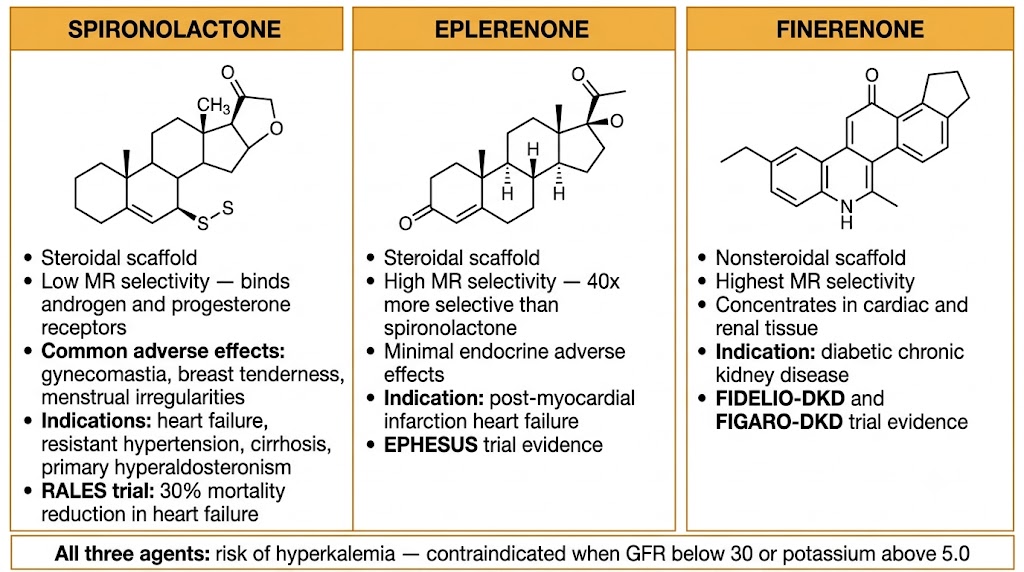
Mineralocorticoid receptor antagonists block aldosterone binding in the principal cells of the collecting duct, reducing sodium reabsorption and potassium secretion. The three available agents differ substantially in selectivity, adverse effect profiles, and approved indications.
Spironolactone is a steroidal mineralocorticoid receptor antagonist that competitively blocks aldosterone at the collecting duct principal cell, reducing epithelial sodium channel and sodium-potassium-ATPase expression. The natriuretic effect is modest — the collecting duct handles only 2 to 3% of filtered sodium — but the potassium-sparing effect is clinically powerful. The RALES trial demonstrated a 30% reduction in mortality when spironolactone was added to standard heart failure therapy in patients with severe heart failure with reduced ejection fraction, establishing mineralocorticoid receptor antagonism as a pillar of heart failure management.
Spironolactone's limited selectivity generates endocrine adverse effects. Its active metabolite canrenone and the parent compound both bind androgen and progesterone receptors, causing gynecomastia and breast tenderness in men and menstrual irregularities in women. These effects are dose-dependent and represent the primary reason for switching to more selective agents in patients who cannot tolerate them.
Eplerenone is a steroidal mineralocorticoid receptor antagonist with approximately 40-fold lower affinity for androgen and progesterone receptors than spironolactone, substantially reducing gynecomastia and menstrual irregularities. The EPHESUS trial demonstrated mortality reduction with eplerenone in patients with heart failure with reduced ejection fraction complicating acute myocardial infarction, and it carries an indication for this post-infarction heart failure population.
Finerenone is a nonsteroidal mineralocorticoid receptor antagonist with greater receptor selectivity than either steroidal agent and a distinct tissue distribution profile that concentrates in cardiac and renal tissue. The FIDELIO-DKD and FIGARO-DKD trials demonstrated that finerenone reduced progression of chronic kidney disease and cardiovascular events in patients with type 2 diabetes and chronic kidney disease, establishing it as the first mineralocorticoid receptor antagonist with outcome data in diabetic kidney disease.
All three agents carry a risk of hyperkalemia proportional to the degree of aldosterone blockade. They are contraindicated when glomerular filtration rate falls below 30 milliliters per minute or when baseline potassium exceeds 5.0 milliequivalents per liter, and potassium monitoring is mandatory after initiation.
Amiloride and triamterene — direct luminal blockade of the epithelial sodium channel, independent of aldosterone
Amiloride and triamterene block the epithelial sodium channel directly at the luminal surface of the collecting duct and connecting tubule, reducing sodium entry into principal cells regardless of aldosterone levels. This mechanism preserves potassium without requiring mineralocorticoid receptor occupancy, making these agents useful when the goal is sodium channel blockade independent of the hormonal axis.
Amiloride has reliable oral bioavailability and predominantly renal elimination. Its most clinically important niche is lithium-induced nephrogenic diabetes insipidus: lithium enters collecting duct principal cells through the epithelial sodium channel, accumulates intracellularly, and impairs aquaporin-2 insertion in response to antidiuretic hormone. Amiloride blocks the channel and reduces lithium entry, attenuating the diabetes insipidus without requiring lithium discontinuation. It is the preferred potassium-sparing agent in lithium-treated patients because, unlike thiazides, it does not promote proximal lithium reabsorption.
Amiloride is commonly combined with thiazides in fixed-dose formulations to offset thiazide-induced hypokalemia, providing additive natriuresis from two distal nephron sites while counterbalancing their opposite effects on potassium.
Triamterene shares amiloride's mechanism but is a prodrug requiring hepatic activation to its active metabolite. Hepatic impairment reduces its effectiveness, and its metabolites are nephrotoxic at high concentrations. Triamterene can crystallize in the renal tubule and has been associated with triamterene nephrolithiasis — a distinguishing toxicity not seen with amiloride. Both agents carry hyperkalemia risk that is amplified by concurrent use of angiotensin converting enzyme inhibitors, angiotensin receptor blockers, or nonsteroidal anti-inflammatory drugs.
Acetazolamide — proximal tubule bicarbonate wasting with clinical utility in altitude sickness, glaucoma, and metabolic alkalosis
Acetazolamide inhibits carbonic anhydrase, the enzyme that catalyzes the interconversion of carbon dioxide and water to carbonic acid in the proximal convoluted tubule. This impairs bicarbonate reabsorption, producing a self-limiting bicarbonate diuresis and metabolic acidosis.
In the proximal convoluted tubule, carbonic anhydrase on both the luminal brush border and inside the tubular cell drives sodium-hydrogen exchanger-mediated sodium reabsorption by regenerating the hydrogen ions needed for exchange. Acetazolamide blocks this enzyme, causing sodium bicarbonate to remain in the tubular lumen and reach the urine. The resulting metabolic acidosis progressively reduces the filtered bicarbonate load, eventually removing the substrate for the diuretic effect — explaining why acetazolamide produces a self-limiting natriuresis rather than the sustained fluid loss of loop diuretics or thiazides.
At high altitude, hypoxia drives hyperventilation that lowers arterial carbon dioxide and raises arterial pH, producing a respiratory alkalosis that paradoxically blunts the hypoxic ventilatory response and worsens altitude sickness. Acetazolamide induces a compensatory metabolic acidosis that restores the ventilatory drive, allowing more effective acclimatization. It is used for prophylaxis and treatment of acute mountain sickness when initiated 24 to 48 hours before ascent.
In open-angle glaucoma, acetazolamide reduces aqueous humor production by inhibiting carbonic anhydrase in the ciliary body epithelium, lowering intraocular pressure through a mechanism independent of its renal diuretic effect. It is used when topical agents fail to achieve adequate intraocular pressure control. In patients with metabolic alkalosis from loop or thiazide diuretics, acetazolamide provides a targeted correction by promoting bicarbonate excretion. The ADVOR trial demonstrated that adding acetazolamide to standard loop diuretic therapy in acute decompensated heart failure accelerated decongestion and increased the rate of successful decongestion at 3 days compared with placebo.
Mannitol — freely filtered, non-reabsorbed osmotic agent with an irreplaceable role in elevated intracranial pressure and acute angle-closure glaucoma
Mannitol is a six-carbon sugar alcohol that is freely filtered at the glomerulus and neither reabsorbed nor secreted by the renal tubule. Its osmotic presence in the tubular lumen retains water that would otherwise be reabsorbed, increasing urine volume without requiring a specific transporter target.
After intravenous administration, mannitol first expands intravascular volume by drawing water osmotically from the intracellular and interstitial compartments into the plasma. This initial volume expansion can be hazardous in patients with heart failure or pulmonary edema. As mannitol reaches the glomerulus and is filtered, its osmotic retention of tubular water produces the diuresis. In patients with intact renal function, the drug is cleared entirely in the urine within several hours.
The primary clinical application is reduction of elevated intracranial pressure in cerebral edema from traumatic brain injury, ischemic stroke with herniation risk, or other causes of acute brain swelling. The osmotic gradient created between plasma and brain tissue draws water out of the cerebral interstitium across the intact blood-brain barrier, reducing cerebral edema within 15 to 30 minutes of infusion. The effect is temporary and requires repeated dosing with osmolality monitoring to avoid hypernatremia and hyperosmolarity.
Mannitol is contraindicated in heart failure and pulmonary edema because the initial intravascular volume expansion precipitates acute decompensation before the diuresis begins. It is contraindicated in anuric renal failure because the drug cannot be excreted and accumulates, worsening hyperosmolarity. In patients with a disrupted blood-brain barrier, mannitol can cross into brain tissue and paradoxically worsen cerebral edema by creating an osmotic gradient in the wrong direction.
Tolvaptan and conivaptan — selective aquaresis without natriuresis for euvolemic and hypervolemic hyponatremia
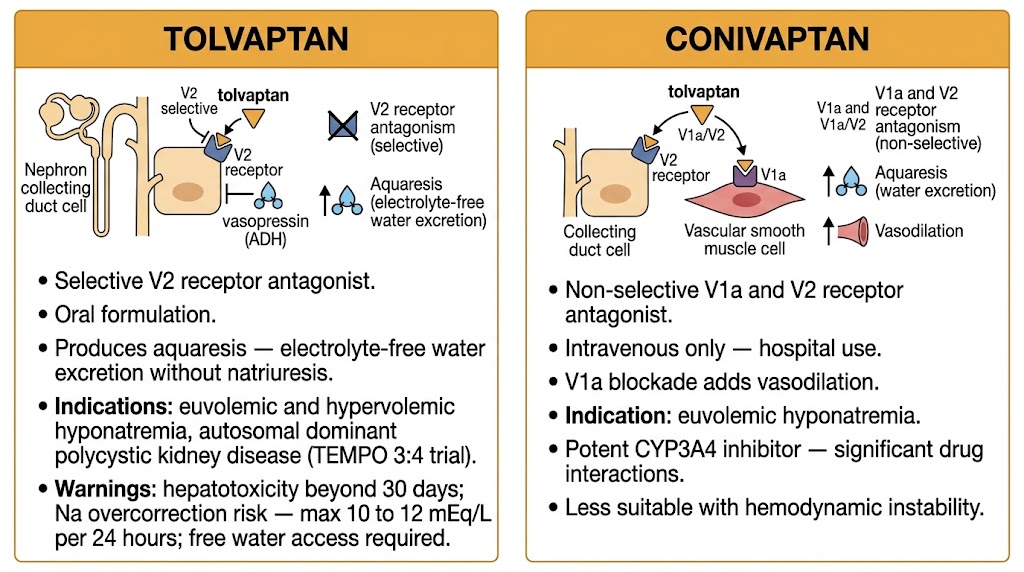
Vasopressin antagonists block the vasopressin type 2 receptor in collecting duct principal cells, preventing aquaporin-2 insertion into the apical membrane and causing electrolyte-free water excretion — termed aquaresis — without sodium loss. This distinguishes them from all other diuretics, which produce natriuresis as their primary effect.
Tolvaptan is a selective oral vasopressin type 2 receptor antagonist approved for euvolemic and hypervolemic hyponatremia in hospitalized patients when the serum sodium is below 125 milliequivalents per liter or below 130 milliequivalents per liter with symptoms. It produces a predictable rise in serum sodium by promoting free water excretion. The rate of sodium correction must be monitored carefully — overcorrection exceeding 10 to 12 milliequivalents per liter per 24 hours risks osmotic demyelination syndrome, a devastating and largely irreversible neurological complication.
Tolvaptan carries a black box warning for hepatotoxicity with use beyond 30 days, limiting its long-term use. It also carries an indication for autosomal dominant polycystic kidney disease to slow cyst growth and preserve kidney function, based on the TEMPO 3:4 trial data. Patients must have free access to water during tolvaptan therapy — fluid restriction is contraindicated because thirst-driven water consumption is the safety buffer against overcorrection.
Conivaptan blocks both vasopressin type 1a receptors on vascular smooth muscle and vasopressin type 2 receptors in the collecting duct. It is available only as an intravenous formulation for in-hospital use in euvolemic hyponatremia. The vasopressin type 1a blockade adds a vasodilatory effect that makes it less suitable for patients with hemodynamic instability. It is a potent inhibitor of cytochrome P450 3A4 and carries significant drug interaction risk in the inpatient setting.
Sodium correction with vaptans must not exceed 10 to 12 milliequivalents per liter per 24 hours or 18 milliequivalents per liter per 48 hours. Patients at highest risk for osmotic demyelination syndrome are those with severe chronic hyponatremia (below 120 milliequivalents per liter for more than 48 hours), malnutrition, alcoholism, or liver disease. Serum sodium must be checked frequently after initiation. Free access to water must be maintained throughout therapy.
Combining diuretics at different nephron sites to overcome compensatory reabsorption and address specific electrolyte problems
No single diuretic class controls all tubular segments. When one segment is blocked, compensatory upregulation in downstream segments partially recaptures the natriuresis. Sequential nephron blockade exploits this physiology by combining agents at distinct tubular sites to prevent compensatory escape.
The most widely used sequential blockade combination pairs a loop diuretic with metolazone. Loop diuretic blockade of the Na-K-2Cl cotransporter increases sodium delivery to the distal convoluted tubule, where hypertrophied sodium-chloride cotransporter expression compensates over time. Metolazone blocks this compensatory site simultaneously, producing dramatic additive natriuresis. This combination requires close electrolyte monitoring within 24 to 48 hours — profound hypokalemia and hypomagnesemia can develop rapidly.
Combining a loop diuretic with a mineralocorticoid receptor antagonist provides complementary natriuresis — the loop diuretic maximizes sodium delivery out of the thick ascending limb while the mineralocorticoid receptor antagonist blocks aldosterone-driven sodium recapture in the collecting duct. This pairing also provides potassium protection: the hypokalemia risk of loop diuretics is offset by the potassium-sparing effect of the mineralocorticoid receptor antagonist, making it a physiologically rational combination in heart failure with reduced ejection fraction.
Patients receiving sustained loop or thiazide therapy frequently develop metabolic alkalosis through secondary aldosteronism, hypokalemia-driven bicarbonate retention, and proximal sodium-hydrogen exchanger upregulation. This alkalosis raises serum bicarbonate, which reduces the fraction of ionized calcium and can impair respiratory drive. Adding acetazolamide promotes bicarbonate excretion, correcting the alkalosis and restoring the bicarbonate substrate for continued loop diuretic responsiveness. The ADVOR trial supports this approach in acute decompensated heart failure with alkalosis, showing faster and more complete decongestion when acetazolamide was added to intravenous furosemide.
| Author / Organization | Title | Source |
|---|---|---|
| Ellison DH, Felker GM | Diuretic treatment in heart failure | N Engl J Med. 2017;377(20):1964–1975 |
| Hoorn EJ, Ellison DH | Diuretic resistance | Am J Kidney Dis. 2017;69(1):136–142 |
| Zannad F, McMurray JJV, Krum H, et al | Eplerenone in patients with systolic heart failure and mild symptoms | N Engl J Med. 2011;364(1):11–21 |
| Bakris GL, Agarwal R, Anker SD, et al | Effect of finerenone on chronic kidney disease outcomes in type 2 diabetes | N Engl J Med. 2020;383(23):2219–2229 |
| Pitt B, Filippatos G, Agarwal R, et al | Cardiovascular events with finerenone in kidney disease and type 2 diabetes | N Engl J Med. 2021;385(24):2252–2263 |
| Batlle DC, von Riotte AB, Gaviria M, Grupp M | Amelioration of polyuria by amiloride in patients receiving long-term lithium therapy | N Engl J Med. 1985;312(7):408–414 |
| Swenson ER | Carbonic anhydrase inhibitors and high altitude illnesses | Subcell Biochem. 2014;75:361–386 |
| Mullens W, Dauw J, Martens P, et al | Acetazolamide in acute decompensated heart failure with volume overload | N Engl J Med. 2022;387(13):1185–1195 |
| Sorani MD, Manley GT | Dose-response relationship of mannitol and intracranial pressure: a meta-analysis | J Neurosurg. 2008;108(1):80–87 |
| Verbalis JG, Goldsmith SR, Greenberg A, et al | Diagnosis, evaluation, and treatment of hyponatremia: expert panel recommendations | Am J Med. 2013;126(10 Suppl 1):S1–S42 |
| Torres VE, Chapman AB, Devuyst O, et al | Tolvaptan in patients with autosomal dominant polycystic kidney disease | N Engl J Med. 2012;367(25):2407–2418 |
| Felker GM, Lee KL, Bull DA, et al | Diuretic strategies in patients with acute decompensated heart failure | N Engl J Med. 2011;364(9):797–805 |