CHAPTER 26  ·  RENAL PHARMACOLOGY
Section 1

Drug Dosing in Chronic Kidney Disease

Glomerular filtration rate-guided dose adjustment, active metabolite accumulation, and high-risk drug classes

Chronic kidney disease reduces the renal clearance of drugs and metabolites in proportion to the fall in glomerular filtration rate. The clinical consequences range from modest dose adjustment at early stages to contraindication at advanced stages — and the risk is highest when active metabolites accumulate silently while the parent drug appears to be at a safe level.

Metformin

Metformin is entirely renally excreted by tubular secretion and accumulates in chronic kidney disease in direct proportion to the decline in glomerular filtration rate. Accumulation raises plasma lactate by inhibiting hepatic lactate clearance, creating the substrate for metformin-associated lactic acidosis — a rare but potentially fatal complication. Metformin is generally held when estimated glomerular filtration rate falls below 30 milliliters per minute per 1.73 square meters, and many guidelines recommend dose reduction and increased monitoring between 30 and 45 milliliters per minute. It should be withheld before procedures using iodinated contrast media and resumed only after confirming stable renal function.

Direct Oral Anticoagulants

Direct oral anticoagulants vary substantially in their renal elimination fraction, which determines the severity of dose accumulation in chronic kidney disease. Dabigatran is 80% renally eliminated and is contraindicated when estimated glomerular filtration rate falls below 30 milliliters per minute — the highest renal risk of the class. Apixaban has the lowest renal elimination fraction (approximately 27%) and is generally the preferred direct oral anticoagulant in advanced chronic kidney disease. Rivaroxaban and edoxaban fall between these extremes and require dose adjustment or avoidance as glomerular filtration rate declines.

Active Metabolite Accumulation

Some drugs are safe at their usual dose in chronic kidney disease but accumulate dangerous active metabolites as renal clearance falls. Morphine is metabolized to morphine-6-glucuronide, an active opioid metabolite with potent respiratory depressant effects that accumulates in renal impairment even when morphine itself is dosed conservatively. Hydromorphone, oxycodone, and codeine carry similar risks through their respective active metabolites. Meperidine accumulates normeperidine, a pro-convulsant metabolite, and is avoided in chronic kidney disease entirely. Recognizing active metabolite accumulation as a distinct pharmacokinetic hazard — separate from accumulation of the parent drug — is essential to safe prescribing in patients with chronic kidney disease.


Section 2

RAAS Blockade for Renoprotection

Angiotensin converting enzyme inhibitors and angiotensin receptor blockers — efferent arteriolar dilation, proteinuria reduction, and long-term nephroprotection

The renin-angiotensin-aldosterone system drives chronic kidney disease progression by sustaining intraglomerular hypertension. Angiotensin II preferentially constricts the efferent arteriole, raising glomerular capillary pressure and forcing protein across the filtration barrier into the tubular lumen, where it triggers tubular injury and interstitial inflammation. Blocking this axis is the cornerstone of renoprotective pharmacotherapy.

Mechanism of Renoprotection

Angiotensin converting enzyme inhibitors and angiotensin receptor blockers dilate the efferent arteriole, reducing intraglomerular pressure and the protein flux that drives tubular injury. Both classes reduce proteinuria through this hemodynamic mechanism independently of any blood pressure lowering effect on systemic circulation. The acute, predictable fall in glomerular filtration rate that occurs when these agents are initiated represents efferent arteriolar dilation reducing the hydraulic pressure driving filtration — it is not renal injury. This initial creatinine rise of up to 30% above baseline is acceptable and expected; rises beyond 30% or occurring in the absence of volume depletion warrant investigation for bilateral renal artery stenosis.

Evidence Base

In diabetic nephropathy, angiotensin converting enzyme inhibitors reduce the rate of doubling of serum creatinine and progression to end-stage kidney disease independently of blood pressure control, establishing them as a disease-modifying class. Angiotensin receptor blockers demonstrated equivalent renoprotection in the IDNT and RENAAL trials in type 2 diabetic nephropathy. Combination of an angiotensin converting enzyme inhibitor with an angiotensin receptor blocker does not provide additional renoprotection over either agent alone and substantially increases the risk of hyperkalemia and acute kidney injury — the ONTARGET trial established this definitively. Current guidelines recommend one agent from either class, not both.

RAAS Blockade — When to Hold

Hold angiotensin converting enzyme inhibitors and angiotensin receptor blockers when estimated glomerular filtration rate falls below 30 milliliters per minute and potassium exceeds 5.5 milliequivalents per liter, during intercurrent illness with volume depletion, before iodinated contrast procedures, and perioperatively when hemodynamic instability is anticipated. These are temporary holds — the long-term renoprotective benefit of resuming therapy when stable outweighs the risk of continued interruption.


Section 3

Sodium-Glucose Cotransporter 2 Inhibitors in Chronic Kidney Disease

Tubuloglomerular feedback restoration, intraglomerular pressure reduction, and outcome trial evidence beyond glycemic control

Sodium-glucose cotransporter 2 inhibitors were developed as glucose-lowering agents but have demonstrated renoprotective effects that are largely independent of their glycemic mechanism. Their renal benefit operates through a tubular physiology pathway that reduces intraglomerular pressure through the same tubuloglomerular feedback axis disrupted in chronic kidney disease.

Renal Mechanism

In chronic kidney disease, reduced nephron mass causes surviving nephrons to hyperfiltrate, increasing sodium reabsorption in the proximal convoluted tubule and reducing sodium delivery to the macula densa. The macula densa interprets this low sodium signal as reduced glomerular filtration and dilates the afferent arteriole to increase blood flow — but this compensatory response raises intraglomerular pressure and accelerates nephron loss. Sodium-glucose cotransporter 2 inhibitors block glucose-coupled sodium reabsorption in the proximal tubule, restoring sodium delivery to the macula densa, triggering afferent arteriolar constriction via tubuloglomerular feedback, and reducing intraglomerular pressure. This mechanism operates regardless of whether the patient has diabetes.

Outcome Trial Evidence

The CREDENCE trial randomized patients with type 2 diabetes and chronic kidney disease to canagliflozin and demonstrated a 30% relative risk reduction in the primary composite of end-stage kidney disease, doubling of serum creatinine, and renal or cardiovascular death. The DAPA-CKD trial extended this to patients without diabetes, with dapagliflozin reducing the composite of sustained decline in estimated glomerular filtration rate, end-stage kidney disease, and cardiovascular or renal death by 39% across diabetic and non-diabetic chronic kidney disease patients. These trials established sodium-glucose cotransporter 2 inhibitors as a new standard of care in chronic kidney disease management.
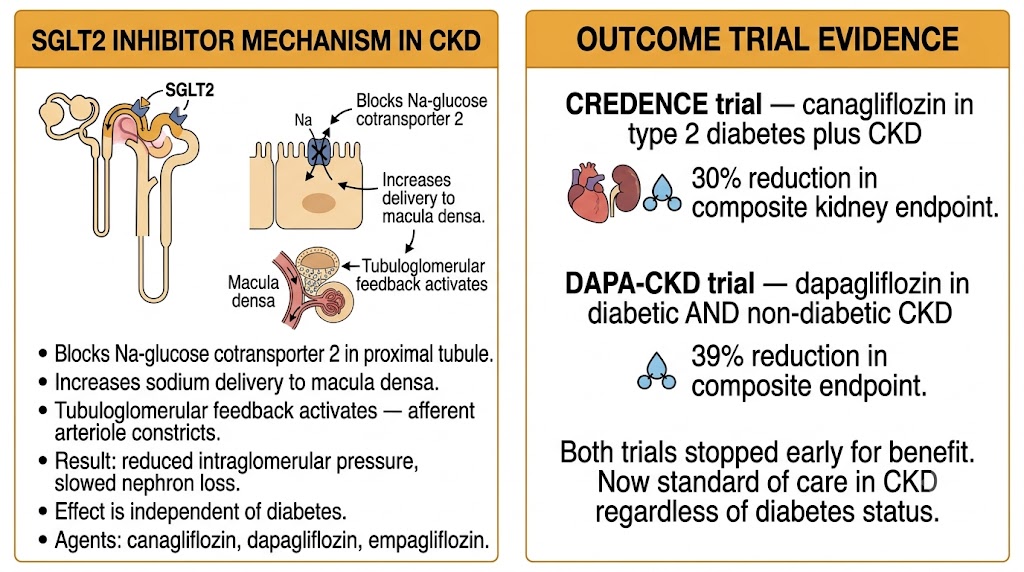
Two-panel diagram showing SGLT2 inhibitor mechanism in CKD and outcome trial evidence
Sodium-glucose cotransporter 2 inhibitors reduce intraglomerular pressure via tubuloglomerular feedback and have demonstrated kidney protection in both diabetic and non-diabetic chronic kidney disease.
Adverse Effects in Chronic Kidney Disease

Genital mycotic infections are the most common adverse effect, occurring in 5 to 10% of patients; they are manageable and rarely require drug discontinuation. Euglycemic diabetic ketoacidosis can occur — serum glucose may be near-normal while ketone production is elevated — requiring clinical suspicion in patients presenting with symptoms of ketoacidosis regardless of glucose level. Fournier's gangrene, a rare necrotizing fasciitis of the perineum, carries a black box warning for the class. The glycosuric efficacy of sodium-glucose cotransporter 2 inhibitors diminishes as glomerular filtration rate declines and filtered glucose load falls, but the renoprotective effect via tubuloglomerular feedback persists at lower glomerular filtration rates than the glucose-lowering effect.

Section 4

Anemia of Chronic Kidney Disease — Erythropoiesis-Stimulating Agents

Erythropoietin deficiency, erythropoiesis-stimulating agent therapy, iron co-requirement, and hemoglobin target evidence

Anemia of chronic kidney disease arises primarily from deficient erythropoietin production by peritubular fibroblasts in the renal cortex as functioning nephron mass decreases. Erythropoietin is the principal growth factor driving red blood cell production in the bone marrow, and its deficiency produces a normochromic, normocytic anemia proportional to the degree of renal dysfunction.

Erythropoiesis-Stimulating Agents

Epoetin alfa is structurally identical to endogenous erythropoietin and administered subcutaneously or intravenously. Darbepoetin alfa is hyperglycosylated, giving it a three-fold longer half-life that permits less frequent dosing — weekly or every two weeks versus two to three times weekly for epoetin alfa. Both agents carry a black box warning: targeting hemoglobin above 11 to 12 grams per deciliter with erythropoiesis-stimulating agent therapy increases the risk of stroke, myocardial infarction, thrombosis, and death. The CHOIR and TREAT trials both demonstrated harm from higher hemoglobin targets, establishing the current guideline recommendation to maintain hemoglobin between 10 and 11.5 grams per deciliter and to use the lowest effective dose.

Iron Co-Requirement

Iron is an absolute co-requirement for erythropoiesis-stimulating agent therapy. These agents drive erythropoiesis and rapidly deplete available iron stores, producing functional iron deficiency — a state in which total body iron may be adequate but mobilization to the bone marrow is insufficient to support the accelerated red cell production. Erythropoiesis-stimulating agent hyporesponsiveness (failure to achieve the target hemoglobin despite adequate dosing) is most commonly caused by iron deficiency, infection, or inflammation. Intravenous iron is preferred over oral supplementation in dialysis patients because gastrointestinal absorption is limited by the inflammatory state associated with chronic kidney disease and because intravenous delivery bypasses the hepcidin-mediated block on iron release from enterocytes that accompanies chronic inflammation.


Section 5

Hypoxia-Inducible Factor Prolyl Hydroxylase Inhibitors

A mechanistically distinct oral approach to chronic kidney disease anemia that stimulates endogenous erythropoietin production

Hypoxia-inducible factor prolyl hydroxylase domain inhibitors represent a new class of oral agents for chronic kidney disease anemia that work by stabilizing hypoxia-inducible factor 1-alpha rather than replacing erythropoietin directly. They exploit the body's own oxygen-sensing machinery to drive erythropoiesis.

Mechanism

Under normal oxygen conditions, prolyl hydroxylase domain enzymes hydroxylate hypoxia-inducible factor 1-alpha, targeting it for proteasomal degradation. When oxygen tension falls — as in high altitude or anemia — prolyl hydroxylase domain enzyme activity decreases, hypoxia-inducible factor 1-alpha accumulates, and it transcriptionally upregulates erythropoietin production, iron transport genes, and other adaptive responses. Prolyl hydroxylase domain inhibitors pharmacologically block these enzymes, mimicking hypoxia and stabilizing hypoxia-inducible factor 1-alpha regardless of ambient oxygen tension, thereby stimulating endogenous erythropoietin production.

Agents and Clinical Evidence

Roxadustat was the first prolyl hydroxylase domain inhibitor approved for chronic kidney disease anemia and is available in Europe, Japan, and China. Daprodustat received approval in the United States and Japan. Phase 3 trials demonstrated that both agents produce hemoglobin increases comparable to erythropoiesis-stimulating agents in both dialysis-dependent and non-dialysis chronic kidney disease patients. A key pharmacological advantage is their oral administration — erythropoiesis-stimulating agents require injection. Cardiovascular safety data from phase 3 trials are under ongoing scrutiny, and these agents are currently positioned as alternatives for patients who do not respond adequately to or cannot receive erythropoiesis-stimulating agents.


Section 6

Chronic Kidney Disease–Mineral Bone Disease

Phosphate binders, active vitamin D analogs, and cinacalcet — managing the calcium-phosphorus-parathyroid hormone axis disrupted by renal failure

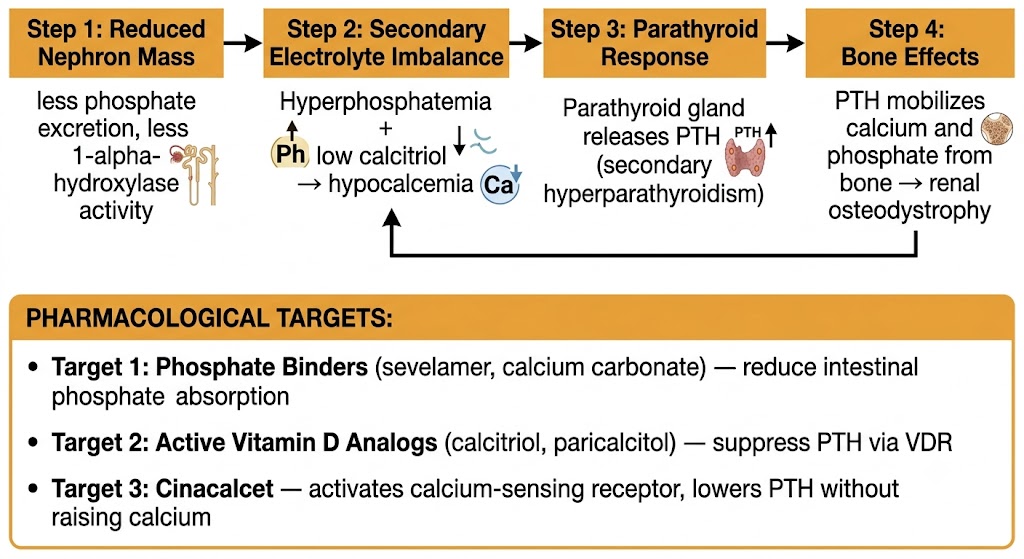
As kidney function declines, reduced phosphate excretion drives hyperphosphatemia, and reduced renal 1-alpha-hydroxylase activity impairs conversion of 25-hydroxyvitamin D to its active form, calcitriol. The resulting hypocalcemia and hyperphosphatemia trigger secondary hyperparathyroidism, which mobilizes calcium and phosphate from bone. The pharmacological goal is to normalize serum phosphorus, restore active vitamin D activity, and suppress parathyroid hormone without causing adynamic bone disease from oversuppression.

Phosphate Binders

Phosphate binders act in the gastrointestinal tract by binding dietary phosphate and preventing its absorption, reducing the phosphate burden delivered to the kidney. Calcium carbonate and calcium acetate are widely used calcium-based binders that are effective and inexpensive; calcium acetate binds phosphate more efficiently per gram of calcium delivered, limiting hypercalcemia risk. However, calcium-based binders contribute to positive calcium balance and have been associated with vascular calcification in dialysis patients. Sevelamer is a non-calcium, non-metal polymer binder that avoids calcium loading and additionally lowers low-density lipoprotein cholesterol. Lanthanum carbonate is an effective non-calcium metal-based binder. All phosphate binders must be taken with meals to be effective — they must be present in the gut when dietary phosphate is absorbed.

Active Vitamin D Analogs

Calcitriol is the naturally occurring fully active form of vitamin D that directly suppresses parathyroid hormone gene transcription via the vitamin D receptor in parathyroid chief cells. Paricalcitol and doxercalciferol are synthetic vitamin D analogs with modified side chains that provide greater selectivity for the parathyroid gland vitamin D receptor relative to the intestinal receptor, reducing hypercalcemia and hyperphosphatemia compared with calcitriol. All active vitamin D analogs carry a risk of hypercalcemia and hyperphosphatemia that limits their use in patients with inadequate phosphate control.

Cinacalcet

Cinacalcet is a calcimimetic that allosterically activates the calcium-sensing receptor on parathyroid chief cells, increasing the receptor's sensitivity to extracellular calcium and reducing parathyroid hormone secretion without raising serum calcium. This mechanism makes cinacalcet suitable for patients with secondary hyperparathyroidism complicated by hypercalcemia, where active vitamin D analogs cannot be used safely. The EVOLVE trial in dialysis patients did not demonstrate a significant reduction in cardiovascular mortality with cinacalcet over placebo, though secondary analyses showed benefit in younger patients. The primary adverse effects are nausea, vomiting, and hypocalcemia from the reduction in parathyroid hormone-mediated calcium mobilization.

Flow diagram showing the CKD mineral bone disease cycle and pharmacological treatment targets
Secondary hyperparathyroidism in chronic kidney disease is driven by hyperphosphatemia and calcitriol deficiency; three drug classes interrupt this cycle at distinct points.
Phosphate Control
Binder Selection
  • Calcium carbonate / acetate — effective, low cost; risk of vascular calcification
  • Sevelamer — non-calcium polymer; also lowers LDL cholesterol
  • Lanthanum carbonate — non-calcium metal binder
  • All binders: must be taken with meals
PTH Suppression
Vitamin D and Calcimimetics
  • Calcitriol — active vitamin D; suppresses PTH via VDR
  • Paricalcitol / doxercalciferol — selective analogs, less hypercalcemia
  • Cinacalcet — activates calcium-sensing receptor; lowers PTH without raising Ca
  • Use cinacalcet when hypercalcemia limits vitamin D analog use
Suggested References
Author / Organization Title Source
Matzke GR, Aronoff GR, Atkinson AJ Jr, et al Drug dosing consideration in patients with acute and chronic kidney disease: a clinical update from KDIGO Kidney Int. 2011;80(11):1122–1137
Jafar TH, Stark PC, Schmid CH, et al Progression of chronic kidney disease: the role of blood pressure control, proteinuria, and angiotensin-converting enzyme inhibition Ann Intern Med. 2003;139(4):244–252
Perkovic V, Jardine MJ, Neal B, et al Canagliflozin and renal outcomes in type 2 diabetes and nephropathy N Engl J Med. 2019;380(24):2295–2306
Heerspink HJL, Stefánsson BV, Correa-Rotter R, et al Dapagliflozin in patients with chronic kidney disease N Engl J Med. 2020;383(15):1436–1446
KDIGO 2012 Anemia Work Group KDIGO clinical practice guideline for anemia in chronic kidney disease Kidney Int Suppl. 2012;2(4):279–335
Pfeffer MA, Burdmann EA, Chen CY, et al A trial of darbepoetin alfa in type 2 diabetes and chronic kidney disease N Engl J Med. 2009;361(21):2019–2032
Singh AK, Carroll K, McMurray JJV, et al Daprodustat for the treatment of anemia in patients not undergoing dialysis (ASCEND-ND) N Engl J Med. 2021;385(25):2313–2324
KDIGO CKD-MBD Update Work Group KDIGO 2017 clinical practice guideline update for the diagnosis, evaluation, prevention, and treatment of CKD-MBD Kidney Int Suppl. 2017;7(1):1–59
Chertow GM, Block GA, Correa-Rotter R, et al Effect of cinacalcet on cardiovascular disease in patients undergoing dialysis N Engl J Med. 2012;367(26):2482–2494
Singh AK, Szczech L, Tang KL, et al Correction of anemia with epoetin alfa in chronic kidney disease N Engl J Med. 2006;355(20):2085–2098
Yusuf S, Teo KK, Pogue J, et al Telmisartan, ramipril, or both in patients at high risk for vascular events (ONTARGET) N Engl J Med. 2008;358(15):1547–1559
KDIGO CKD Work Group KDIGO 2024 clinical practice guideline for the evaluation and management of chronic kidney disease Kidney Int. 2024;105(4S):S117–S314