CHAPTER 24  ·  VASOACTIVE PEPTIDE PHARMACOLOGY
Section 1
Angiotensin Receptor Blockers: Mechanism and Key Differences from ACE Inhibitors
How angiotensin receptor blockers block the AT1 receptor directly, why they lack the cough and angioedema of angiotensin-converting enzyme inhibitors, and what adverse effects they share

Angiotensin receptor blockers block the angiotensin type 1 receptor directly, preventing angiotensin II from binding regardless of how it was generated. Because they act downstream of angiotensin-converting enzyme and do not touch bradykinin metabolism, they produce similar therapeutic benefits to angiotensin-converting enzyme inhibitors while avoiding the bradykinin-driven adverse effects that are the most common reason patients discontinue angiotensin-converting enzyme inhibitor therapy.

Mechanism of Action

Angiotensin receptor blockers competitively and selectively block the angiotensin type 1 receptor on vascular smooth muscle, the adrenal cortex, the kidney, and the heart. By occupying the receptor, they prevent angiotensin II from producing its downstream effects: vasoconstriction, aldosterone secretion, sodium and water retention, and cardiac and vascular remodeling. Because the blockade occurs at the receptor level — not at the enzymatic step that converts angiotensin I to angiotensin II — angiotensin-converting enzyme remains fully active. Bradykinin continues to be degraded normally, and bradykinin levels do not rise.

This single mechanistic difference explains the entire adverse effect distinction between the two classes. No elevated bradykinin means no dry cough and no bradykinin-mediated angioedema. Angiotensin receptor blockers are therefore the standard alternative when a patient develops cough on an angiotensin-converting enzyme inhibitor. They are used cautiously rather than freely in patients with a history of angiotensin-converting enzyme inhibitor angioedema, since the angioedema risk is substantially lower but not completely absent with angiotensin receptor blockers.

Shared Adverse Effects and Contraindications

Despite the bradykinin distinction, angiotensin receptor blockers share all of the angiotensin-converting enzyme inhibitor adverse effects that derive from reduced angiotensin II and aldosterone activity rather than from bradykinin. Hyperkalemia occurs because aldosterone suppression reduces potassium excretion in the collecting duct — the same mechanism as with angiotensin-converting enzyme inhibitors. The same renal hemodynamic risk applies in bilateral renal artery stenosis: removing angiotensin II-dependent efferent arteriolar constriction collapses filtration pressure and can precipitate acute kidney injury.

The pregnancy contraindication is absolute and identical to that of angiotensin-converting enzyme inhibitors. The developing fetal kidney depends on its own renin-angiotensin-aldosterone system for normal tubular development; angiotensin receptor blockers suppress fetal angiotensin II signaling and cause the same spectrum of fetal harm — oligohydramnios, fetal anuria, and pulmonary hypoplasia — as angiotensin-converting enzyme inhibitors.

ARBs Do NOT Cause
Bradykinin-Dependent Effects
  • Dry cough — absent (bradykinin not elevated)
  • Angioedema — absent or very rare (not bradykinin-driven)
ARBs DO Cause
Angiotensin II Blockade Effects
  • Hyperkalemia (reduced aldosterone)
  • Acute kidney injury in bilateral renal artery stenosis
  • Fetal harm — contraindicated in pregnancy
  • Hypotension

Section 2
Angiotensin Receptor Blocker Clinical Use and Pharmacokinetics
Indications, the relationship to angiotensin-converting enzyme inhibitor use, pharmacokinetic features of the class, and why dual blockade with both drug classes is contraindicated

Angiotensin receptor blockers are used in all the same clinical settings as angiotensin-converting enzyme inhibitors and are considered therapeutically equivalent for most indications. Their primary role in practice is as the preferred alternative when a patient cannot tolerate an angiotensin-converting enzyme inhibitor — most commonly because of cough.

Clinical Indications

The indications for angiotensin receptor blockers mirror those for angiotensin-converting enzyme inhibitors: hypertension, heart failure with reduced ejection fraction, post-myocardial infarction left ventricular dysfunction, and diabetic nephropathy with proteinuria. The CHARM-Alternative trial established that candesartan reduces cardiovascular mortality and hospitalizations in heart failure patients who are intolerant of angiotensin-converting enzyme inhibitors, providing the evidence base that made angiotensin receptor blockers a guideline-endorsed alternative rather than just a substitute of convenience.

In diabetic nephropathy, the Reduction of Endpoints in Non-Insulin Dependent Diabetes Mellitus with the Angiotensin II Antagonist Losartan (RENAAL) and Irbesartan Diabetic Nephropathy Trial (IDNT) trials demonstrated that losartan and irbesartan reduce progression to end-stage renal disease in type 2 diabetes with established nephropathy, mirroring the renal protective effects of angiotensin-converting enzyme inhibitors through the same mechanism of efferent arteriolar dilation and reduced intraglomerular pressure.

Pharmacokinetics

Unlike most angiotensin-converting enzyme inhibitors, angiotensin receptor blockers are not prodrugs — they are pharmacologically active as administered. Most are metabolized hepatically and eliminated via biliary/fecal routes, with less dependence on renal excretion than angiotensin-converting enzyme inhibitors. This means dose adjustment in renal impairment is generally less critical for angiotensin receptor blockers than for renally eliminated angiotensin-converting enzyme inhibitors, though the pharmacodynamic risks of hyperkalemia and acute kidney injury apply equally.
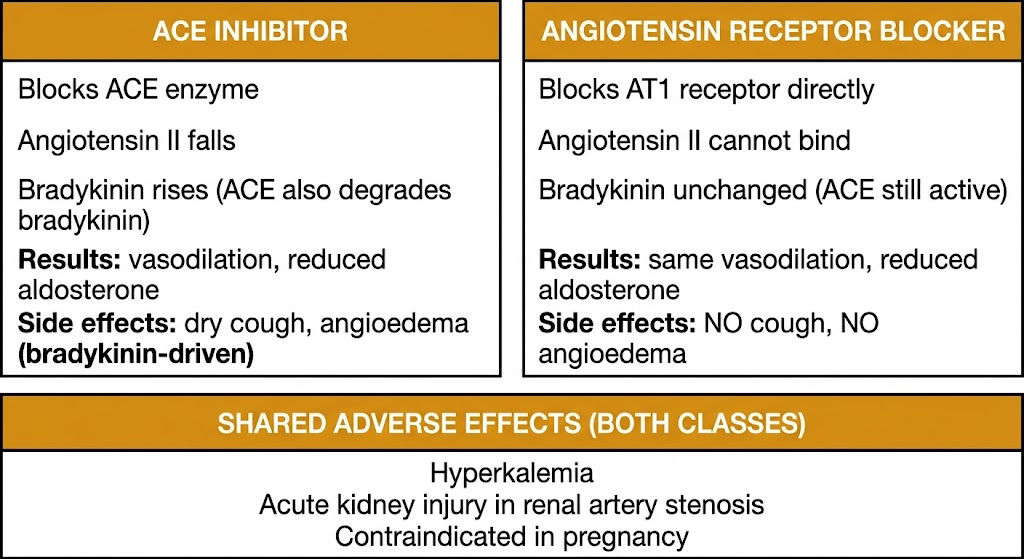
Two-panel diagram comparing angiotensin-converting enzyme inhibitor and angiotensin receptor blocker mechanisms. Left panel shows angiotensin-converting enzyme inhibitor blocking the angiotensin-converting enzyme, reducing angiotensin II and raising bradykinin, with dry cough and angioedema as bradykinin-driven side effects. Right panel shows angiotensin receptor blocker blocking the AT1 receptor directly, with bradykinin unchanged and no cough or angioedema. A shared panel below lists hyperkalemia, acute kidney injury in renal artery stenosis, and pregnancy contraindication as effects common to both classes.
Mechanism comparison: angiotensin-converting enzyme inhibitors versus angiotensin receptor blockers, showing the bradykinin-dependent adverse effects unique to the angiotensin-converting enzyme inhibitor class. Generated with Gemini AI for educational use.
Why Dual Blockade Is Contraindicated

Combining an angiotensin-converting enzyme inhibitor with an angiotensin receptor blocker — so-called dual renin-angiotensin-aldosterone system blockade — was tested in the ONTARGET trial. The combination did not reduce cardiovascular outcomes compared to either agent alone but significantly increased rates of acute kidney injury, hyperkalemia, and hypotension. Dual blockade is contraindicated for this reason. The one apparent exception — adding an angiotensin receptor blocker to an angiotensin-converting enzyme inhibitor in heart failure with reduced ejection fraction — was also evaluated and found to produce more harm than benefit compared to adding a mineralocorticoid receptor antagonist instead. Current guidelines recommend mineralocorticoid receptor antagonists as the preferred add-on to angiotensin-converting enzyme inhibitor or angiotensin receptor blocker therapy in heart failure.

Section 3
Natriuretic Peptide Physiology
What atrial natriuretic peptide and brain natriuretic peptide are, what triggers their release, what they do, how neprilysin degrades them, and why brain natriuretic peptide is used as a heart failure biomarker

The natriuretic peptides are a family of endogenous hormones that oppose the renin-angiotensin-aldosterone system — promoting sodium excretion, vasodilation, and reduced aldosterone. In heart failure, the failing heart secretes large amounts of brain natriuretic peptide, making it both a compensatory response and the most useful laboratory biomarker of ventricular wall stress.

Atrial Natriuretic Peptide and Brain Natriuretic Peptide

Atrial natriuretic peptide is released from atrial cardiomyocytes in response to atrial wall stretch — the kind caused by volume overload. Brain natriuretic peptide (the name is historical; it is made primarily in the ventricles, not the brain) is released from ventricular cardiomyocytes in response to ventricular wall stretch and increased filling pressure. In heart failure, chronically elevated ventricular wall stress drives sustained brain natriuretic peptide secretion, which is why plasma brain natriuretic peptide and its inactive cleavage fragment NT-proBNP rise in proportion to the severity of heart failure and fall with effective treatment.

Both peptides act through natriuretic peptide receptors coupled to cyclic guanosine monophosphate signaling, producing three key effects: natriuresis and diuresis (increased sodium and water excretion by the kidney), vasodilation (both arterial and venous), and suppression of aldosterone secretion from the adrenal cortex. These effects directly oppose the sodium retention, vasoconstriction, and aldosterone excess of the activated renin-angiotensin-aldosterone system in heart failure.

Neprilysin: The Degrading Enzyme

Neprilysin is a zinc metallopeptidase expressed on vascular endothelium and in the kidney that cleaves and inactivates natriuretic peptides, along with bradykinin and several other vasoactive peptides. In the context of heart failure, neprilysin activity limits the beneficial compensatory response of elevated natriuretic peptides. Inhibiting neprilysin allows natriuretic peptide levels to rise, amplifying their vasodilatory and natriuretic effects. This is the mechanism exploited by sacubitril, the neprilysin inhibitor component of sacubitril-valsartan.

Brain Natriuretic Peptide as a Heart Failure Biomarker

A plasma brain natriuretic peptide above 100 pg/mL or NT-proBNP above 300 pg/mL supports a diagnosis of acute decompensated heart failure in a patient with dyspnea. Levels correlate with severity: higher brain natriuretic peptide reflects greater ventricular wall stress. Brain natriuretic peptide falls with diuresis and effective heart failure therapy, making it useful for monitoring treatment response. One important caveat: brain natriuretic peptide levels are falsely low in obese patients and falsely elevated in renal impairment and in patients taking sacubitril-valsartan (because neprilysin inhibition reduces brain natriuretic peptide degradation).


Section 4
Sacubitril-Valsartan: Mechanism and Clinical Evidence
How combining neprilysin inhibition with angiotensin receptor blockade amplifies the natriuretic peptide response in heart failure, and the PARADIGM-HF trial that established its superiority over enalapril

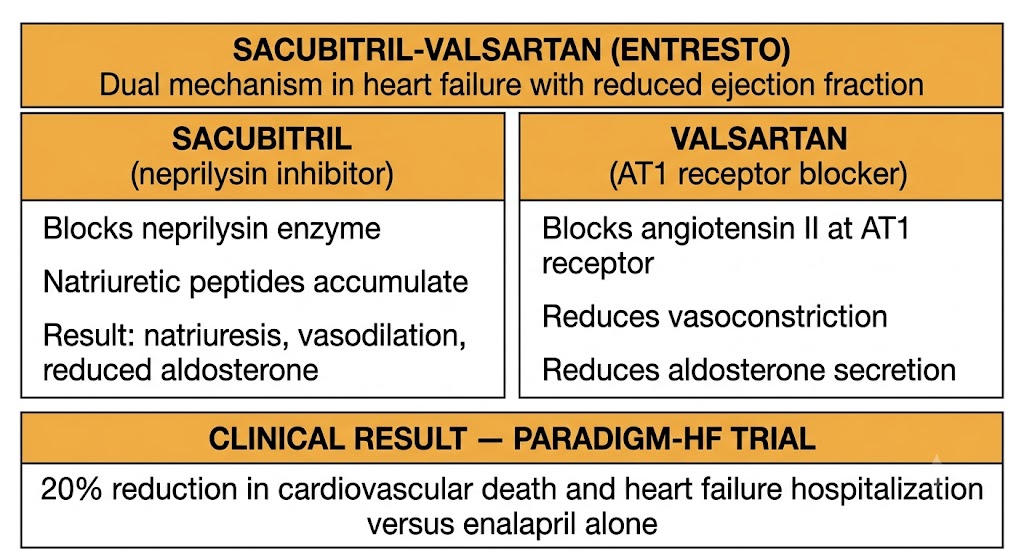
Sacubitril-valsartan (brand name Entresto) is a fixed-dose combination of two drugs with complementary mechanisms: sacubitril inhibits neprilysin to raise natriuretic peptide levels, while valsartan blocks the AT1 receptor to reduce angiotensin II effects. Together they simultaneously amplify the body's own counter-regulatory response to heart failure while suppressing the pathological renin-angiotensin-aldosterone activation that drives disease progression.

Dual Mechanism

Sacubitril is a prodrug that is hydrolyzed after absorption to its active neprilysin-inhibiting metabolite. By blocking neprilysin, sacubitril prevents the degradation of natriuretic peptides, bradykinin, and other vasoactive peptides, raising their circulating and tissue levels. The consequence is enhanced natriuresis, vasodilation, and suppression of aldosterone and sympathetic activation — all beneficial in heart failure with reduced ejection fraction.

Valsartan, the angiotensin receptor blocker component, blocks the AT1 receptor and reduces vasoconstriction, aldosterone secretion, and cardiac remodeling. The combination produces complementary suppression of the renin-angiotensin-aldosterone system while amplifying the opposing natriuretic peptide system. Neither mechanism alone produces the same magnitude of benefit, and the two together are superior to angiotensin-converting enzyme inhibitor monotherapy in head-to-head comparison.

Mechanism diagram of sacubitril-valsartan showing two components: sacubitril inhibits neprilysin, allowing natriuretic peptides to accumulate and producing natriuresis, vasodilation, and reduced aldosterone; valsartan blocks the AT1 receptor, reducing angiotensin II-driven vasoconstriction and aldosterone secretion. A panel below summarizes the PARADIGM-HF trial result showing 20 percent reduction in cardiovascular death and heart failure hospitalization versus enalapril.
Dual mechanism of sacubitril-valsartan: neprilysin inhibition amplifies natriuretic peptides while valsartan suppresses angiotensin II signaling. PARADIGM-HF trial result shown. Generated with Gemini AI for educational use.
PARADIGM-HF Trial

The PARADIGM-HF trial compared sacubitril-valsartan to enalapril in over 8,000 patients with heart failure with reduced ejection fraction (ejection fraction 40 percent or below) who were already on standard therapy. Sacubitril-valsartan reduced the primary composite endpoint of cardiovascular death or heart failure hospitalization by 20 percent relative to enalapril. It also reduced all-cause mortality and cardiovascular mortality individually. The trial was stopped early because the benefit was so clear that continuing would have been ethically problematic.

Based on PARADIGM-HF, current heart failure guidelines recommend sacubitril-valsartan as the preferred agent over angiotensin-converting enzyme inhibitors or angiotensin receptor blockers alone in patients with heart failure with reduced ejection fraction who can tolerate it. It effectively replaces, rather than adds to, angiotensin-converting enzyme inhibitor or angiotensin receptor blocker therapy — this distinction matters for the contraindications discussed in Section 5.


Section 5
Sacubitril-Valsartan Safety, Contraindications, and Practical Use
The angioedema danger when combined with angiotensin-converting enzyme inhibitors, the mandatory 36-hour washout rule, pregnancy contraindication, and the brain natriuretic peptide monitoring caveat

Sacubitril-valsartan has two absolute contraindications that every prescriber must know before initiating it: concurrent use with an angiotensin-converting enzyme inhibitor, and pregnancy. Both derive directly from the drug's mechanism, and both can produce serious or fatal outcomes if ignored.

Angioedema Risk with ACE Inhibitors: The 36-Hour Rule

Sacubitril inhibits neprilysin, which is one of the enzymes that degrades bradykinin. Angiotensin-converting enzyme inhibitors reduce bradykinin degradation through a completely separate mechanism. When both drugs are present simultaneously, bradykinin accumulates to levels that can trigger severe, potentially fatal angioedema. This combination is absolutely contraindicated — the two drugs must never be used together.

Because sacubitril and its active metabolite have a prolonged tissue half-life, simply stopping one drug and starting the other on the same day does not eliminate the risk. A mandatory 36-hour washout period is required in both directions: a patient switching from an angiotensin-converting enzyme inhibitor to sacubitril-valsartan must wait at least 36 hours after the last angiotensin-converting enzyme inhibitor dose before starting sacubitril-valsartan, and vice versa. This 36-hour rule is one of the most commonly tested clinical pharmacology facts about this drug.

Other Contraindications and Adverse Effects

Pregnancy is an absolute contraindication shared with all renin-angiotensin-aldosterone system-blocking agents. The valsartan component suppresses fetal angiotensin II signaling with the same consequences as angiotensin-converting enzyme inhibitors — oligohydramnios, fetal renal tubular dysgenesis, and potential neonatal death.

Hypotension is the most common adverse effect in practice, particularly at initiation. Starting at a low dose and up-titrating slowly is important, especially in patients who are already on diuretics or who have borderline low blood pressure. Hyperkalemia occurs via the same mechanism as with angiotensin receptor blockers — aldosterone suppression reducing potassium excretion — and requires monitoring.

Brain Natriuretic Peptide Monitoring Caveat

Neprilysin degrades brain natriuretic peptide. When neprilysin is inhibited by sacubitril, brain natriuretic peptide levels rise even as the patient's heart failure improves — because the peptide is no longer being cleared normally. This means that brain natriuretic peptide levels cannot be used to monitor treatment response or assess disease severity in patients taking sacubitril-valsartan. NT-proBNP is the preferred biomarker in this setting because it is not a neprilysin substrate and its levels reflect actual ventricular wall stress rather than the drug's effect on clearance.

Safety Summary
Sacubitril-Valsartan: Must-Know Rules
  • Never combine with an angiotensin-converting enzyme inhibitor — angioedema risk is additive and potentially fatal
  • 36-hour washout required switching to or from any angiotensin-converting enzyme inhibitor
  • Contraindicated in pregnancy (valsartan component — fetal renal toxicity)
  • Monitor blood pressure closely at initiation — hypotension is the most common adverse effect
  • Monitor potassium — hyperkalemia risk as with all renin-angiotensin-aldosterone system blockers
  • Do not use brain natriuretic peptide to monitor heart failure in patients on this drug — use NT-proBNP instead

Suggested References
Author / Organization Title Source
Burnier M, Brunner HR Angiotensin II receptor antagonists Lancet. 2000;355(9204):637–645
Sica DA, Gehr TWB, Ghosh S Clinical pharmacokinetics of losartan Clin Pharmacokinet. 2005;44(8):797–814
Granger CB, McMurray JJ, Yusuf S, et al Effects of candesartan in patients with chronic heart failure and reduced left-ventricular systolic function intolerant to angiotensin-converting-enzyme inhibitors: the CHARM-Alternative trial Lancet. 2003;362(9386):772–776
Mann JF, Schmieder RE, McQueen M, et al Renal outcomes with telmisartan, ramipril, or both, in people at high vascular risk (the ONTARGET study) Lancet. 2008;372(9638):547–553
Pfeffer MA, McMurray JJ, Velazquez EJ, et al Valsartan, captopril, or both in myocardial infarction complicated by heart failure, left ventricular dysfunction, or both N Engl J Med. 2003;349(20):1893–1906
de Bold AJ, Borenstein HB, Veress AT, Sonnenberg H A rapid and potent natriuretic response to intravenous injection of atrial myocardial extract in rats Life Sci. 1981;28(1):89–94
McMurray JJ, Packer M, Desai AS, et al Angiotensin-neprilysin inhibition versus enalapril in heart failure (PARADIGM-HF) N Engl J Med. 2014;371(11):993–1004
Heidenreich PA, Bozkurt B, Aguilar D, et al 2022 AHA/ACC/HFSA guideline for the management of heart failure J Am Coll Cardiol. 2022;79(17):e263–e421
Packer M, McMurray JJ, Desai AS, et al Angiotensin receptor neprilysin inhibition compared with enalapril on the risk of clinical progression in surviving patients with heart failure Circulation. 2015;131(1):54–61
Januzzi JL, Prescott MF, Butler J, et al Association of change in N-terminal pro-B-type natriuretic peptide following initiation of sacubitril-valsartan treatment with cardiac structure and function in patients with heart failure with reduced ejection fraction JAMA. 2019;322(11):1085–1095