Endothelin-1 is a 21-amino-acid peptide produced by vascular endothelial cells that is the most potent endogenous vasoconstrictor known. Its prolonged action on pulmonary vascular smooth muscle makes it a key driver of pulmonary arterial hypertension, and its two receptor subtypes — with opposing vascular effects in some contexts — are the pharmacological targets of the endothelin receptor antagonist drug class.
Vascular endothelial cells synthesize and secrete endothelin-1 constitutively, with secretion amplified by hypoxia, shear stress, angiotensin II, and inflammatory cytokines. Once released, endothelin-1 acts primarily in a paracrine fashion on adjacent vascular smooth muscle cells, producing vasoconstriction of sustained duration. The sustained nature of endothelin-1-mediated vasoconstriction — much longer than that produced by angiotensin II or norepinephrine — reflects the slow dissociation of endothelin-1 from its receptors and contributes to its particular importance in the high-resistance pulmonary vasculature.
Endothelin-1 acts through two receptor subtypes. The ETA receptor is expressed on vascular smooth muscle cells and mediates the dominant physiological effects of endothelin-1: sustained vasoconstriction and vascular smooth muscle proliferation. ETA receptor activation increases intracellular calcium and activates growth-promoting pathways, contributing to the vascular remodeling that characterizes established pulmonary arterial hypertension.
The ETB receptor is expressed on both vascular endothelial cells and smooth muscle cells, with opposing effects depending on location. ETB receptors on endothelial cells stimulate nitric oxide and prostacyclin release, producing vasodilation — a counter-regulatory response. ETB receptors on smooth muscle cells, like ETA receptors, mediate vasoconstriction. ETB receptors also clear endothelin-1 from the circulation via receptor-mediated internalization and degradation. The net in vivo effect of endothelin-1 is vasoconstriction dominated by ETA receptor signaling, since the vasodilatory ETB endothelial response is overwhelmed at elevated endothelin-1 concentrations seen in pulmonary arterial hypertension.
Blocking both ETA and ETB receptors simultaneously (dual antagonism, as with bosentan and macitentan) eliminates all endothelin-1 signaling including the ETB-mediated endothelial vasodilation and the ETB-mediated clearance of endothelin-1. Selective ETA antagonism (ambrisentan) blocks vasoconstriction and proliferation while preserving the vasodilatory and clearance functions of endothelial ETB receptors. In practice, both approaches improve outcomes in pulmonary arterial hypertension; the theoretical advantage of ETB-sparing has not translated into a clear clinical superiority for selective agents.
Pulmonary arterial hypertension is a progressive disease of the small pulmonary arteries characterized by sustained vasoconstriction, vascular remodeling, and ultimately right ventricular failure. Endothelin-1 is elevated in the plasma and pulmonary vascular tissue of patients with pulmonary arterial hypertension and drives all three pathological processes, making the endothelin pathway a rational therapeutic target.
The right ventricle is normally a thin-walled, low-pressure chamber designed to pump against the low resistance of the pulmonary vasculature. In pulmonary arterial hypertension, sustained vasoconstriction and structural remodeling of the small pulmonary arteries dramatically increase pulmonary vascular resistance. The right ventricle initially compensates by hypertrophying, but over time it cannot maintain adequate output against the chronically elevated afterload and dilates, leading to right ventricular failure. Clinically this manifests as progressive dyspnea on exertion, reduced exercise capacity, and eventually signs of right heart failure — elevated jugular venous pressure, peripheral edema, and hepatic congestion.
In pulmonary arterial hypertension, endothelin-1 production by pulmonary vascular endothelial cells is markedly upregulated, and endothelin-1 plasma levels correlate with disease severity and prognosis. Elevated endothelin-1 contributes to disease through three mechanisms operating simultaneously: vasoconstriction of the pulmonary arterioles through ETA receptor activation, proliferation of pulmonary vascular smooth muscle cells leading to medial hypertrophy and luminal narrowing, and fibrosis of the vessel wall. The combination of functional vasoconstriction and fixed structural remodeling means that endothelin receptor antagonists produce the greatest benefit early in the disease course, before irreversible structural changes dominate.
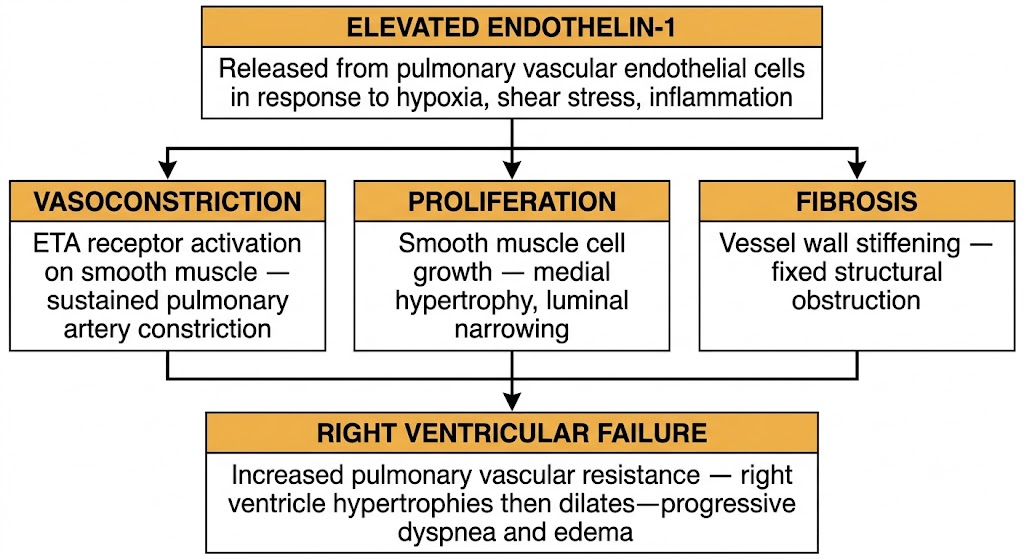
Pulmonary arterial hypertension is defined hemodynamically as a mean pulmonary artery pressure at or above 25 mmHg at rest with a normal pulmonary capillary wedge pressure, distinguishing it from pulmonary hypertension caused by left heart disease. The World Health Organization classification groups pulmonary hypertension into five categories by cause; endothelin receptor antagonists are approved for Group 1 (pulmonary arterial hypertension), which includes idiopathic, heritable, and connective tissue disease-associated forms. The disease is more common in women and in patients with systemic sclerosis (scleroderma).
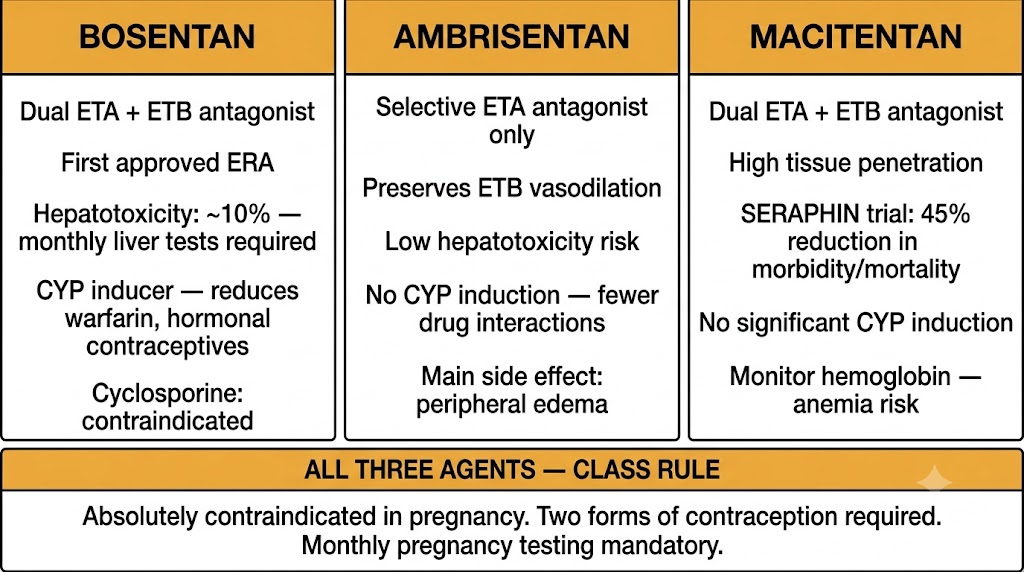
Three endothelin receptor antagonists are approved for pulmonary arterial hypertension: bosentan, ambrisentan, and macitentan. All are orally administered and all share the class-defining contraindication of pregnancy. They differ in receptor selectivity, hepatotoxicity risk, and drug interaction potential in ways that influence agent selection in individual patients.
Bosentan was the first endothelin receptor antagonist approved for pulmonary arterial hypertension and remains a reference agent for the class. It blocks both ETA and ETB receptors with roughly equal affinity. Bosentan is metabolized by cytochrome P450 3A4 and cytochrome P450 2C9 and, critically, is also an inducer of these enzymes. This enzyme induction creates clinically important drug interactions: bosentan reduces plasma levels of cyclosporine (contraindicated combination due to mutual pharmacokinetic interference), warfarin, hormonal contraceptives, and other cytochrome P450 substrates. Monthly liver function testing is required because bosentan causes dose-dependent elevations in liver transaminases in approximately 10 percent of patients, which are reversible on dose reduction or discontinuation but require monitoring.
Ambrisentan selectively blocks the ETA receptor, preserving ETB receptor function on endothelial cells (vasodilatory nitric oxide release) and on smooth muscle cells (endothelin-1 clearance). It does not induce cytochrome P450 enzymes, giving it a significantly cleaner drug interaction profile than bosentan. Hepatotoxicity was a concern early in its development but post-marketing data have shown it is substantially lower than with bosentan, and monthly liver function monitoring is no longer required by regulatory agencies in most regions. Peripheral edema is the most common adverse effect, occurring in a higher proportion of patients on ambrisentan than on bosentan, likely related to preserved ETB-mediated effects on fluid balance.
Macitentan is a newer dual endothelin receptor antagonist designed to have high tissue penetration and sustained receptor occupancy in the pulmonary vasculature. The SERAPHIN trial, the first endothelin receptor antagonist trial powered for morbidity and mortality outcomes rather than just exercise capacity, demonstrated that macitentan reduced the composite endpoint of pulmonary arterial hypertension-related death, hospitalization, or worsening by 45 percent relative to placebo. Macitentan does not significantly induce cytochrome P450 enzymes, and hepatotoxicity has been low in clinical trials. Anemia is more common with macitentan than with the other agents and is monitored at baseline and during treatment.
All three endothelin receptor antagonists share two non-negotiable safety rules: they are absolutely contraindicated in pregnancy, and patients must use reliable contraception throughout treatment. Beyond this shared requirement, the agents differ meaningfully in hepatotoxicity risk and drug interaction potential.
All endothelin receptor antagonists are teratogenic in animal studies at doses below the human therapeutic range and are absolutely contraindicated in pregnancy. The endothelin system plays a role in cardiovascular and craniofacial development in the fetus; blockade during organogenesis causes major defects. In practice, this means that any woman of childbearing potential must have a negative pregnancy test before starting therapy, must use two reliable methods of contraception simultaneously during treatment, and must have monthly pregnancy testing. Bosentan additionally reduces the efficacy of hormonal contraceptives through cytochrome P450 induction, making non-hormonal contraception mandatory for patients on bosentan.
Dose-dependent liver transaminase elevation is the most important organ toxicity of the endothelin receptor antagonist class. The risk is highest with bosentan (approximately 10 percent of patients) and substantially lower with ambrisentan and macitentan. Liver function tests must be checked at baseline and monthly during bosentan therapy. Elevations more than three times the upper limit of normal require dose reduction or discontinuation. The mechanism is thought to involve bile salt transport inhibition leading to intrahepatic accumulation of bile acids. Elevations are reversible on stopping the drug.
Fluid retention and peripheral edema occur across the class, most prominently with ambrisentan. Nasal congestion and headache are common, particularly at treatment initiation. Anemia, through a mechanism related to reduced erythropoietin signaling, is seen most commonly with macitentan and requires baseline and periodic hemoglobin monitoring.
The most clinically consequential drug interaction is the combination of bosentan with cyclosporine, which is contraindicated. Cyclosporine inhibits the organic anion transporting polypeptide transporters responsible for bosentan hepatic uptake, dramatically raising bosentan plasma levels and hepatotoxicity risk; simultaneously, bosentan's cytochrome P450 induction reduces cyclosporine levels, creating bidirectional pharmacokinetic interference. Bosentan also reduces warfarin and statin levels through cytochrome P450 induction, requiring dose monitoring. Current guidelines recommend combining endothelin receptor antagonists with phosphodiesterase-5 inhibitors (sildenafil or tadalafil) in most patients with pulmonary arterial hypertension, as the combination targets complementary pathways and produces additive clinical benefit.
All three agents: Absolutely contraindicated in pregnancy. Mandatory pregnancy testing before initiation and monthly during treatment. Two forms of contraception required simultaneously.
Bosentan specifically: Monthly liver function test monitoring. Contraindicated with cyclosporine. Reduces efficacy of hormonal contraceptives — non-hormonal contraception mandatory. Reduces warfarin levels — monitor international normalized ratio.
Macitentan specifically: Monitor hemoglobin for anemia at baseline and during therapy.
| Author / Organization | Title | Source |
|---|---|---|
| Yanagisawa M, Kurihara H, Kimura S, et al | A novel potent vasoconstrictor peptide produced by vascular endothelial cells | Nature. 1988;332(6163):411–415 |
| Davenport AP, Hyndman KA, Dhaun N, et al | Endothelin | Pharmacol Rev. 2016;68(2):357–418 |
| Galiè N, Humbert M, Vachiery JL, et al | 2015 ESC/ERS guidelines for the diagnosis and treatment of pulmonary hypertension | Eur Heart J. 2016;37(1):67–119 |
| Humbert M, Guignabert C, Bonnet S, et al | Pathology and pathobiology of pulmonary hypertension: state of the art and research perspectives | Eur Respir J. 2019;53(1):1801887 |
| Channick RN, Simonneau G, Sitbon O, et al | Effects of the dual endothelin-receptor antagonist bosentan in patients with pulmonary hypertension: a randomised placebo-controlled study | Lancet. 2001;358(9288):1119–1123 |
| Galiè N, Olschewski H, Oudiz RJ, et al | Ambrisentan for the treatment of pulmonary arterial hypertension: results of the ARIES study 1 and 2 | Circulation. 2008;117(23):3010–3019 |
| Pulido T, Adzerikho I, Channick RN, et al | Macitentan and morbidity and mortality in pulmonary arterial hypertension (SERAPHIN) | N Engl J Med. 2013;369(9):809–818 |
| Humbert M, Kovacs G, Hoeper MM, et al | 2022 ESC/ERS guidelines for the diagnosis and treatment of pulmonary hypertension | Eur Heart J. 2022;43(38):3618–3731 |
| Rubin LJ, Badesch DB, Barst RJ, et al | Bosentan therapy for pulmonary arterial hypertension | N Engl J Med. 2002;346(12):896–903 |
| Sitbon O, Channick R, Chin KM, et al | Selexipag for the treatment of pulmonary arterial hypertension | N Engl J Med. 2015;373(26):2522–2533 |