CHAPTER 24  ·  VASOACTIVE PEPTIDE PHARMACOLOGY
Section 1
Vasopressin Synthesis, Release, and Receptor Pharmacology
How arginine vasopressin is made and released from the posterior pituitary, what triggers its secretion, and how its two receptor types produce vasoconstriction and water reabsorption

Arginine vasopressin — also called antidiuretic hormone — is the body's primary regulator of water balance. Synthesized in the hypothalamus and stored in the posterior pituitary, it is released in response to rising plasma osmolality and falling blood pressure, and acts on two receptor subtypes to produce vasoconstriction and water retention. The drugs that block or mimic this system are used to treat hyponatremia, diabetes insipidus, and bleeding disorders.

Synthesis and Release

Vasopressin is a nine-amino-acid peptide synthesized in hypothalamic neurons and transported down axons to the posterior pituitary, where it is stored in secretory granules until released into the systemic circulation. Two stimuli trigger vasopressin release. The primary stimulus is a rise in plasma osmolality, sensed by osmoreceptors in the anterior hypothalamus; even a 1 to 2 percent increase above the normal set point of approximately 285 mOsm/kg triggers vasopressin secretion. The secondary stimulus is a fall in blood pressure or blood volume, sensed by baroreceptors in the carotid sinus and aortic arch; this stimulus requires a larger drop (approximately 10 to 15 percent) to activate vasopressin release but produces a larger vasopressin surge when activated. Nausea, pain, and several drugs including nicotine and opioids also stimulate vasopressin release.

V1 and V2 Receptors

Vasopressin acts through two main receptor subtypes with distinct locations and effects. V1 receptors are located on vascular smooth muscle cells throughout the systemic and pulmonary circulation. V1 receptor activation triggers vasoconstriction — an effect exploited clinically when vasopressin is used as a vasopressor in septic shock and cardiac arrest, where it raises systemic vascular resistance without the tachycardia associated with catecholamines.

V2 receptors are located on the principal cells of the renal collecting duct. V2 receptor activation triggers insertion of aquaporin-2 water channels into the luminal membrane of collecting duct cells, dramatically increasing water permeability. As tubular fluid passes through the collecting duct, water moves osmotically into the hypertonic medullary interstitium, producing concentrated urine and reducing water excretion. This is vasopressin's primary physiological role: conserving free water when plasma osmolality rises or blood volume falls.
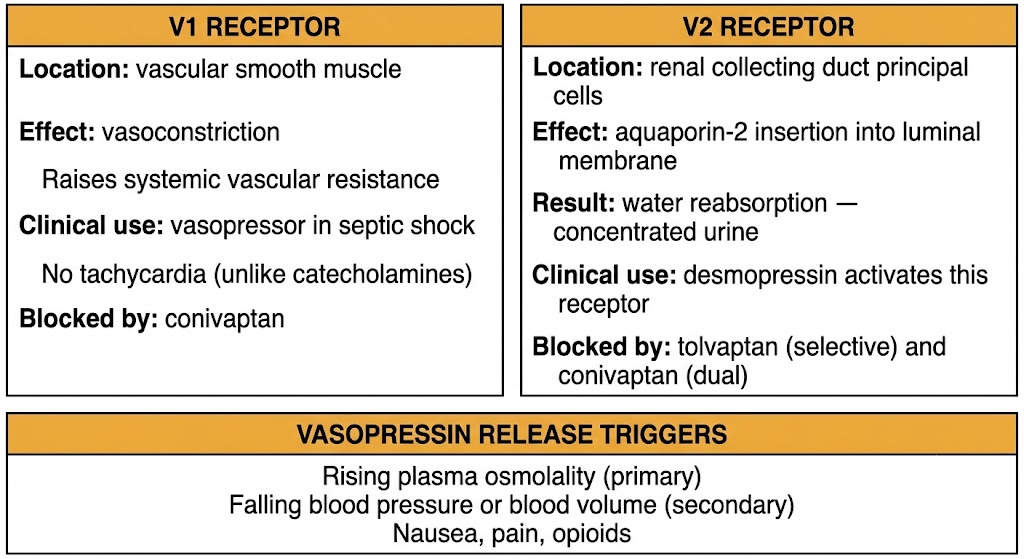
Two-panel diagram of vasopressin receptor pharmacology. Left panel shows V1 receptor on vascular smooth muscle producing vasoconstriction and raising systemic vascular resistance, used as a vasopressor in septic shock without causing tachycardia, blocked by conivaptan. Right panel shows V2 receptor on renal collecting duct principal cells triggering aquaporin-2 insertion into the luminal membrane, producing water reabsorption and concentrated urine, activated by desmopressin and blocked by tolvaptan and conivaptan. Shared panel below lists vasopressin release triggers: rising plasma osmolality, falling blood pressure or volume, and nausea, pain, and opioids.
Vasopressin receptor subtypes: V1 (vasoconstriction) and V2 (water reabsorption via aquaporin-2), with vasopressin release triggers. Generated with Gemini AI for educational use.
Vascular Smooth Muscle
V1 Receptor
  • Vasoconstriction — raises systemic vascular resistance
  • Used clinically as vasopressor in septic shock and cardiac arrest
  • No tachycardia (unlike catecholamines)
  • Blocked by conivaptan (V1+V2 antagonist)
Renal Collecting Duct
V2 Receptor
  • Inserts aquaporin-2 water channels into luminal membrane
  • Water reabsorbed → concentrated urine
  • Primary mechanism of antidiuresis
  • Blocked by tolvaptan and conivaptan (vaptans)
  • Activated by desmopressin

Section 2
Syndrome of Inappropriate Antidiuretic Hormone Secretion
Why vasopressin excess causes hyponatremia, the conditions that trigger inappropriate vasopressin release, how to recognize it, and the critical rate-of-correction rule that prevents osmotic demyelination syndrome

The syndrome of inappropriate antidiuretic hormone secretion is the most common cause of hyponatremia in hospitalized patients. It results from vasopressin secretion that is not appropriately suppressed when plasma osmolality falls, leading to continued free water retention, dilutional hyponatremia, and — if severe or rapidly corrected — devastating neurological injury.

Pathophysiology

Normally, vasopressin secretion is suppressed when plasma osmolality falls below the set point (approximately 280 to 285 mOsm/kg), allowing the kidney to excrete dilute urine and correct any free water excess. In the syndrome of inappropriate antidiuretic hormone secretion, vasopressin continues to be secreted despite low plasma osmolality, driving continued water reabsorption in the collecting duct. The result is dilutional hyponatremia — plasma sodium falls not because sodium is lost but because water is retained in excess. Because water distributes throughout total body water, there is no volume overload; patients are euvolemic, which is the key clinical distinguishing feature from hyponatremia caused by heart failure or cirrhosis.

Causes

The most common causes of the syndrome of inappropriate antidiuretic hormone secretion fall into four categories. Central nervous system disorders — including meningitis, encephalitis, stroke, and head trauma — stimulate hypothalamic vasopressin release through neural pathways that override osmotic suppression. Pulmonary disorders, particularly pneumonia and positive-pressure ventilation, activate thoracic baroreceptors that signal volume depletion and drive vasopressin release. Malignancies, most commonly small cell lung cancer, can produce ectopic vasopressin directly. Drugs are a frequent cause: the most important include selective serotonin reuptake inhibitors, carbamazepine, cyclophosphamide, and thiazide diuretics. A helpful mnemonic is SIADH causes: CNS, Pulmonary, Ectopic (tumor), Drugs.

Diagnosis

The diagnosis of the syndrome of inappropriate antidiuretic hormone secretion requires demonstrating that urine is inappropriately concentrated despite low plasma osmolality. The key laboratory findings are low plasma sodium (hyponatremia) with low plasma osmolality, urine osmolality greater than 100 mOsm/kg (inappropriately concentrated), urine sodium greater than 40 mEq/L (sodium wasting because total body sodium is normal), and euvolemia on clinical examination. Thyroid function and adrenal function must be confirmed as normal because hypothyroidism and adrenal insufficiency can mimic the syndrome independently.

Treatment and the Correction Rate Rule

The treatment approach depends on severity. Mild to moderate hyponatremia (sodium above 125 mEq/L, no neurological symptoms) is treated with fluid restriction to 1 to 1.5 liters per day. When fluid restriction is insufficient, vaptans (tolvaptan or conivaptan) can be added to block V2 receptors and promote free water excretion. Severe symptomatic hyponatremia — manifesting as seizures, coma, or respiratory arrest — requires cautious correction with hypertonic saline.

The rate of sodium correction is one of the most clinically consequential pharmacological rules in medicine. Correcting chronic hyponatremia too rapidly causes osmotic demyelination syndrome — a devastating neurological injury caused by rapid osmotic shifts that demyelinate central pontine and extrapontine white matter, producing locked-in syndrome or death. The maximum safe correction rate is 8 to 10 mEq/L per 24 hours in most patients, and no more than 18 mEq/L in the first 48 hours. In patients at high risk — those with severe hyponatremia, malnutrition, alcoholism, or hypokalemia — the limit is even lower. This rule applies regardless of which treatment modality is used.

Osmotic Demyelination Syndrome: The Non-Negotiable Rate Limit

Maximum safe correction of chronic hyponatremia: 8 to 10 mEq/L per 24 hours. Never exceed 18 mEq/L in the first 48 hours. If the sodium rises faster than intended — for example, if fluid restriction or a vaptan works more rapidly than expected — give hypotonic fluids or desmopressin to slow the correction. The neurological injury of osmotic demyelination syndrome is largely irreversible. Acute hyponatremia (developing within 48 hours, such as from marathon-associated hyponatremia) can be corrected more rapidly because the brain has not had time to adapt osmotically.


Section 3
Vaptans: Tolvaptan and Conivaptan
How vasopressin receptor antagonists produce aquaresis to correct hyponatremia, the key differences between oral and intravenous vaptans, and the hepatotoxicity restriction on tolvaptan use

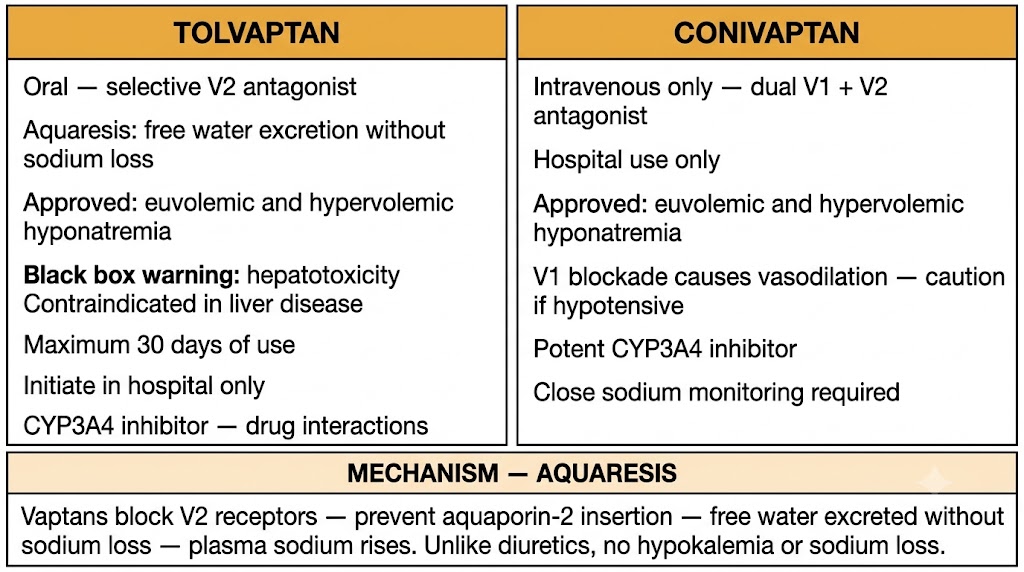
The vaptans are vasopressin receptor antagonists that block V2 receptors in the renal collecting duct, preventing aquaporin-2 insertion and promoting excretion of free water without sodium loss — a process called aquaresis to distinguish it from diuresis, which removes both water and electrolytes. By selectively removing free water, vaptans raise plasma sodium in hyponatremia caused by vasopressin excess.

Tolvaptan — Oral Selective V2 Antagonist

Tolvaptan is an orally administered selective V2 receptor antagonist approved for euvolemic and hypervolemic hyponatremia associated with the syndrome of inappropriate antidiuretic hormone secretion, heart failure, and cirrhosis. By blocking V2 receptors, tolvaptan prevents vasopressin-driven water reabsorption, producing free water excretion and raising plasma sodium. Unlike diuretics, tolvaptan does not cause hypokalemia or worsen sodium balance.

Tolvaptan carries a black box warning for hepatotoxicity based on data from the TEMPO 3:4 trial in autosomal dominant polycystic kidney disease, where high doses taken for extended periods caused serious liver injury. As a result, tolvaptan is contraindicated in patients with liver disease (including cirrhosis), must not be used for more than 30 days, and should be initiated only in a hospital setting where the rate of sodium correction can be monitored. Tolvaptan is a substrate and inhibitor of cytochrome P450 3A4, producing interactions with strong cytochrome P450 3A4 inhibitors (which raise tolvaptan levels) and inducers (which reduce efficacy).

Conivaptan — Intravenous V1 and V2 Antagonist

Conivaptan blocks both V1 and V2 receptors and is available only as an intravenous formulation for in-hospital use. It is approved for euvolemic and hypervolemic hyponatremia in non-cirrhotic patients. The V1 blockade component produces some degree of vasodilation, which limits its use in patients who are already hypotensive. Like tolvaptan, conivaptan is a potent cytochrome P450 3A4 inhibitor and raises plasma levels of co-administered cytochrome P450 3A4 substrates. Hospital-only administration allows close monitoring of the sodium correction rate, reducing the risk of overcorrection.

Two-panel comparison of the vaptans. Left panel shows tolvaptan as an oral selective V2 antagonist producing aquaresis, approved for euvolemic and hypervolemic hyponatremia, with a black box warning for hepatotoxicity, contraindication in liver disease, 30-day use limit, hospital initiation requirement, and cytochrome P450 3A4 inhibitor status. Right panel shows conivaptan as an intravenous dual V1 and V2 antagonist for hospital use only, with V1 blockade causing vasodilation requiring caution in hypotensive patients and potent cytochrome P450 3A4 inhibition. Shared panel below explains the aquaresis mechanism: V2 blockade prevents aquaporin-2 insertion, freeing water excretion without sodium loss.
Vaptan comparison: tolvaptan versus conivaptan, showing receptor selectivity, route, indications, and key safety distinctions. Generated with Gemini AI for educational use.
Aquaresis vs Diuresis: Why Vaptans Are Preferred in Hyponatremia

Loop diuretics and thiazides cause loss of both water and sodium — they can worsen hyponatremia or have unpredictable effects on plasma sodium. Vaptans cause aquaresis: free water excretion without sodium loss. This selectivity makes them mechanistically ideal for hyponatremia caused by free water excess (as in the syndrome of inappropriate antidiuretic hormone secretion or heart failure with elevated vasopressin). The trade-off is cost, hepatotoxicity risk with tolvaptan, and the need for close sodium monitoring to prevent overcorrection.


Section 4
Desmopressin: Central Diabetes Insipidus, Nocturnal Enuresis, and Hemostasis
How desmopressin selectively activates V2 receptors without V1-mediated vasoconstriction, its three clinical indications, and why it is ineffective in nephrogenic diabetes insipidus

Desmopressin is a synthetic vasopressin analog modified to be highly selective for the V2 receptor with minimal V1 activity, eliminating the vasoconstrictor effects of native vasopressin. This selectivity makes it safe for long-term use in conditions requiring V2 receptor activation: central diabetes insipidus, nocturnal enuresis, and — through a distinct mechanism involving endothelial release of clotting factors — mild hemophilia A and type 1 von Willebrand disease.

Central Diabetes Insipidus

Central diabetes insipidus results from deficient vasopressin production by the hypothalamus, most commonly due to head trauma, neurosurgery, pituitary tumors, or infiltrative diseases such as sarcoidosis. Without vasopressin, aquaporin-2 channels are not inserted in the collecting duct, and the kidney cannot concentrate urine — patients produce massive volumes (5 to 20 liters per day) of dilute urine (osmolality below 200 mOsm/kg) and become profoundly thirsty and hypernatremic if fluid intake cannot keep pace with losses. Desmopressin replaces the missing vasopressin, restoring V2 receptor activation and urine concentration. It can be administered intranasally, orally, or subcutaneously depending on the clinical context.

Desmopressin is ineffective in nephrogenic diabetes insipidus, in which the kidney is resistant to vasopressin because the V2 receptor itself is absent (X-linked inherited form) or blocked (lithium, demeclocycline) or the aquaporin-2 system is dysfunctional. In nephrogenic diabetes insipidus, adding more V2 receptor agonist cannot overcome the downstream resistance. Treatment of nephrogenic diabetes insipidus uses thiazide diuretics and low-sodium diet to create mild volume contraction that indirectly reduces urine output.

Nocturnal Enuresis

In primary nocturnal enuresis (bedwetting in children without an anatomical cause), desmopressin given intranasally or orally at bedtime reduces nocturnal urine production by activating V2 receptors in the collecting duct, allowing the bladder to remain within its functional capacity overnight. The effect is temporary — it suppresses enuresis on nights it is taken but does not cure the underlying condition. Hyponatremia is a risk if excessive fluid is consumed before the evening dose, particularly with the intranasal preparation; the oral tablet has a more predictable dose-response. Fluid restriction after the evening dose is standard practice.

Hemostasis: Mild Hemophilia A and Type 1 von Willebrand Disease

Desmopressin has a distinct hemostatic mechanism unrelated to its antidiuretic effect. V2 receptor activation on vascular endothelial cells triggers exocytosis of Weibel-Palade bodies, releasing stored von Willebrand factor and factor VIII into the circulation within 30 to 60 minutes of administration. This transient surge of clotting factors is sufficient to cover minor surgical procedures, dental extractions, and bleeding episodes in patients with mild hemophilia A (factor VIII activity above 5 to 10 percent) and type 1 von Willebrand disease (the most common subtype, characterized by a quantitative reduction in normally functioning von Willebrand factor).

Desmopressin is ineffective in severe hemophilia A (where factor VIII activity is too low for a relative increase to be clinically meaningful) and in type 2B von Willebrand disease (where desmopressin-induced release of abnormal von Willebrand factor can paradoxically worsen thrombocytopenia). Repeated doses within 24 to 48 hours cause tachyphylaxis as Weibel-Palade body stores are depleted.

Clinical Uses Summary
Desmopressin: Three Indications, One Mechanism Caveat
  • Central diabetes insipidus — replaces deficient vasopressin; V2 agonism concentrates urine
  • Nocturnal enuresis — reduces overnight urine production; fluid restriction required with each dose
  • Mild hemophilia A and type 1 von Willebrand disease — endothelial release of von Willebrand factor and factor VIII; tachyphylaxis limits repeated dosing
  • Ineffective in nephrogenic diabetes insipidus — V2 receptor absent or blocked; adding agonist cannot overcome downstream resistance
  • Hyponatremia risk — excessive fluid intake with desmopressin can cause dangerous water retention; fluid restrict after dosing

Suggested References
Author / Organization Title Source
Robertson GL Vasopressin in osmotic regulation in man Annu Rev Med. 1974;25:315–322
Bichet DG Vasopressin receptor mutations causing nephrogenic diabetes insipidus Semin Nephrol. 2008;28(3):245–251
Ellison DH, Berl T The syndrome of inappropriate antidiuresis N Engl J Med. 2007;356(20):2064–2072
Schrier RW, Gross P, Gheorghiade M, et al Tolvaptan, a selective oral vasopressin V2-receptor antagonist, for hyponatremia N Engl J Med. 2006;355(20):2099–2112
Konstam MA, Gheorghiade M, Burnett JC Jr, et al Effects of oral tolvaptan in patients hospitalized for worsening heart failure: the EVEREST Outcome Trial JAMA. 2007;297(12):1319–1331
Zeltser D, Rosansky S, van Rensburg H, Verbalis JG, Smith N; Conivaptan Study Group Assessment of the efficacy and safety of intravenous conivaptan in euvolemic and hypervolemic hyponatremia Am J Nephrol. 2007;27(5):447–457
Rozen-Zvi B, Yahav D, Gheorghiade M, Korzets A, Leibovici L, Gafter U Vasopressin receptor antagonists for the treatment of hyponatremia: systematic review and meta-analysis Am J Kidney Dis. 2010;56(2):325–337
Mannucci PM Desmopressin (DDAVP) in the treatment of bleeding disorders: the first 20 years Blood. 1997;90(7):2515–2521
Fenske W, Allolio B Current state and future perspectives in the diagnosis of diabetes insipidus: a clinical review J Clin Endocrinol Metab. 2012;97(10):3426–3437
Verbalis JG, Goldsmith SR, Greenberg A, et al Diagnosis, evaluation, and treatment of hyponatremia: expert panel recommendations Am J Med. 2013;126(10 Suppl 1):S1–S42